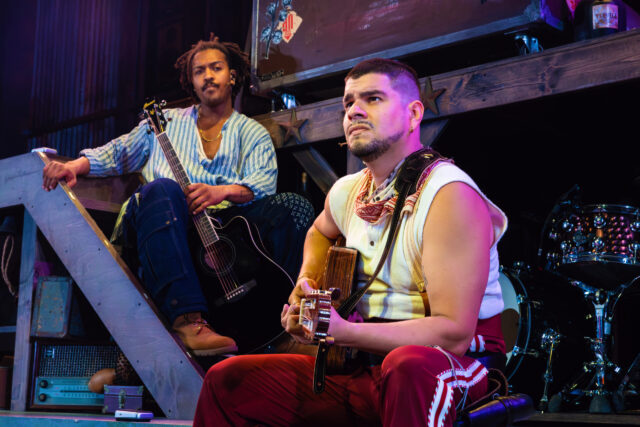
Nygel D. Robinson and Brian Quijada wrote and star in Mexodus (photo by Curtis Brown)
MEXODUS
Audible’s Minetta Lane Theatre
18 Minetta Lane between Sixth Ave. and MacDougal St.
Monday – Saturday through November 1, $56.50-$120.50
mexodusmusical.com
www.audible.com
Between 1829 and the end of the Civil War, several thousand American slaves escaped to Mexico, a kind of Underground Railroad that headed south instead of north, though without the same organized support system. Brian Quijada and Nygel D. Robinson have adapted that story into Mexodus, an exhilarating, funny, and passionate must-see two-person musical that has been extended through November 1 at Audible’s Minetta Lane Theatre.
“Did you know this shit? / We didn’t know this shit!” they declare early on. “In eighteen forty-eight it was America that won the war. / Ten territories from Mexico / Including the behemoth of Texas, yo! / And what would that land be used for? / Oh lord! To pick a bale of cotton / And what was slaves’ most common chore? / To jump down, turn around, and pick a bale a day. / Cotton: America’s original sin / And it’s then and there where our story begins.”
Quijada and Robinson switch between portraying versions of themselves, speaking directly to the audience in the present day, and two tough men from the pre–Civil War era. They also play all the instruments — guitars, keyboards, standup bass, harmonica, accordion, drums, percussion, triangle — creating live loops by recording snippets of music, then layering them electronically so it often sounds like there’s a full band in the theater while allowing them to act with their hands and feet free.
Henry (Robinson) is a Black man who has escaped from a brutal incident on the Texas plantation where he was enslaved, while Carlos (Quijada) is a former Mexican army medic and deserter overwhelmed by guilt, now working on a farm in la Frontera, which he describes as “la mitad — the middle. No laws, no lines, tierra descontrolada,” evoking a kind of middle passage.
Carlos found Henry washed up on the shore of the Rio Grande and is nursing him back to health. Henry is suspicious of Carlos; when Henry asks if it’s safe there, Carlos responds, “It’s not safe anywhere,” adding that he’s seen many “gringos” in the area hunting down runaways.
Both men are in vulnerable positions, alone and on their own, so they’ll need to help each other if they are going to survive while battling the elements and worrying about the slave hunters.
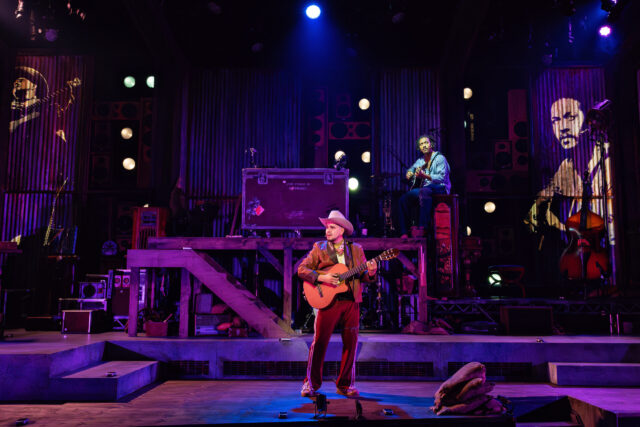
Brian Quijada and Nygel D. Robinson play all the instrument in historical loop musical (photo by Curtis Brown)
Quijada and Robinson met at a conference in February 2020 and decided to team up for the show, which was inspired by a Facebook post Quijada saw in 2017 and is named after this little-known Mexican exodus. The story of how the two strangers came to team up runs parallel to the relationship fostered between Carlos and Henry, who are composites of real figures, bonding through different aspects of looping. During the musical, Quijada and Robinson each share a tale from their childhood involving racism, love, and sacrifice. Robinson, honoring three generations of women in his family, says, “I don’t think I’m their wildest dreams because where we’re from, you don’t get to dream like this.” Quijada, describing a frightening instance of racial profiling at a gas station, explains, “We are taught to separate, we are taught to stick to our own, / Taught how to protect our homes. / We are given reasons to fight and start wars. / But what if / What if / What if we weren’t so quick to lock our doors.”
Director and costume designer David Mendizábal (Tell Hector I Miss Him, the bandaged place) expertly blends the multilayered narrative with Mextly Couzin’s lighting, Mikhail Fiksel’s looping and powerful sound, Johnny Moreno’s live projections, and Tony Thomas’s movement choreography on Riw Rakkulchon’s barn set, which includes multiple platforms, doors at either end, a DJ table at the top, and a rear wall of lights and speakers.
Robinson and Quijada, who wrote the book, music, and lyrics, are magnetic as they move across the stage and pause for emotional interludes. The score is influenced primarily by Hamilton, but in this case hip-hop interlaced with country and the blues. Their apprehension is palpable every step of the way — not just as Henry and Carlos but as themselves, Black and brown men in a nation that is rounding up nonwhite people ever more frequently and violently. When the law comes knocking at the barn door, it is hard not to think about what ICE is doing to legal and illegal immigrants — and citizens — in America.
“We’re all in this together,” Henry says. Echoing his words in Spanish, Carlos replies, “Todos estamos juntos en esto.” Henry responds, “Whoa, slow that down.”
The message of Mexodus is clear: We are all in this together — and this is no time to slow down.
[Mark Rifkin is a Brooklyn-born, Manhattan-based writer and editor; you can follow him on Substack here.]