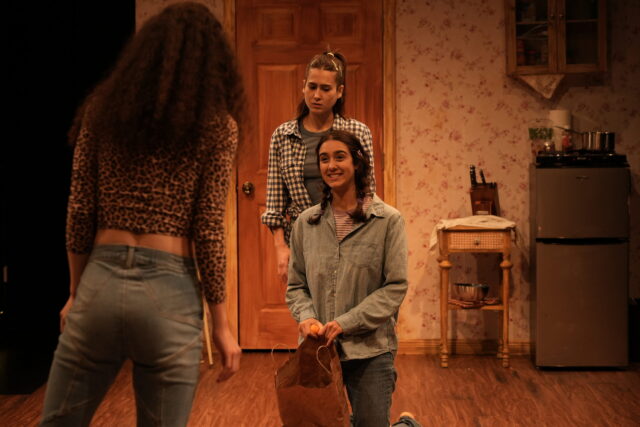
Three teenage girls face threats of violence in Abigail Duclos’s Blood Orange (photo by Gabriela Amerth)
BLOOD ORANGE
The Jeffrey & Paula Gural Theatre, A.R.T./New York
502 West 53rd St. between Tenth & Eleventh Aves.
Thursday – Monday through September 27, $33.85-$60.54
www.etaliatheater.com
www.art-newyork.org
Abigail Duclos’s Blood Orange is a creepy foray into grief and loneliness in a world devoid of caring adults, where teenage girls turn to roadkill for solace and escape as they face the trials and tribulations of adolescence.
Presented at the Jeffrey & Paula Gural Theatre at A.R.T./New York by the all-female Et Alia company, the show takes place in the mid-2000s in a small town outside of Asheville, North Carolina. Faye’s (Luísa Galatti or Maria Müller) father has just died a bloody death, and her stepmother, Mariah (Doreen Oliver), spends almost all her time in bed, leaving Faye to fend for herself.
Faye is regularly visited by her longtime bestie, Georgia (Müller or Giorgia Valenti), and her new friend, Eden (Ana Moioli); Faye and Georgia are sixteen, Eden fifteen. Sex and violence are on the girls’ minds as they navigate through trauma and tragedy and the normal fears and desires of high school. Faye asks Eden and Georgia to punch her over and over again in order to cause bruises and to make her throw up so maybe her stepmother will notice her and help her through the loss of her father; Eden reluctantly obliges, but Georgia refuses.
Faye has recently found a dead animal in the road and keeps it in a paper bag in the refrigerator; she names it Agnivis and starts to build a ritualistic religion around it. Eden feels that same power emanating from the creature, but Georgia is disgusted by it, seeing it only as a rotting corpse and wondering whether Faye is okay.
When Georgia is not there, Faye and Eden pray to Agnavis — the name appears to be made up, but there is a Pinterest page called “Agnavis Inspiration” that consists of about a dozen images of strange rabbits, deer, and lambs. Faye wants Agnavis to bring her father back from the dead, while Eden asks Agnavis to get rid of her dad so he can stop hurting her and her mother.
As Faye and Eden grow closer, Georgia becomes jealous, asserting that she is having sex with her older boyfriend while obsessing over whether Eden wants to sleep with Faye.
When Faye shows up unexpectedly at Eden’s house, she notices that Eden has a stuffed animal on her bed and grabs it; observing how limp it is, she asks Eden what happened to it. “My dad got. Angry. At me. He said I was being too childish. Um. And yeah,” she says. “I was always kinda worried that he’d do the same to me.”
As the three girls learn more about one another, things come to a head in a shocking finale.
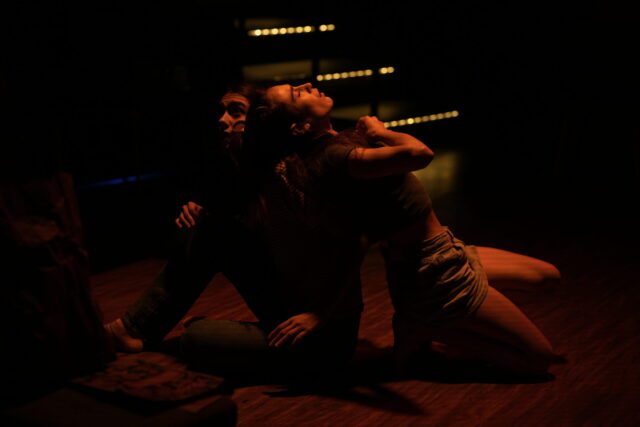
Intimate moments add to the dark mystery behind Et Alia Theater world premiere (photo by Gabriela Amerth)
The threat of violence underlies much of Blood Orange. At various times, Faye tells Eden that she will kill her with a kitchen knife or strangle her, then says Eden should shoot her abusive father. Georgia asks Faye if she has “murder-suicided” her stepmother yet. When Eden is late one day, Georgia surmises that “maybe she got hit by a car. Or kidnapped by some weirdo and stored in his apocalypse bunker.”
The number twenty-one, associated with the age of adulthood in many countries, is prevalent throughout the play. The opening scene takes place on the twenty-first day after Faye found Agnavis, it’s been twenty-one days since Mariah has come downstairs, and Georgia’s boyfriend is twenty-one.
Blood is central to the narrative, from specks of her father’s blood that Faye thinks she can still see on the floor and Faye going to third base with Devin Davis while she was on her period to the “sticky sweet” blood that was on Agavnis when Faye first found her and the tomato soup Faye heats up for Mariah.
In addition, orange is a leitmotif, from the fruit that Agnavis magically delivers out of thin air to the flavor of soda Devin prefers to a reference to Wendy Cope’s poem “The Orange,” which concludes with the line “I love you. I’m glad I exist.” Oranges are also associated with queer culture; for example, many Jewish households now add an orange on their seder plate during Passover in recognition of gays and lesbians.
The audience sits on opposite sides of Ningning Yang’s narrow, horizontal set, which has a futon and ottoman at one end and a door and tiny kitchen at the other, with a small refrigerator and a hotplate. The casual costumes are by Whitney Fabre; the characters are often barefoot, which make for intimate moments like when Faye and Georgia intermingle their feet on the ottoman. Laura Pereira’s sound is highlighted by offstage creaking signaling that Mariah — or someone/something else — might be moving around, and Hayley Garcia Parnell’s lighting features a ceiling light that flickers whenever the girls take out Agnavis.
Director Vernice Miller maintains an eerie pace — aside from one awkward scene involving Mariah and the overuse of the word “beautiful,” which is said more than a dozen times — where just about anything can happen, while associate director Amelia Estrada adds ghostly choreography. At the matinee I saw, Galatti was a superb Faye, a teenager searching for answers but getting lost in obsession; Müller was dangerously sexy as Georgia, while Moioli mixed a wide-eyed innocence with more than a tinge of mystery as Eden — whose name, of course, evokes the biblical garden where Eve took a bite of an apple, which altered the fate of humankind, and particularly women.
The mission of Et Alia, which has previously staged such works as Hasnain Shaikh’s Running in Place at Dixon Place, Müller’s On How to Be a Monster at Casa Italiana Zerilli Marimò and the Tank, None of the Above at Rattlestick’s Global Forms Theater Festival, and This Is Me Eating___ at the Alchemical Studios, is to “create art for the other, by the other, and about the other.” The dark, supernatural Blood Orange fits that bill.
In a program note, Duclos writes, “Tonight, I hope that you can think about loved ones you’ve lost. Maybe the next time they appear in the corner of your eye, you can give them a small smile or do a little dance.”
Maybe.
Or maybe not.
[Mark Rifkin is a Brooklyn-born, Manhattan-based writer and editor; you can follow him on Substack here.]