
Anthony Roth Costanzo is sensational as a fictionalized version of Maria Callas in Galas at Little Island
GALAS: A MODERN TRAGEDY
The Amph at Little Island
Pier 55, Hudson River Park at West Thirteenth St.
September 6-28, $10 standing room, $25 seats, 8:30
littleisland.org
The first half of Eric Ting’s exciting version of Charles Ludlam’s rarely revived 1983 downtown hit, Galas: A Modern Tragedy, is everything you want it to be: hilariously campy, with fabulous singing, outrageous staging, and delicious costumes. The second half veers far off course until righting itself for a thrilling finale.
Ludlam, who founded the highly influential Ridiculous Theater Company in 1967, wrote, directed, and starred in the original, portraying the title character, Maria Magdalena Galas, an opera diva based on American-born Greek soprano Maria Callas. Today, the use of the word “tragedy” in the subtitle is twofold: the revered Callas died in 1977 at the age of fifty-three, while the beloved Ludlam passed away in 1987 when he was just forty-four, of AIDS.
Despite the inspired lunacy of the acting and plot, Galas is surprisingly faithful to Callas’s life and career. The show begins at the Verona train station, where successful brick industrialist Giovanni Baptista Mercanteggini (Carmelita Tropicana) is waiting to pick up Galas (Anthony Roth Costanzo), who is scheduled to perform the lead role in Amilcare Ponchielli’s La Gioconda at the Arena di Verona. They meet at a café, where they have a delightful and meaningful exchange.
Galas: You are an opera lover?
Mercanteggini: Yes, I’m a real aficionado. Now there’s something we have in common, eh?
Galas: What’s that?
Mercanteggini: We are both music lovers.
Galas: I am not a music lover. I am a musician.
Mercanteggini: But surely you love music.
Galas: I am a musician. And because I am a singer I am a musical instrument. A music lover, no. I am music.
Mercanteggini: But you don’t love it? Not even a little bit?
Galas: I wouldn’t dare. Art is so great it frightens me sometimes.
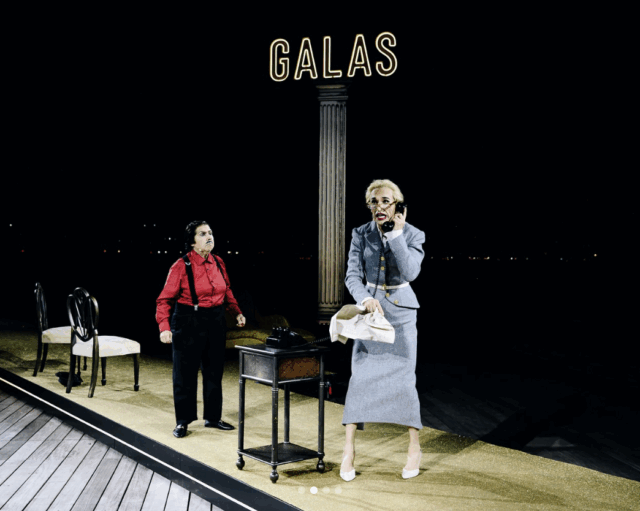
Carmelita Tropicana and Anthony Roth Costanzo make a fine comic duo in Galas
Mercanteggini offers her a deal: He will serve as her manager and benefactor for one year; she agrees, moving into his home, where she encounters his brusque housekeeper, Bruna Lina Rasta (Mary Testa), a former soprano based on Lina Bruna Rasa, who had a meltdown onstage and, because of mental illness, stopped singing.
Soon Galas and Mercanteggini are married, and she experiences success on tour but it’s not enough; she desperately wants to become a company member of La Scala. Fritalini (Samora la Perdida) and Ghingheri (Austin Durant) of La Scala offer her a onetime slot as a guest-artist replacement for the ill Baldini to sing La Gioconda, which she reluctantly does after some fabulous prima donna fits of pique. Later, after a tough negotiation, Galas does become a company member, agreeing to appear in I Vespri Siciliani, Norma, and Don Carlo on the condition that she sing La Traviata as well, an occasion for even more entertaining diva displays.
While the feverish Italian press offers ever-more outré explanations for her significant weight loss, which made her a svelte femme fatale, Galas has a contentious audience with Pope Sixtus VII (la Perdida), with whom she argues about the value of Wagner’s operas, and later has to cut short her performance of Norma at La Scala because she has lost control of her voice.
Giving up singing, she heads out with Mercanteggini and Bruna on a yacht owned by wealthy womanizer Aristotle Plato Socrates Odysseus (Caleb Eberhardt), who is traveling with his wife, Athina (Erin Markey); his former mistress, Hüre von Hoyden (Patricia Black); and gossip columnist Ilka Winterhalter (la Perdida); and takes an instant liking to Galas, not hiding his desire. (After ten years of marriage, Callas left Mercanteggini for Aristotle Onassis.) A final conversation between Galas and Bruna reveals a desperate Maria trying to hold on to something, anything.
Tony and Obie winner Mimi Lien’s set features a long, movable catwalk, some furniture, and a tall Greek column with the word Galas at the top in neon lights that change color. Jackson Wiederhoeft’s costumes for Galas are spectacular, from an elegant red gown to a tight-fitting business dress. The other costumes, by Hahnji Jang, are fun and frolicsome, especially the getups for the pope. Jiyoun Chang’s lighting and Tei Blow’s sound work well in the outdoor setting. Raja Feather Kelly’s choreography is way too over the top during the yacht scene.
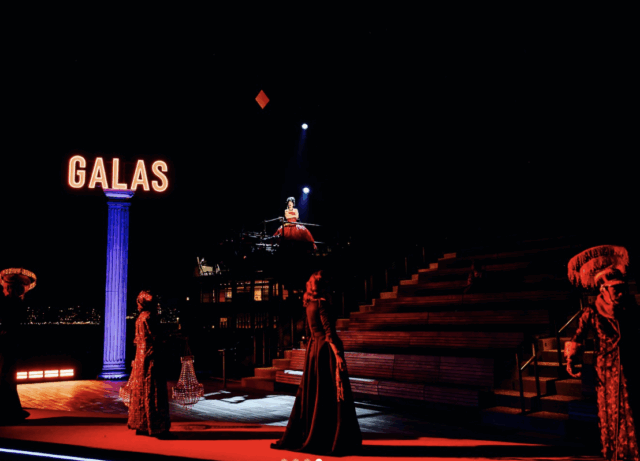
Rare revival of Charles Ludlam’s Galas continues through September 28
Countertenor Costanzo, who has appeared in lead roles for the Metropolitan Opera, the English National Opera, the Teatro Real Madrid, and other international companies and is the general director and president of the innovative Opera Philadelphia, has become Little Island’s breakout star; last year he performed all the live singing parts in an almost-solo version of Mozart’s The Marriage of Figaro, and he is outstanding here as Galas, wearing fanciful outfits, dishing dirt, and luxuriating in the high life but understanding that it could all go away in the blink of an eye. The role was originally played by Ludlam, then by the late Ludlam’s longtime partner, Everett Quinton, in the first-ever revival in 2019. (Quinton designed the costumes and played Bruna in the 1983 staging.)
Obie winner Testa (On the Town, Oklahoma!) serves as the anchor for the show, balancing pathos with physical comedy and her lovely singing voice. Tropicana (With What Ass Does the Cockroach Sit?/Con Que Culo Se Sienta la Cucaracha, Memorias de la Revolucion) is a hoot as the short and stout Mercanteggini, and la Perdida sparkles as the nonbinary pontiff.
Obie-winning director Ting (The Comeuppance, Between Two Knees), who helmed Alina Troyano and Branden Jacobs-Jenkins’s Give Me Carmelita Tropicana!, guides numerous delightful moments in the first half, particularly with his interpretation of a train arriving at a station and his later use of chandeliers, but the yacht scenes drag on, feeling like a Fellini movie that was never released. And the way the characters say “La Scala” with their tongues sticking out is humorous at first but eventually dries up.
Galas is at its best when Costanzo is singing, whether an aria from Carmen, “Casta Diva” from Norma, or additional selections he made. But even with its troubled center section, it’s a triumphant tribute to a downtown theater legend, an eternal opera diva, and the cost of living for art.
[Mark Rifkin is a Brooklyn-born, Manhattan-based writer and editor; you can follow him on Substack here.]