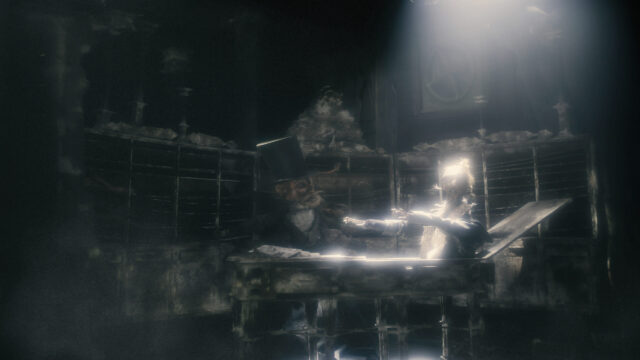
The Quay Brothers return to Film Forum with their first feature-length film in twenty years, another foray into the unknown and unseen
SANATORIUM UNDER THE SIGN OF THE HOURGLASS (the Quay Brothers, 2024)
Film Forum
209 West Houston St.
Opens Friday, August 29
212-727-8110
www.filmforum.org
As if a new film from the Quay Brothers is not already reason enough to celebrate, the rejoicing can escalate because their latest, Sanatorium under the Sign of the Hourglass, is another masterful addition to their forty-year career.
Philadelphia-born, England-based identical twins Stephen and Timothy Quay make unique, complex stop-motion animated works that incorporate elements of German expressionism, silent film tropes, noir, and psychoanalysis, creating dark, heavily atmospheric tales that push the boundaries of storytelling conventions, using eerie, fragile dolls and puppets along with mysterious live action and spectral experimental music. They started out in 1985 with the eleven-minute Little Songs of the Chief Officer of Hunar Louse, or This Unnameable Little Broom, Being a Largely Disguised Reduction of the Epic of Gilgamesh, Tableau II, a dreamlike fantasia involving a creepy, clownlike figure surrounded by doors and drawers that open and close by themselves and windows that offer views into other worlds. They followed that up with the 1986 classic Street of Crocodiles, based on Bruno Schulz’s 1934 short story collection and inspired by the work of Czech filmmaker, artist, and playwright Jan Švankmajer; the twenty-minute opus revolutionized the genre, focusing on a man, dressed like a magician, who looks into a strange contraption that leads him into a portentous alternate universe where inanimate objects move and clocks have no hands.
Only their third feature-length film — after 1994’s Institute Benjamenta and 2004’s The Piano Tuner of Earthquakes — Sanatorium under the Sign of the Hourglass, based on the 1937 novel and other writings by Schulz, is a natural progression from those early days, a kind of summation of everything that came before it. The narrative is set at Sanatorium Karpaty in the foothills of the Karpathian Mountains, where patient J (Zenaida Yanowsky) is convalescing. We first meet Adela I (Allison Bell), a young woman peering around suspiciously, her knee blocking part of her face as we listen to a scratchy 1936 Radio Archive recording of a voice explaining, “Sometimes, at the opening . . . of a street someone turned to the sky half a face, with one frightened and shining eye, and listened to the rumble of space.” Next we see, through the pupil in a large, disembodied eye, three men in top hats, two chimneysweeps (Andrzej Kłak and Leszek Bzdyl) and an auctioneer (Tadeusz Janiszewski). The auctioneer is selling such unusual items as “Twin Quail eggs of supernatural size, laid during the Solar Eclipse . . . of 12 May 1706? Or three petrified ribs of a Siren . . . together with her hands found in the Royal Menagerie of Fredensborg . . . in the year 27 September 1674. Or an Iron Harpoon . . . struck by lightning! Or the Warm Blood of Bees! Or the Hour of your Death!”
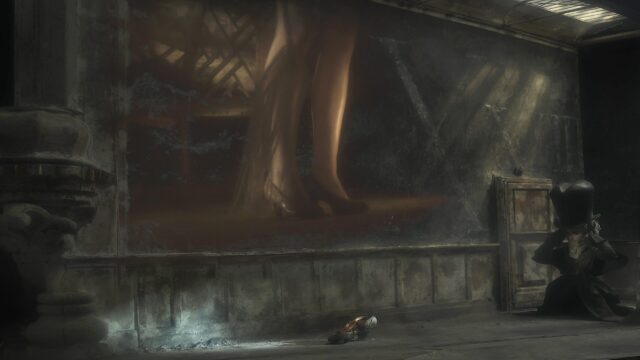
Sanatorium under the Sign of the Hourglass is another audiovisual marvel by the Brothers Quay
The auctioneer, who also refers to himself as a flogger and a pedlar, returns to his sparse office, where his assistant (Wioletta Kopańska) shows him a new item that has been delivered for him to sell; in his booming thespian voice, he reads: “Forbiddingly called Maquette for the Sepulchre of a Dead Retina, it is a singularly decrepit but ornate wooden box having the appearance of a miniature funerary cabinet with a skilfully hidden secret drawer allegedly containing the deceased retina of its original owner. Penetrating the exterior skin of this box are seven randomly placed lenses with tiny adjustable screws. Each lens holds a glimpse of one of the seven final images that the said eye beheld. And when positioned correctly, once a year, on the 19th of November, the sun’s rays are aligned to strike the dead retina — thereby liquefying it, anointing each of the seven images and setting them in motion.”
The box suddenly comes to life, and the auctioneer peers into one of the lenses and sees Józef, a doll in a top hat who wanders through an old, ghostly train, going from coach to coach as doors and secret entrances swing open and closed and ghastly figures appear and disappear. In voiceover, the auctioneer narrates the proceedings as Józef meets the multiarmed Dr. Gotard, who is caring for Józef’s ailing father. Józef encounters a broken hourglass, a dilapidated bridge, a buzzing neon sign in red and blue, used chalk for hire, and old mirrors as he makes his way through netherworld vestibules.
The story occasionally cuts back to live action with real actors, where Józef (Kłak) is told by the chambermaid (Kopańska) that it is always night there. He peers through a keyhole and watches what might be some kind of S&M encounter, bathed in a golden light. A horde of men (Bzdyl, Robert Martyniak, Łukasz Łucjan, Marek Jasek) are tantalized by Adela II (Kopańska). Back in his doll form, Józef is led to a crumbling theater for one person; his seat is Loge 7A, which is restricted view.
It all combines for a storytelling tour de force, zeroing in on the voyeuristic nature of humanity, from how we watch movies and theater to how we interact with one another in real life and fantasy.
Sanatorium under the Sign of the Hourglass unfolds in seven sections, including “Provocations Found in Evening Corridors: Hosanna!,” “Distant Presences Traced Around the Circumference of a Knee,” “The Idolatrous Procession,” and “Travels in the Last World.” It’s a Victorian steampunk dark nightmare that is like an ASMR fan’s dream. The attention to detail in every shot, every sound is remarkable, resulting in a hypnotic audiovisual experience. The Quays are credited with the puppets, décors, animation, and cinematography; the spectacular production design is by Agata Trojak, with sets by Anna Podhajny, props by Mateusz Niedzielak, costumes by Dorothée Roqueplo, live-action cinematography by Bartosz Bieniek, and sound by Joakim Sundström and the Quays.
Timothy Nelson’s original score features electronic noise, propulsive drumming, and spectral tones, accompanied by additional music by Alfred Schnittke performed by the Berlin Radio Symphony Orchestra. The methods employed by the Brothers Quay are so dazzling that their mind-blowing sets were on display in the fall 2009 exhibit “Dormitorium: Film Décors by the Quay Brothers” at Parsons the New School for Design, and they were honored with the wide-ranging 2012–13 MoMA retrospective “Quay Brothers: On Deciphering the Pharmacist’s Prescription for Lip-Reading Puppets.”
Not even the most serious students of Freud and Jung will make sense of everything as the film investigates concepts of time and space, of life and death in ways that both chill and thrill. (In their director comments, the Quays call Sanatorium “an exploration of motifs and themes taken from the mytho-poetic writings of Bruno Schulz integrating both puppets and live-action to score the demiurgic nervature of Schulz’s 13th apocryphal month in the Regions of the Great Heresy.”) As they have done in This Unnameable Little Broom, Street of Crocodiles, and such other shorts as The Comb, The Phantom Museum: Random Forays into the Vaults of Sir Henry Wellcome’s Medical Collection, Metamorphosis, Through the Weeping Glass: On the Consolations of Life Everlasting (Limbos & Afterbreezes in the Mütter Museum), and The Doll’s Breath — some of which are documentaries — they invite viewers into fantastical, unimaginable realms and dimensions that are as confounding as they are beautiful, as unnerving as they are intensely involving and satisfying.
Sanatorium under the Sign of the Hourglass opens August 29 at Film Forum; each screening will be preceded by a specially recorded introduction by the Quay Brothers. The 6:10 show on Friday will be introduced by Literary Hub editor Olivia Rutigliano.
[Mark Rifkin is a Brooklyn-born, Manhattan-based writer and editor; you can follow him on Substack here.]