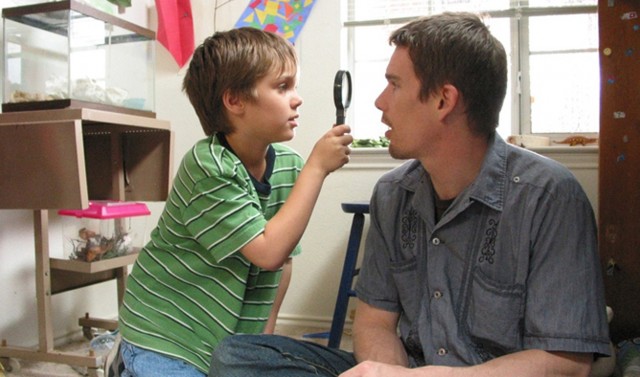
Mason Jr. (Ellar Coltrane) and Mason Sr. (Ethan Hawke) take a look at their lives in Richard Linklater’s brilliant Boyhood
BOYHOOD (Richard Linklater, 2014)
IFC Center
323 Sixth Ave. at West Third St.
Sunday, August 31, 1:45
Monday, September 1, 11:15 am
Wednesday, September 3, 1:00
www.ifccenter.com
IFC Center is celebrating its twentieth anniversary by screening twenty films, one from each year it’s been open. The first part of the series runs through September 4 and includes 2006’s Inland Empire, 2007’s Fay Grim, 2009’s Antichrist, and 2014’s Boyhood.
Since 2002, Austin auteur Richard Linklater has made a wide range of successful films, from the family-friendly School of Rock and Bad News Bears to the second and third parts of the more adult Before series (Before Sunset, Before Midnight), with Ethan Hawke and Julie Delpy, in addition to the Philip K. Dick thriller A Scanner Darkly and the Jack Black black comedy Bernie. But during that entire period he was also making one of the grandest films ever about childhood, the deceptively simple yet mind-blowingly complex Boyhood. The work follows Mason Evans Jr. (Ellar Coltrane) as he goes from six years old to eighteen, maturing for real as both the actor and the character grow up before our eyes. As the film begins, Mason, his older sister, Samantha (Linklater’s real-life daughter, Lorelei), and their mother, Olivia (Oscar winner Patricia Arquette), are preparing to move to Houston just as their usually absent father, Mason Sr. (Hawke), returns from a job in Alaska, supposedly ready to be a more regular part of their lives. But his emotional immaturity leads to divorce, and Mason Jr. spends the next dozen years dealing with school, stepfathers, and the normal machinations of everyday life, including sex, drugs, rock and roll, and, for him, a determination from an early age to become an artist. Along the way, his sister and parents experience significant changes as well as they all learn lessons about life, love, and loss.
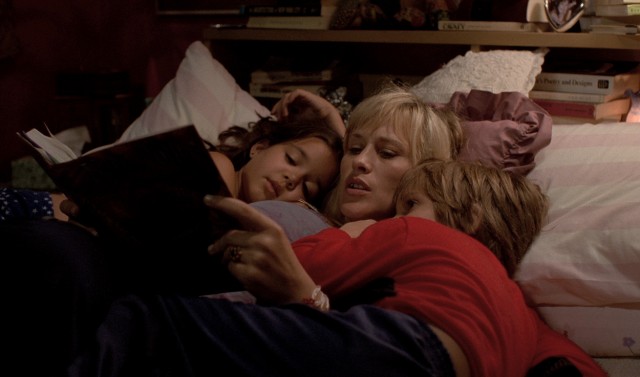
Olivia (Patricia Arquette) reads to children Samantha (Lorelei Linklater) and Mason Jr. (Ellar Coltrane) in Boyhood
To make the film, the cast and crew met every year for three or four days of shooting, with writer-director Linklater moving the story ahead by incorporating real elements from Coltrane’s life that add to the natural ease and flow of the story. Despite the obvious difficulties of maintaining continuity over a dozen years, cinematographers Lee Daniel and Shane Kelly and editor Sandra Adair do a masterful job of keeping the narrative right on track. It’s breathtaking to see Mason Jr. go upstairs in one scene, then come downstairs a year later, ready for something new, dressed slightly differently, with a little more facial hair, to signal the change in time. (Linklater also uses the soundtrack to note the passing years, with songs by Coldplay, the Hives, Cat Power, Gnarls Barkley, the Flaming Lips, and others.) Mason Jr.’s unique relationship with each parent and his sister is utterly believable, complete with all the pluses and minuses that entails; at one point, Lorelei, tired of being in the movie, asked her father to kill off her character, and even that energy is apparent onscreen. In addition to Coltrane’s career-making performance, Hawke and Arquette are sensational, doing something no other actors before them have ever done. You won’t be bored for a second of this two-hour, forty-minute journey with a relatively average American family that helps define the modern human condition like no other single film before it. “Photography is truth . . . and cinema is truth twenty-four times a second,” Bruno Forestier (Michel Subor) tells Véronica Dreyer (Anna Karina) in Jean-Luc Godard’s Le Petit Soldat. With Boyhood, that statement has rarely been so true. Nominated for six Academy Awards, Boyhood is screening in the IFC Center series “20 Films for 20 Years” on August 31 and September 1 and 3, the first two on 35mm.
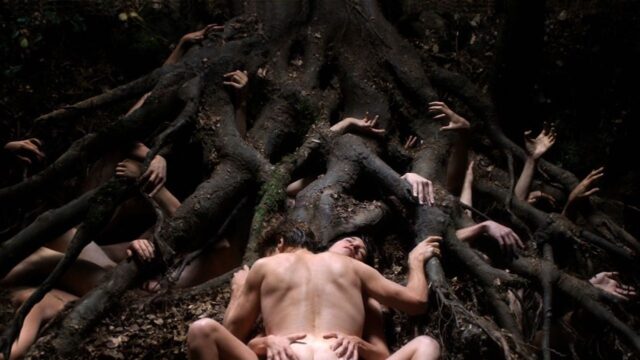
Lars von Trier’s Antichrist is yet another controversial work by the Danish filmmaker
ANTICHRIST (Lars von Trier, 2009)
IFC Center
Saturday, August 30, 7:05
Monday, September 1, 9:40
Wednesday, September 3, 4:25
Thursday, September 4, 11:15 am
www.ifccenter.com
Generally, Danish Dogme practitioner Lars von Trier makes films that critics and audiences alike are either repulsed by or deeply love. Controversial works such as Breaking the Waves, The Idiots, Dancer in the Dark, and Dogville win international awards while also driving people out of theaters. In fact, at the New York Film Festival press conference for Antichrist, he was asked how he feels when no one walks out on his work: “Then I have failed,” he replied with a sly grin. Well, there are sure to be many walkouts during Antichrist, a harrowing tale of grief, pain, and despair that begins with a gorgeously shot, visually graphic sex scene followed by a tragic accident. The rest of the film details how the unnamed couple (Willem Dafoe and Charlotte Gainsbourg) deal with the loss of their young child; a therapist, he opts to treat her more as a patient than as his wife, a highly questionable decision that threatens to tear them apart — both psychologically and physically, as the film turns into an extremely violent horror flick in the final scenes.
Somehow, I found myself pretty much right in the middle of this one, neither loving it nor hating it while admiring it greatly despite its odd meanderings, loose holes, sappy dialogue, and occasionally awkward scenarios. In certain ways, it’s a bizarre amalgamation of Alfred Hitchcock’s Spellbound, Ingmar Bergman’s Scenes from a Marriage, Stanley Kubrick’s The Shining (and various other Stephen King stories), Roman Polanski’s Rosemary’s Baby, Richard Donner’s The Omen, Robert Wise’s Audrey Rose, and Tobe Hooper’s The Texas Chainsaw Massacre. Or something like that. Antichrist is screening in the IFC Center series “20 Films for 20 Years” on August 30 and September 1, 3, and 4, the last at an ungodly 11:15 am
[Mark Rifkin is a Brooklyn-born, Manhattan-based writer and editor; you can follow him on Substack here.].