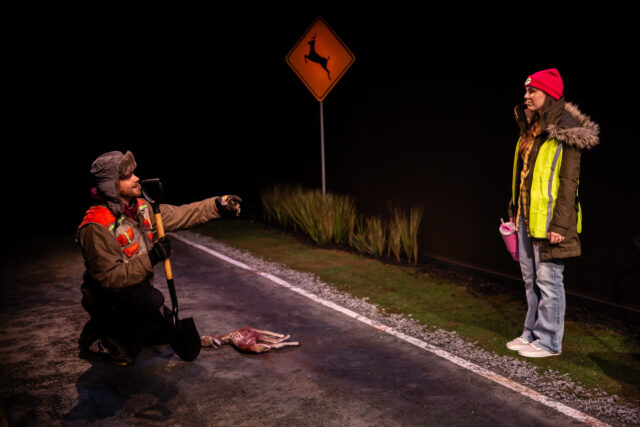
Owen (D. B. Milliken) has to teach Jaki (Mia Sinclair Jenness) the ins and outs of roadkill collection in world premiere play (photo by Nina Goodheart)
ROAD KILLS
Paradise Factory Theater
64 East Fourth St. between Second & Third Aves.
Thursday – Saturday through September 6, $19.50 – $53.25
www.goodapplescollective.com
www.paradisefactory.org
“If having a soul means being able to feel love and loyalty and gratitude, then animals are better off than a lot of humans,” British veterinary surgeon and author James Herriot wrote. Playwright Sophie McIntosh explores relationships between animals and humans — and humans with one another — in her powerful, beautifully staged new play, Road Kills, continuing at the Paradise Factory Theater through September 6.
The eighty-five-minute show takes place in a narrow, horizontal space, designed by Junran “Charlotte” Shi, with the audience sitting in three rows of folding chairs on one side; on the other side is a strip of grass, rocks, dirt, and a deer crossing sign. In between is an asphalt road, where a shocking image lies. The first row of seats are on a double yellow line, creating a level of intimacy and potential risk that hovers over the proceedings.
The play follows professional roadkill collector Owen Morris (D. B. Milliken) and Jaki Johnson (Mia Sinclair Jenness), a twenty-year-old college student who has been ordered to do six Saturdays of community service with Owen for an initially unnamed offense. It’s late fall in rural Wisconsin, so both are wearing parkas, with Owen in a red vest and Jaki in a yellow one, along with a red Green Bay Packers knit cap and a pink Stanley cup. (The props are by Sean Frank, with costumes by Saawan Tiwari; the temperature in the theater has been lowered for added effect, so a sweatshirt or other jacket is recommended for audience members.)
Owen and Jaki use shovels to carry the roadkill to a wheelbarrow; Owen asks Jaki, who would rather be anywhere else, to spot him, watching for oncoming traffic. “We’re in the middle of nowhere,” she argues. It turns out that the dead animal is stuck to the road, so removal will require additional finesse, as well as Jaki’s participation. Owen asks for some of Jaki’s coffee to help thaw the carcass, but she steadfastly refuses, claiming that it’s iced mocha — but as we soon learn, it’s got an extra kick to it.
She ultimately has to help pick up the carcass, but when she tosses it into the wheelbarrow like it’s a bag of garbage, Owen interjects, “Hey, careful. Don’t go throwing her around. . . . She deserves some respect.” Jaki then pukes in the wheelbarrow. Owen suggests they take a break before heading out to collect two other dead animals, but she insists on moving ahead because “Sigma Chi is throwing a Homecoming party tonight, and I’m not gonna miss it.”
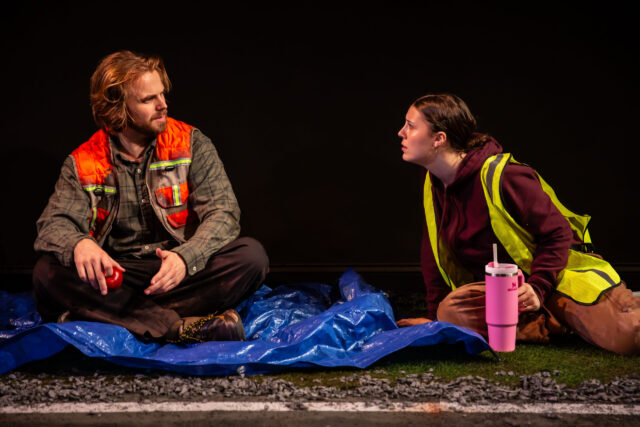
A picnic does not go quite as planned in Sophie McIntosh’s Road Kills (photo by Nina Goodheart)
It’s a terrific opening scene, firmly establishing the characters and the situation and immersing the audience in the setting. Each successive scene begins with a prerecorded mini audio drama in which a variety of drivers carelessly speed down the road, leaving carnage in their wake as the car lights flash by in the darkness. At each stop, Owen and Jaki share a little more about their lives; Owen, who is in his late twenties, inherited his job when he was sixteen from his father and lives with his mother and their dog, Annie. He is soft-spoken and displays a natural affinity for the dead animals and the environment. Jaki is attending the University of Wisconsin–Oshkosh, which she calls Sloshkosh, although she is destined to work on her family’s farm, which she is not happy about but thinks she has no other options. She talks openly about how much sex she is having with different guys, which makes Owen uncomfortable.
“You sure it’s safe to be . . . hooking up . . . with a stranger?” Owen says. Jaki responds matter-of-factly, “Aww, you worried about me? I’ll be fine. Just scared he’ll say my pussy smells like roadkill.”
The essential beliefs of each character are emphasized in this key exchange about Jaki’s family’s business:
Owen: Animals are — They’re us. I mean, we’re one of them, you know?
Jaki: Yeah, sure, humans are just supersmart monkeys. But I’ve seen Planet Earth. Even the chimps eat each other.
Owen: I know this isn’t . . . You may not see it this way. But when G-d made His creatures, great and small, He put His spirit into each of us. We didn’t get more or less than any other being — it’s not something you can measure like that. It’s . . . It’s all just life. And to take away the dignity of any man, any animal . . . it’s wrong.
Jaki: At least we don’t, like, mass murder our cattle.
Owen: Could be what you do is even worse. Violating them like that.
Jaki: Come on. It’s not like it’s — Like they have any concept of — You can’t rape a thing.
Owen: You really believe that?
Jaki: Yeah. And even if I didn’t . . . you know what they say. It’s a fuck-or-get-fucked world.
On one Saturday, Owen and Jaki meet Neil (Michael Lepore), and on another Jaki’s cousin Miles (Lepore) comes to get her; both interactions result in altercations that lead to the revelation of dark secrets.
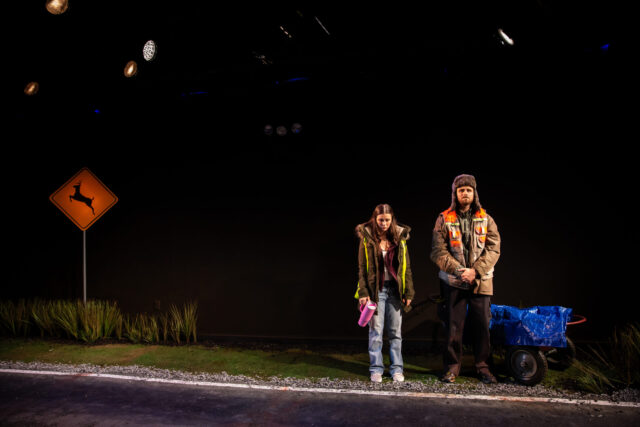
Jaki (Mia Sinclair Jenness) and Owen (D. B. Milliken) forge an intriguing relationship while performing an unusual job (photo by Nina Goodheart)
Wisconsin native McIntosh started researching and writing the play in 2019, when she was an undergrad. Over the years she drove the Wisconsin streets looking for roadkill, interviewed the wife of a Wisconsin roadkill collector, and took some of the cast and crew on a five-day trip as preparation. It all paid off, as Road Kills has an intensely realistic and relatable feel to it. It’s exquisitely directed by Nina Goodheart, who cofounded Good Apples Collective with McIntosh; they previously collaborated on cunnicularii, which also starred Milliken. Each scene is carefully choreographed, although there are some confusing moments, particularly when Owen and Jaki don’t bring the wheelbarrow close to the carcasses and instead have to pick the pieces off the road and walk them over. The production features stellar lighting by Paige Seber and sound by Max Van; despite being such a small space with primarily only two actors, there is always something new to see or hear. Milliken is warm and gentle as the easygoing Owen, while Jenness is fearless as the complicated Jaki, who has a bitter edge to everything she says and does.
As with her 2022 play, macbitches, McIntosh makes some harsh turns near the end, piling on too much as we learn more about Owen and Jaki. Good Apples describes itself as “a developmental orchard for new theatrical works that expose abuses of power, challenge taboos around desire and sexuality, and uplift the voices of queer and gender marginalized communities,” but the show nearly overloads on that in a short period of time. Still, it’s a powerful, provocative, and compelling statement on contemporary society.
Like American author, marine biologist, and environmentalist Rachel Carson wrote, “Until we have the courage to recognize cruelty for what it is — whether its victim is human or animal — we cannot expect things to be much better in this world.”
Also, and just as important, after experiencing Road Kills, you’re likely to be more careful than ever when you’re behind the wheel, and you’ll never hear John Denver’s “Annie’s Song” or Cat Stevens’s “Moonshadow” quite the same way again.
[Mark Rifkin is a Brooklyn-born, Manhattan-based writer and editor; you can follow him on Substack here.]