
Elizabeth McGovern wrote and stars in off-Broadway premiere of Ava: The Secret Conversations (photo by Jeff Lorch)
AVA: THE SECRET CONVERSATIONS
New York City Center Stage I
131 West 55th St. between Sixth & Seventh Aves.
Tuesday – Sunday through September 14, $63-$219
avagardnerplay.com
nycitycenter.org
There are currently two off-Broadway premieres that feature fine performances by actors portraying film and television royalty, but each play struggles to get past frame stories that detract from the overall production.
Oscar-nominated actress Elizabeth McGovern wrote and stars in Ava: The Secret Conversations, a touring show running through September 14 at New York City Center Stage I. It’s based on the 2013 biography Ava: The Secret Conversations by British journalist Peter Evans and Oscar-nominated Hollywood legend Ava Gardner, compiled from interview sessions between the two in Gardner’s lavish London apartment initiated in 1988. Gardner had suffered a stroke in 1986 and had not appeared on camera since.
The play opens with Gardner (McGovern) in silhouette, calling Evans (Aaron Costa Gani) on the phone, talking about possibly ending her life. The narrative then cuts back to the first time they spoke; Gardner had chosen Evans to ghostwrite her memoir for Dick Snyder at Simon and Schuster. Evans, who wants to move away from celebrity gossip and instead work on his novel, thought it was a gag and insults her, but he soon realizes from his agent, Ed Victor (John Tufts), that the project is the real deal. While Evans gets excited about the prospect of exploring the Golden Age of Hollywood, Gardner just wants to barrel through it without making it a kiss-and-tell.
“I gotta write a book, or sell the jewels. I’m kinda sentimental about the jewels,” she admits to him.
He wants to start the memoir with her childhood on a farm in North Carolina, but she wants to talk about her recent stroke. Meanwhile, Victor, in voice-over, advises him, “Dick Snyder says he wants you to ask her about it. Frank’s penis. . . . I can get close to 800K if she talks Sinatra.”
Evans and Gardner quickly get down to business; she reveals the details of meeting and marrying Mickey Rooney, Artie Shaw, and Sinatra and enjoying a lot of sex. They touch on such films as The Killers, Mogambo, The Sun Also Rises, and The Barefoot Contessa and such key figures as Marlon Brando, John Ford, Howard Hughes, and Omar Sharif. Alex Basco Koch’s projections range from archival news footage to clips from Gardner’s films, immersing the audience in her glamorous world.
As she recounts her past relationships, Gani morphs into Rooney, Shaw, and Sinatra, re-creating scenes from Gardner’s past, focusing on her three husbands; none of whom were saints. Evans, who was married with two kids, spends a lot of time with Gardner, who does not hide her flirtatious nature from him. Although she doesn’t have full use of her left arm because of the stroke, she smokes and drinks and curls up seductively on the couch, which initially bothers Evans — until it doesn’t.
Just as Gardner is really opening up, outside forces suddenly stop the interviews and put the kibosh on the book. Gardner went on to publish the 1990 memoir Ava: My Story without Evans’s input; it took more than twenty years for Evans to acquire the rights to the interviews and release them in the 2012 book Ava: The Secret Conversations, which is credited to him and Gardner.
“When you get blown up so big, Peter, you end up paper thin,” she tells him late in the play, summarizing her life as well as her attempts to tell her story her way.
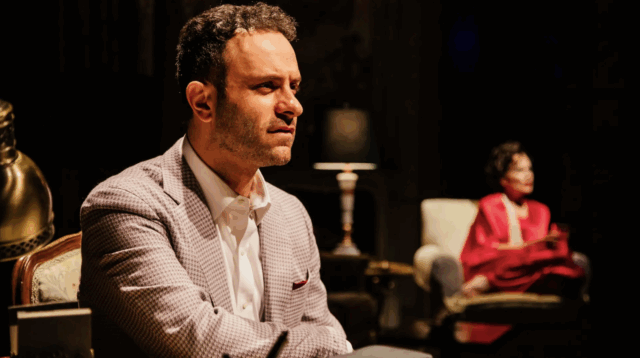
British journalist Peter Evans’s (Aaron Costa Gani) life is turned inside out when he is hired to ghostwrite Ava Gardner’s memoir (photo by Jeff Lorch)
McGovern (Time and the Conways, Downton Abbey) is lovely as Gardner; her accent may waver in and out, but her facial gestures, hair (by Matthew Armentrout), and costumes (by Toni-Leslie James) help her transform into the glamorous silver screen star in a mesmerizing performance. Ganis (Bernhardt/Hamlet, Homos or Everyone in America) does not fare as well, primarily because his characters — Evans, Rooney, Shaw, Sinatra — basically steal time away from Gardner, who merits all the attention.
McGovern the writer and Tony-nominated director Moritz von Stuelpnagel (Hand to God, The Thanksgiving Play) are exploring the creative process, but we learn only so much about Evans and instead want to know everything about Gardner. The pace comes to a screeching halt whenever Peter is not speaking with Ava and is instead talking to Ed or someone else; it’s a shame it couldn’t have been a one-woman show, but that would have been a different play.
In addition, there are bothersome plot holes; for example, Evans has a tiny notebook and only occasionally jots down notes, so it seems impossible for him to have gotten so many direct quotes; in actuality, he used a tape recorder, which would have been useful to point out so we don’t wonder about it.
Ava: The Secret Conversations might not be The Killers, Mogambo, or The Night of the Iguana, but it’s also not Ghosts on the Loose, The Sentinel, or The Naked Maja, falling somewhere in the middle of Gardner’s diverse oeuvre.
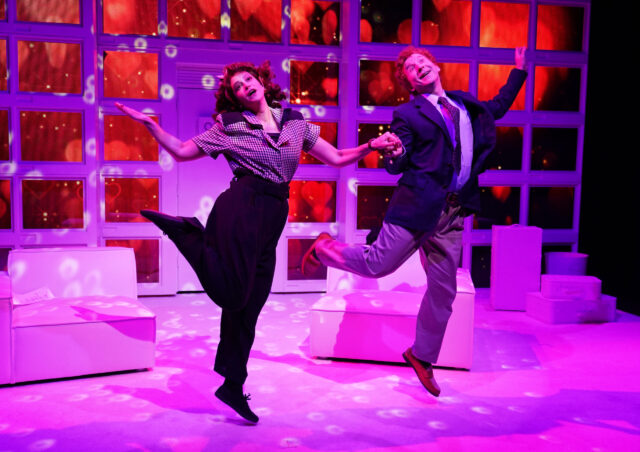
The whirlwind romance between Gilda Radner (Jordan Kai Burnett) and Gene Wilder (Jonathan Randell Silver) comes to life in off-Broadway premiere (photo by Carol Rosegg)
GENE & GILDA
59E59 Theaters
59 East 59th St. between Park & Madison Aves.
Tuesday – Sunday through September 7, $66-$86
212-279-4200
www.59e59.org
Cary Gitter’s Gene & Gilda, a Penguin Rep production running through September 7 at 59E59, details the whirlwind romance between Saturday Night Live superstar Gilda Radner (Jordan Kai Burnett) and comedy legend Gene Wilder (Jonathan Randell Silver). The show opens as Wilder is sitting down for his first interview since Radner’s tragic death. He’s hesitant to discuss his personal life with talk show host Dick Cavett, who appears here only in voice-over.
“I thought we agreed we wouldn’t discuss that,” Wilder says, but Cavett pushes him. “I’d rather keep that off limits,” Wilder answers, but is then interrupted by the sudden apparition of Radner, who declares, “Off limits? You wanna keep me off limits? . . . We can tell our story together. The good, the bad, and the ugly. The whole megillah.” The rest of the eighty-five-minute show flashes between the interview and reenacted scenes from Radner and Wilder’s relationship.
The two met on August 13, 1981, on the set of Hanky Panky, a 1982 comic thriller directed by Sidney Poitier that did not fare very well. At the time, Radner, who was born in 1946 in Detroit, was married to future SNL bandleader G. E. Smith, who had worked on her 1979 one-woman Broadway show, Gilda Radner — Live from New York. Wilder, who was born in 1933 in Milwaukee, had been divorced twice and was coming off the huge success of Stir Crazy, the second of his four collaborations with Richard Pryor. Although Radner knew in advance that she was going to fall in love with Wilder, he took a bit of convincing before being swept away by the gale force that was Gilda Radner. “But — but what about my vertigo, and the comfort handkerchief, and the praying?” he says to her, referring to some of his neuroses. She replies, “I love all of it. We complement each other’s craziness. A match made in meshugas.”
They both suffer creative crises but find solace in each other and their home away from home, the south of France, where they wed in 1984. At one point, Wilder complains that he is only being offered parts in “Crap! Trash! Garbage!,” telling Radner, “I’m seeing clearly for the first time in years! I wanted to be a thespian. When I was a kid, I saw Death of a Salesman on Broadway, and it changed my life. That was art. I studied at the Actors Studio. I wanted to impact people. And now I’m nothing but a, a cheap Hollywood commodity, making stupid comedies like Hanky Panky! No offense.”
Radner reassures him that making people laugh is his gift. “What do you think people would rather do on a Saturday night — watch me give a speech about the hardships of life, or crack up over Roseanne
Roseannadanna? What we do is a — it’s a public service.”
But their idyllic life is turned upside down when Radner falls ill, experiencing mysterious symptoms that doctors cannot diagnose — until it’s too late.
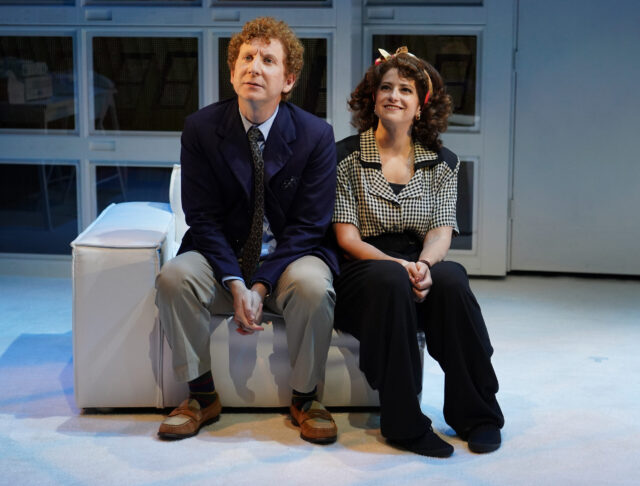
Gene Wilder (Jonathan Randell Silver) looks back at his life with Gilda Radner (Jordan Kai Burnett) in Gene & Gilda (photo by Carol Rosegg)
Christian Fleming’s set features all-white furniture, from a two-section couch and a desk with a typewriter to luggage and a big box (perhaps to make the room seem ghostly or to keep the spotlight more on the couple — except at least twice, the night I went, when the spotlight loses Wilder). Wilder occasionally sits in a black director chair when being interviewed by Cavett; those segments slow down the pace dramatically.
The backdrop is a wall of television monitors where Brian Pacelli’s projections range from hearts and flowers to a shot of the south of France and live video of Wilder answering Cavett’s questions; at the center is a door marked “On the Air,” a constant reminder that we’re watching a TV show. Gregory Gale’s costumes put Wilder in relatively conservative suits and Radner in frumpy yet wacky outfits, while Bobbie Zlotnik’s hair and wigs hit their mark. Sound designer Max Silverman’s treacly score evokes telephone hold music.
In the script, Gitter (The Steel Man, The Sabbath Girl) explains that Gene & Gilda “is a work of fiction, based freely on fact.” Among his sources were Wilder’s 2005 memoir, Kiss Me Like a Stranger, Radner’s posthumous 1989 autobiography, It’s Always Something, and Lisa Dapolito’s 2018 documentary, Love, Gilda, as well as archival footage; although Wilder did sit down with Cavett for an interview in 1991, they did not delve into detail about Radner, instead talking about how ovarian cancer could and should be diagnosed earlier. Director Joe Brancato (The Devil’s Music, The Sabbath Girl) can’t quite find the balance between fact and fiction, fantasy and reality. There is too much telling, describing what happened, and not enough showing.
Burnett (Found, Romy & Michele the Musical), who previously portrayed Radner in a December 2023 workshop reading of Not Ready for Prime Time, a play about SNL’s first five years that is scheduled to debut in New York City in October, is adorable as the determined star, who is not afraid to say what she wants and go after it, although a brief skit in which she channels Roseanne Roseannadanna, Emily Litella, Baba Wawa, Judy Miller, and Candy Slice is a tough challenge.
Silver (Please Continue, Shear Madness!), who portrayed Richard Dreyfuss in regional productions of The Shark Is Broken for the fiftieth anniversary of Jaws, captures the essence of the mild-mannered, tentative Wilder. A scene in which they re-create one of the funniest bits from The Producers — when Max Bialystock (Zero Mostel) attempts to calm down a hysterical Leo Bloom (Wilder) — is another challenge, but there are several lovely moments between them, especially when they dance together.
Gene & Gilda is reminiscent of an episode of Saturday Night Live, with some good sketches, some okay ones, and some, well, not so memorable. It might not be Willy Wonka & the Chocolate Factory, Young Frankenstein, or Silver Streak, but it’s also not Hanky Panky, Haunted Honeymoon, or Rhinoceros. It’s more like The Frisco Kid, The Woman in Red, and Quackser Fortune Has a Cousin in the Bronx. And no need to worry; you won’t need your comfort hankie.
[Mark Rifkin is a Brooklyn-born, Manhattan-based writer and editor; you can follow him on Substack here.]