
Meredith Monk looks at her past, present, and future in Billy Shebar’s celebratory and deeply affecting documentary
MONK IN PIECES: A CONCEPT ALBUM (Billy Shebar, 2025)
IFC Center
323 Sixth Ave. at West Third St.
July 24–31
www.ifccenter.com
monkinpieces.com
Near the beginning of Billy Shebar’s revelatory documentary, Monk in Pieces, composer Philip Glass explains that Meredith Monk “was a self-contained theater company. She, amongst all of us, I think, was the uniquely gifted one — is the uniquely gifted one.” It’s an important correction because Monk, at eighty-three, is still hard at work, creating live performances and films that defy categorization.
While several of her earliest projects were met with derision in critical circles, today she is revered for her remarkable output, although it is still impossible to put her into any kind of box. At one point in the documentary, a chorus of Monk scholars sings her praises; one says, “She’s achieved so much, has received so many accolades, and yet she’s this unknown,” a second notes, “She kind of falls through the cracks of music history,” and a third admits, “We don’t know how to talk about her.”
Written, directed, and produced by Shebar — whose wife, coproducer Katie Geissinger, has been performing with Monk since 1990 — and David Roberts, Monk in Pieces does a wonderful job of righting those wrongs, celebrating her artistic legacy while she shares private elements of her personal and professional life. Born and raised in Manhattan, Monk details her vision problem, known as strabismus, in which she is unable to see out of both eyes simultaneously in three dimensions, which led her to concentrate on vocals and the movement of her physical self. She studied Dalcroze Eurhythmics: “All musical ideas come from the body; I think that’s where I’m coming from,” she says. All these decades later, her distinctive choreography and wordless tunes are still like nothing anyone else does.
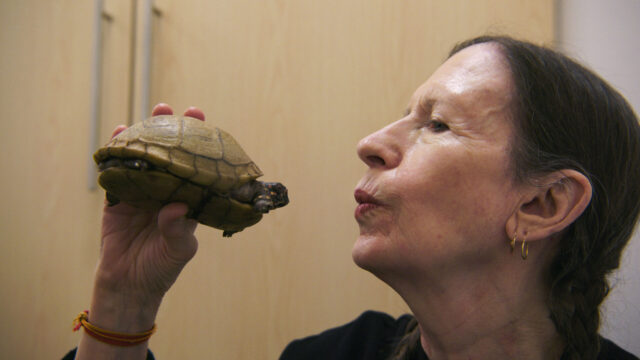
Meredith Monk shares a special moment with her beloved turtle, Neutron
Unfolding at a Monk-like unhurried pace, the ninety-five-minute documentary is divided into thematic chapters based on her songs, including “Dolmen Music,” “Double Fiesta,” “Memory Song,” “Turtle Dreams,” and “Teeth Song,” while exploring such presentations as Juice (1969), the first theatrical event to be held at the Guggenheim; Education of the Girlchild (1973), in which a woman ages in reverse; Quarry (1976), a three-part opera about an American child sick in bed during WWII; Impermanence (2006), inspired by the sudden death of her partner, Mieke von Hook; and her masterwork, Atlas (1991), in which the Houston Grand Opera worries about her numerous requests and production costs, whether the piece will be ready in time, and if it even can be considered opera. There are also clips from Ellis Island, Book of Days, Facing North, and Indra’s Net, her latest show, which was staged at Park Ave. Armory last fall. In addition, Monk reads from her journals in scenes with playful animation by Paul Barritt.
Monk opened up her archives for the filmmakers, so Shebar, Roberts, and editor Sabine Krayenbühl incorporate marvelous photos and video from throughout Monk’s career, along with old and new interviews. “It was her voice that was so extraordinary, not only the different kind of sounds she could make, but the imagination she was using in producing the sound . . . totally individual,” Merce Cunningham says. WNYC New Sounds host John Schaefer gushes, “I don’t know when words like multimedia and interdisciplinary began to become in vogue, but Meredith was all of those things.” Her longtime friend and collaborator Ping Chong offers, “She had to fight to be acknowledged in the performing arts world because critics were saying that what she was doing was nonsensical, was crazy, was not serious; in a way, it’s a fight to survive. Pain is where art comes from. . . . Art has to come out of need. And now she’s an old master.”
And Björk, who recorded Monk’s “Gotham Lullaby,” touts, “Meredith’s melody making is like a timeless door that’s opened, like a gateway to the ancient is found. It definitely affected my DNA. . . . Her loft that she has lived in for half a century is an oasis in a toxic environment.” Among the other collaborators who chime in are longtime company member Lanny Harrison; composer Julia Wolfe; and David Byrne, for whom she created the opening scene of his 1986 film, True Stories, and who says he learned from Monk that “you can do things without words and it still has meaning, it still has an emotional connection.”
Some of the most beautiful moments of the film transpire in Monk’s loft, where she tends to her beloved forty-two-year-old turtle named Neutron, puts stuffed animals on her bed, meditates while staring at windows lined with Tibetan prayer flags, composes a new song, looks into a mirror as she braids her trademark pigtails, and sits at her small kitchen table, eating by herself. Surrounded by plants and personal photographs, she moves about slowly, profoundly alone, comfortable in who she is and what she has accomplished, contemplating what comes next.
“What happens when I’m not here anymore?” Monk, who received the 2014 National Medal of Arts from President Barack Obama, asks while working with director Yuval Sharon, conductor Francisco J. Núñez, and performer Joanna Lynn Jacobs on a remounting of Atlas for the LA Philharmonic in 2019. “It’s very rare that anybody gets it.”
Monk in Pieces goes a long way toward rectifying that, filling in the cracks, helping define her place in music history.
Monk in Pieces runs July 24-31 at IFC Center; there will be Q&As following the 6:45 screenings on July 24 with Monk, Shebar, and producer Susan Margolin, moderated by Schaefer; on July 25 with Monk, Shebar, and Margolin, moderated by violist Nadia Sirota; and on July 26 with Shebar.
[Mark Rifkin is a Brooklyn-born, Manhattan-based writer and editor; you can follow him on Substack here.]