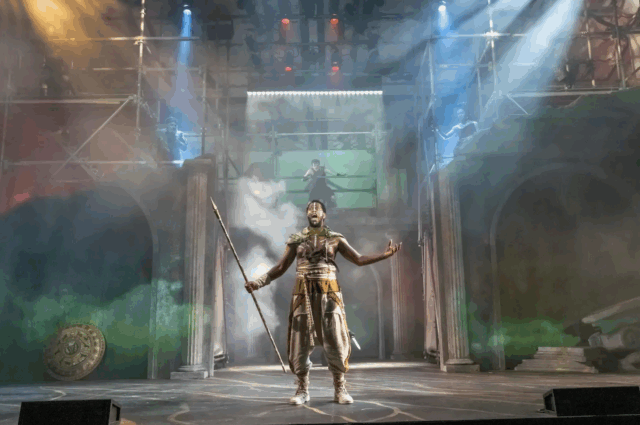
Eric Berryman resurrects a Greek hero in Classical Theatre of Harlem’s Memnon (photo by Richard Termine)
UPTOWN SHAKESPEARE IN THE PARK: MEMNON
Classical Theatre of Harlem
Richard Rodgers Amphitheater, Marcus Garvey Park
18 Mt. Morris Park W.
Tuesday – Sunday through July 27, free (advance RSVP recommended), 8:30
www.cthnyc.org
Writer Will Power and director Carl Cofield follow up their 2021 Richard III reimagination, Seize the King, with Memnon, a bold antiwar missive about a key battle in the legendary fight between the Achaeans and the Trojans about eight hundred years ago.
Presented by the Classical Theatre of Harlem at the Richard Rodgers Amphitheater in Marcus Garvey Park through July 27 at part of its Uptown Shakespeare in the Park series, Memnon zeroes in on the little-known title character, an Ethiopian king, in the mold of Black Panther, who appears in some ancient texts (Virgil’s Aeneid, the extant Aethiopis) and on cups, vases, and mirrors. Priam (Jesse J. Perez), the king of Troy, is mourning the death of his son Hector, a warrior who was killed by Achilles (Jesse Corbin). Priam believes that Hector was “Troy’s last hope,” while Polydamas (David Darrow), Priam’s trusted adviser, declares, “So now without him, our hero gone, our men / Soon slaves to Hades or other men / Our wives violated / And children’s bones crushed by boots.”
But then Polydamas suggests that Priam turn to his nephew, Memnon (Eric Berryman), who self-exiled to Ethiopia many years before under mysterious circumstances. “Never will I call this man of which you speak. Never, I say! / He is us only in lineage, not in spirit / No, his treacherous soul belongs to others / And he has proven that,” Priam argues vociferously. “He is nothing to me!”
Helen (Andrea Patterson), the queen of Troy, entreaties Priam to reconsider; she left her husband in Sparta, abducted or of her free will, as various tales have it, with Paris, Hector’s brother, and the Greek cuckold’s furor led to the Trojan War. “In Troy Helen is Helen at home Helen is hell / In Troy Helen has choice at home no free will / So the place that is home may be truly foreign / And the new place foreign may be true indigen,” Helen says, adding, “Caught up you are in who is foreign / And who is citizen. / Why not who is true and what false?”
Priam eventually relents, and, though hesitant at first, Memnon arrives with his army, although he first speaks of a peaceful resolution to the war. “In Ethiopia, able we are / To speak through disagreements and sidestep bloodshed,” Memnon explains. Priam wants to know how many enemies he has killed, and by what methods, but Memnon tells him, “We didn’t kill we captured to calm them. . . . Once I slaughtered two hundred men myself, in one single battle / Not proud of that.”
Soon Memnon is facing off with Antilochus (David Darrow), son of Nestor (Jesse J. Perez), the king of Pylos. “Your father Nestor, an old man in a young man’s game / He should not be here at war, and neither should you / I see through your brave mirage, men should not slay boys,” Memnon, holding a shield made by the god Hephaestus, warns Antilochus. “Vacate now as I will not attack but, if you should be so bold / To use sword, javelin, and shield against me / Young man, no choice will I have but to end you / Think on this, Antilochus, and think well.”
He doesn’t think well enough.
Next, Nestor appeals to Achilles to fight Memnon, not only to defend the Achaeans, but to seek revenge for his childhood friend Patroclus, who was killed by Hector. Achilles initially does not want to get involved. “To kill again I could easily do, summon the dark and blanket battle fields / With slumbering, lifeless men. But to what end, Nestor?” Achilles asks. “I despise not the Trojans, but gods that play chess with souls of men / These devilish immortals are set on us as their light amusements.” However, Nestor convinces Achilles to take up arms against Memnon, so the two heroic figures, neither of whom wants to shed more blood, are face-to-face in heated battle.
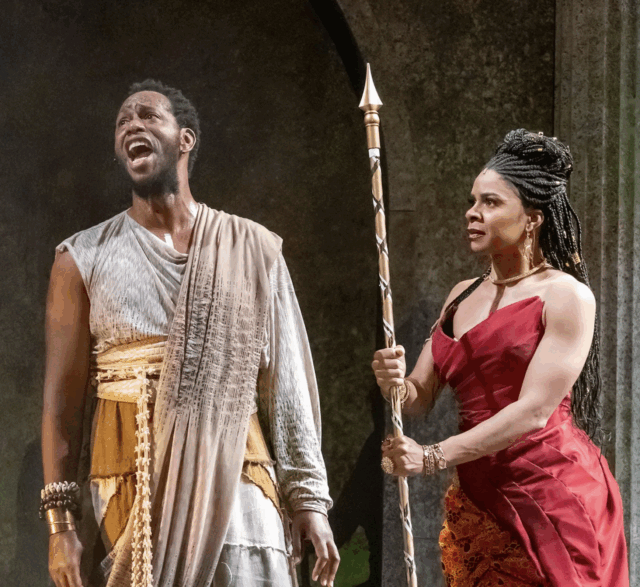
Memnon (Eric Berryman) and Helen (Andrea Patterson) consider their fate as battle awaits (photo by Richard Termine)
Told in iambic hexameter, Memnon is laced with references to immigrants that ring true with what is happening in America today. In response to Helen’s statement about who is foreign and who is citizen, Priam answers, “Is this a man true who loves Troy? That makes the citizen.” Polydamas notes, “Helen became not foreigner but blood to us.” And Memnon, when deciding whether to return to Troy and join his uncle’s cause, considers, “Now times there were when reminded I was / That Troy and I were not the same, that I / Was Troy but not fully Trojan, kin and / Not kin, still would I tuck feelings away. . . . I am of the east and yet / This Troy still calls. I cannot abandon her fully / Though I have tried. / It makes no sense, to fight for that which has proven / Time and time again that you will forever be other.”
Riw Rakkulchon’s set is a multilevel crumbling castle with stairs leading to platforms within scaffolding. Yee Eun Nam’s projections are primarily atmospheric abstractions that morph from black and white into color. Frederick Kennedy’s sound and music has to contend with loud noises in the park but ultimately prevails. Celeste Jennings’s costumes range from regal to battle armor to Memnon’s African-influenced garb, accompanied by white sneakers. The lighting, by Alan C. Edwards, adjusts to the setting sun and the shifts in narrative style, from extended dialogues to rousing dance interludes choreographed by Tiffany Rea-Fisher and performed by Jenna Kulacz, Madelyn LaLonde, Alyssa Manginaro, Caitlyn Morgan, Erik Penrod Osterkil, Tiffany “2Ts” Terry, and Travon M. Williams.
Berryman (Primary Trust, Get Your Ass in the Water and Swim Like Me) is captivating as Memnon, a thoughtful man, strong in mind and body, who favors peace but is thrust into war. His diction is initially heavy with broken English but becomes smoother as he spends more time with Priam and Helen. Perez (Party People, Informed Consent) moves smoothly between Priam and Nestor, both of whom speak loudly, fathers seeking revenge no matter the cost. Patterson (cullud wattah, Confederates) makes the most of her moments as Helen, while Darrow (All Is Calm, the Revival) excels as Polydamas and Antilochus, with several of his longer scenes receiving well-deserved exit applause, and artist, musician, and fitness trainer Corbin (The Lion . . . & the Wardrobe) shows off his muscles as Achilles.
The play unfurls almost too rapidly, with a few plot holes and a lot of exposition that at times makes it feel like something is missing, and some of the contemporary language sticks out like a sore thumb — for example, when Memnon says, “We will always be a nation sliced apart / Haves and have nots, belongs and kind of belongs.” But Power (Flow; Fetch Clay, Make Man) and Cofield (The Bacchae, King Lear) have done Greek tragedy a service by resurrecting a true hero with a unique understanding of glory.
[Mark Rifkin is a Brooklyn-born, Manhattan-based writer and editor; you can follow him on Substack here.]