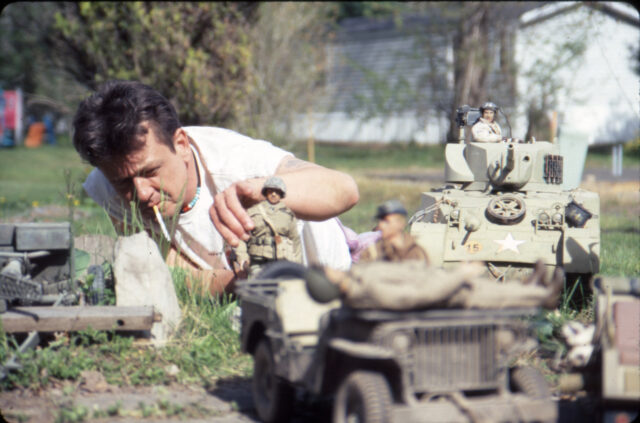
Mark Hogancamp tries to rebuild his life in a carefully constructed alternate reality (photo by Tom Putnam)
ARTIST’S CHOICE: MOVIE NIGHTS
The FLAG Art Foundation
545 West 25th St. between Tenth & Eleventh Aves.
Wednesday, July 23, July 30, August 6, free with advance RSVP, 7:00
www.flagartfoundation.org
For the next three Wednesdays, the FLAG Art Foundation is hosting free screenings of works handpicked by three artists, films that have been meaningful to them in their life and artistic practice. The series begins July 23 with Jeff Malmberg’s Marwencol, selected by New York City–born, Jersey City–based Ana Benaroya, who explores the human body and aspects of herself in colorful characters in manic situations. For July 30, LA-based Ethiopian-American multidisciplinary artist Awol Erizku has chosen three of the most important and influential indie films ever made, Maya Deren and Alexander Hammid’s Meshes of the Afternoon, Chris Marker’s La Jetée, and Ousmane Sembène’s Black Girl. The program concludes August 6 with short films picked by Baltimore-born painter, writer, and musician Cynthia Daignault.
MARWENCOL (Jeff Malmberg, 2010)
Wednesday, July 23, free with advance RSVP, 7:00
www.flagartfoundation.org
www.marwencol.com
Named Best Documentary at numerous film festivals across the country, Marwencol offers a surprising look inside the creative process and the fine line that exists between art and reality. On April 8, 2000, Mark Hogancamp was nearly beaten to death outside a bar in his hometown of Kingston, New York. He spent nine days in a coma and more than a month in the hospital before being released, suffering severe brain damage that has left his memory a blur. To help put his life back together, he began using toys and dolls — Barbies, celebrity replicas, army men — to re-create his personal journey. He makes dolls of his friends and relatives, the people he works with, and others, constructing an alternate WWII-era universe he calls Marwencol, complete with numerous buildings and plenty of Nazis. He captures the detailed story in photographs that are not only fascinating to look at but that also help him figure out who he was and who he can be.
This miniature three-dimensional world is reminiscent of the two-dimensional one carefully fashioned by outsider artist Henry Darger in his fifteen-thousand-page manuscript, The Story of the Vivian Girls, in What is known as the Realms of the Unreal, of the Glandeco-Angelinnian War Storm, Caused by the Child Slave Rebellion, which also features an alternate reality involving military battles set amid stunning artwork. Director, producer, and editor Jeff Malmberg makes no judgments about Hogancamp, and asks the same of the audience. In his first full-length film, Malmberg shares the compelling story of a deeply troubled, flawed man suddenly forced to begin again, using art and creativity to bring himself back to life. He speaks with Hogancamp’s mother, his old roommate, the prosecutor who handled his case, and others who are first seen proudly holding the doll Hogancamp made of them. And Malmberg doesn’t turn away from the more frightening aspects of Hogancamp’s daily existence. Marwencol is an unforgettable portrait of lost identity and the long road to redemption.
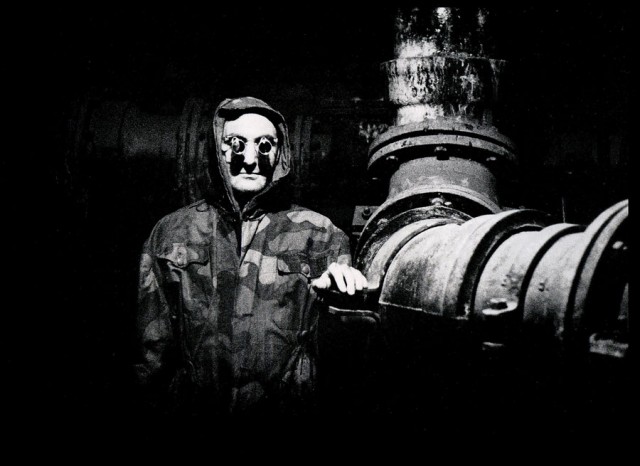
Chris Marker’s La Jetée is a postapocalyptic thriller about movies and memory, told almost exclusively through still images
LA JETÉE (Chris Marker, 1962) / MESHES OF THE AFTERNOON (Maya Deren and Alexander Hammid, 1943) / BLACK GIRL (LA NOIRE DE . . .) (Ousmane Sembène, 1966)
Wednesday, July 30, free with advance RSVP, 7:00
www.flagartfoundation.org
The Flag series continues with an inspired trio of wildly different low-budget, black-and-white works that experiment with the language of cinema. Chris Marker’s La Jetée is a nearly half-hour postapocalyptic dystopian thriller set in a world that calls “past and future to the rescue of the present.” Told almost completely in dark, eerie black-and-white photographs — the camera moves only once, pulling back on the opening establishing shot of the titular pier at Paris’s Orly airport, and at another point a woman opens her eyes in bed — La Jetée explores time and memory as a WWIII survivor (Davos Hanich) in the underground Palais de Chaillot galleries revisits an event that occurred with a woman (Hélène Chatelain) on the jetty. The film, referred to in the credits as “un photo-roman,” is narrated by Jean Négroni, with the only dialogue occasional unintelligible whispering by the German scientists in charge of the mysterious operation; the soundtrack also includes lush music from Trevor Duncan and a repeated thumping that mimics heartbeats. The film explores both art as memory and memory as art as well as the cinema itself; for example, Marker (Sans Soleil, Le joli mai) references Alfred Hitchcock’s Vertigo when the man and woman look at the rings of a Sequoia tree, and it has gone on to influence such films as Terry Gilliam’s 12 Monkeys, the Matrix trilogy, and countless other movies and videos. It’s a mesmerizing work that brings fresh insight upon each viewing.
In 1943, the husband-and-wife team of Maya Deren and Alexander Hammid made the fourteen-minute masterpiece, Meshes of the Afternoon, at their home in Hollywood. The silent work — soundtracks were added by others later — is a celebration of the surreal, filled with shots of shadowy figures and such objects as a flower, a key, a knife in a loaf of bread, and a telephone receiver off its cradle. Stairs and slow motion figure prominently as a black-draped figure with a mirror for a face haunts the proceedings and the protagonist is joined by her doppelgänger. The film stands with such works as Salvador Dalí and Luis Buñuel’s Un Chien Andalou and Ballet Mécanique, René Clair’s Entr’acte, and Jean Cocteau’s The Blood of a Poet as masterpieces of the avant-garde.
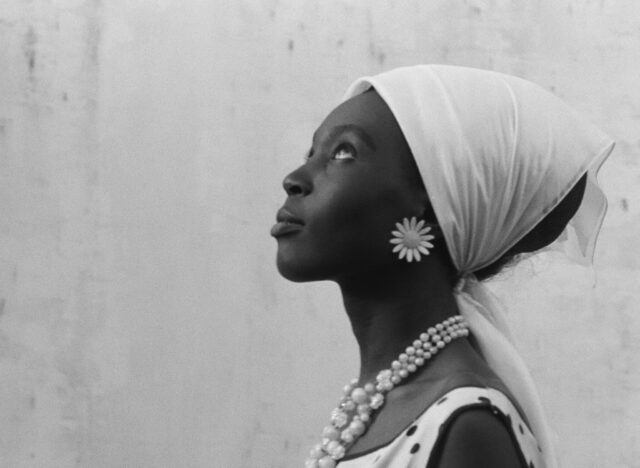
Diouana (Mbissine Thérèse Diop) seeks so much more out of life in Ousmane Sembène’s Black Girl
Ousmane Sembène’s debut, 1966’s Black Girl, launched an award-winning career that established the Senegalese author and filmmaker as a leading international storyteller for five decades. In Black Girl, also known as Le noire de . . . , Mbissine Thérèse Diop stars as Diouana, a Senegalese woman who leaves Dakar to work for a wealthy French family in Antibes. Colonialism rules the day as she tries to assert her identity but is treated with dismissive condescension. Early on, a dinner-party guest announces, “I’ve never kissed a black woman,” and pecks her on each cheek as she stares away blankly and the others laugh. “I’ve got a feeling she’s angry,” another guest says, while one of the men adds, “Their independence has made them less natural.” Diouana dreams of a better life as she remembers what it was like in Senegal, but she is thwarted by racism and bigotry every step of the way. Sembène, who would go on to make such films as Mandabi, Faat Kiné, and Moolaadé, incorporates a unique editing style with an often playful silent-film-like score to share Diouana’s longing for something else.
[Mark Rifkin is a Brooklyn-born, Manhattan-based writer and editor; you can follow him on Substack here.]