A summer outing offers multiple traumatic situations in Lithuanian drama Drowning Dry
DROWNING DRY (SESĖS; SISTERS) (Laurynas Bareiša, 2024)
IFC Center
323 Sixth Ave. at West Third St.
July 18-31
www.ifccenter.com
www.dekanalog.com
In 2018, Lithuanian filmmaker Laurynas Bareiša served as one of the cinematographers on Marija Kavtaradzė’s debut feature, Summer Survivors, about young adults dealing with mental illness. Bareiša now follows up his own debut feature, the 2021 crime drama Pilgrims, with the haunting Drowning Dry, which could have also been called Summer Survivors. (The Lithuanian title, Sesės, means “Sisters.”)
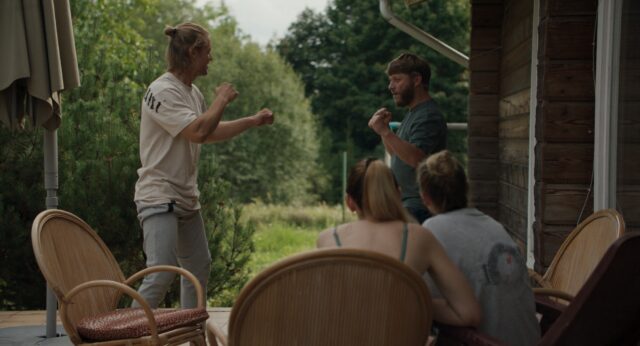
Close siblings Ernesta (Gelminė Glemžaitė) and Justė (Agnė Kaktaitė) have traveled with their families for a weekend getaway at a cabin on a lake. Ernesta is married to Lukas (Paulius Markevičius), an MMA champion, and they have a young son, Kristupa (Herkus Sarapas); Justė is married to Tomas (Giedrius Kiela), a schlubby dude jealous of Lukas’s strength, and they have a young daughter, Urte (Olivija Eva Viliüné). They all go swimming off the pier, but when tragedy strikes, their relationships with one another change — until Bareiša, who wrote, directed, and photographed the film, reverses time and the result of the event is altered, rearranging the dynamics. Bareiša ends up doing this multiple times, as various episodes happen differently from how they occurred originally, so the interaction among the characters keeps shifting as they face alternate forms of grief and trauma.
Drowning Dry is named after the medical term “dry drowning,” an urban myth that instills fear in parents that their children can drown long after they have been rescued from water. “Dry drowning is a symbol of this overprotection of kids because the real medical condition is very rare,” Bareiša told the Hollywood Reporter. Bareiša was inspired to make the film after having to resuscitate his two-year-old son and thinking about four paths the near-tragedy could have taken, represented by the adults in the film. By the end, numerous characters are having breathing difficulties, requiring help.
The film unfurls in long, uncut scenes in which Bareiša barely moves the camera; it is as if we are there with the family, sitting at the table, standing by the pier, waiting for the ambulance — or perhaps seeing it as a memory of our own grief. The repetition, or doubling, of certain scenes puts the audience in the position of questioning what they’re experiencing and wondering about the disparate paths their personal trauma could have led to.
Drowning Dry opens July 18 at IFC Center, with Bareiša on hand for Q&As at the 7:20 shows on Friday, moderated by Ryan Lattanzio, and Saturday, moderated by Sierra Pettengil.
[Mark Rifkin is a Brooklyn-born, Manhattan-based writer and editor; you can follow him on Substack here.]