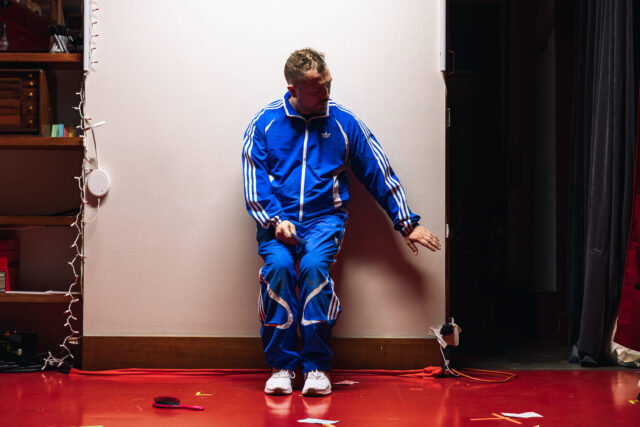
Carl Holder shares his hopes and dreams, his successes and failures in Out of Order (photo by Rebecca J Michelson)
OUT OF ORDER
East Village Basement
321 East Ninth St. between First & Second Aves.
Thursday – Tuesday through July 30, $30-$60
www.outofordertheshow.com
www.carlholder.com
“When was the last time you felt something new?” Carl Holder asks in the New York City premiere of his solo participatory Out of Order, which opened tonight for a three-week run at the appropriately named East Village Basement on Ninth St.
I now have the answer: Holder’s frantic and frenetic show.
Despite penning plays for twenty years and winning several awards and grants, upon turning forty the Gainesville-born, Brooklyn-based Holder found himself with a bad case of writer’s block. Worried he had reached the end of the road, he came up with Out of Order, a one-man production that challenges him to perform prompts from three dozen index cards, tossed into a bowl in random order, many involving audience participation. The only element that is the same for each presentation is the first card, which falls from a box on the ceiling and is read by an audience member, laying out the ground rules, including the following: “Everything you are about to see is real. If Carl doesn’t complete every task tonight, he will quit theater forever.” He’s not kidding.
The evening actually begins with the audience gathering downstairs, filling small bags of free popcorn from a cart in the center of the room and purchasing beer, wine, or seltzer from the bar in the far corner, operated by Simon Henriques, who will soon serve as “referee,” running the sound and lighting, strumming a ukulele, and keeping track of the time.

Audience members are encouraged to take and post their own photos at one point of unique solo show at East Village Basement (photo by Rebecca J Michelson)
Wearing a blue track suit and off-white sneakers, Holder races around the room, selecting a card from a big glass bowl in the middle, reading it out loud, and then acting it out, sometimes using a whiteboard, a lone chair, and/or an audience member. On the floor are such words and phrases as “You,” “Me,” “RIP,” and “Climax.” For “Three questions,” he says “How long do I have to wait?” three very different ways, each with its own meaning. For “Show your bank statement,” he does exactly that, projecting his bank statement on a wall and going over it in detail, talking about how much he has in his account, what he has spent money on, and how he might not be able to make his next rent payment by the due date. For “Teach them how to write a play,” he outlines on the board the five key ingredients of a play: Exposition, Inciting Incident, Rising Action, Climax, and Falling Action or Denouement. There are also separate cards for each element, allowing him to give a mini-theater class. Among the other prompts are “How much do you like being in control?,” “Can this be enough?,” and “Be brave.” While not every prompt works, the vast majority do.
There are several cards that relate the complex story of Ass, Chicken, and Peacock on Farmer Farmer’s Farm, involving ego, corporatization, self-awareness, drinking, and dancing; as with “Teach them how to write a play,” the order in which they’re told impacts the narrative, particularly when it comes to how a carrot is used, not just as food, but as creative incentive. For “Try again,” Holder explains, “This whole thing really started because I couldn’t write a play. And I guess I still can’t. But I found I could write down the things I couldn’t stop thinking to myself, the thoughts that were getting in the way of a play. Card by card. And somehow, more than anything I’ve tried to make for the last twenty years, doing this actually feels like being an animal.”
The night I went, the first prompt was about the bank statement, so that led to a focus that might change if, for example, “Mortality” or “Open this later” was selected instead. Thus, we knew from the start what serious financial shape Holder is currently in and how important this play is to his daily existence. It also makes us think about our own fiscal solvency, although so many of the prompts make us look at our unique personal situations.
I was chosen for one of the final cards, “Review the possibilities,” in which I read sixteen statements about how Holder’s life might go, and he decided which might happen and which should be tossed in the trash as a pipe dream. As I announced what was written on each card, I thought about how it related to my own life, and I imagine that must have been the case with just about everyone in the audience. Who hasn’t considered such possibilities as “I will have the money I need to live comfortably” or “I will mend ties with my family”?

Audience interaction is central to Carl Holder’s Out of Order (photo by twi-ny/mdr)
And therein lies why Out of Order, previously staged in living rooms, a theater lobby, a public park, and a bird sanctuary and designed by Adam Wyron and Obie-winning director Skylar Fox, is such a success, whether Holder realizes or not. At each performance, forty or so strangers are brought together in a small room, partake of food and drink, and interact with Holder and other audience members for ninety nearly breathless minutes as Holder shares his hopes and dreams with us, almost painfully realistically, and we do the same with him (if we so desire).
He is eminently likable; we immediately want him to do well. And he is very funny and quick on his feet, with sharp improvisatory skills. I was sitting at the far end of my row and had put my popcorn, wineglass, and phone on the shelf next to me. When Holder ran over there to act out a card, he first took my bag of popcorn and started casually eating from it. It’s important to note that he does not force anyone to do anything, but as one of the prompts announces, “Content warning: audience participation.”
For “The forgotten intro,” Holder even sings, summing up life in a few stanzas: “We are all born once and then we die / along the way we try some things / some are good some are bad some are great / most are forgettable . . . / but every so often a moment comes along / that’s a little bit different than all of the other moments / . . . you get to have this one special moment / and the other special moments where you’re not dead yet / and sometimes people gather around and they want to wish you well / and tell you something special, something very special / and this is one of those moments and that something very special is . . .”
I’m not about to give away what that something very special is here, since, in the show, just like in life, that’s for you to discover. But we should all be thankful that Holder has shared his special moments with us.
[Mark Rifkin is a Brooklyn-born, Manhattan-based writer and editor; you can follow him on Substack here.]