
Royal siblings Charlitte (N’yomi Allure Stewart) and George (John McCrea) toast to their future in Prince Faggot (photo by Marc J. Franklin)
PRINCE FAGGOT
Playwrights Horizons, the Peter Jay Sharp Theater
416 West 42nd St. between Ninth & Tenth Aves.
Tuesday-Sunday through July 27, $68.50 – $103.50
www.playwrightshorizons.org
Studio Seaview
305 West 43rd St. between Eighth & Ninth Aves.
September 11 – December 13, $69-$249
studioseaview.com
The central image accompanying Jordan Tannahill’s new play, Prince Faggot, is Salman Toor’s 2022 ink and gouache Fag Puddle with Crown and Wire, on the program cover and on view in the fourth-floor lobby of Playwrights Horizons, where the show, coproduced with Soho Rep, runs through July 27. [ed note: The production will move to Studio Seaview for an extension September 11 – December 13.] The drawing depicts assorted body parts, a candle, a crown, a wig, and other items, commenting on, among other things, colonialism and queer identity. Toor told the New Yorker, speaking of his artistic approach, “I wanted to have parts of the painting that responded to my need for realism, and other parts that were deliberately sketchlike and a bit irreverent.”
Both descriptions can be applied to Prince Faggot, which feels like two separate plays that don’t quite merge; one is more realistic, and far more engaging; the other irreverent, and far less cohesive.
The play opens with the six actors sharing anecdotes about how their queerness impacted their childhood; five stories include a photo of the performer as a child. The first one, told by Mihir Kumar, and the last, which concludes the show, from N’yomi Allure Stewart, are based on their lives; the other four narratives, related by Rachel Crowl, K. Todd Freeman, David Greenspan, and John McCrea, are fictional creations of the playwright. (The six are listed as Performer #1, Performer #2, etc., in the program, but I will refer to them by their last names here for simplification when not in royal character.)
Prince Faggot feeds off a 2017 photograph of Prince George of Cambridge, the son of William and Kate, the prince and princess of Wales. The picture of the four-year-old in blue shorts, hands on his chin, went viral; Kumar notes, “I remember literally hundreds of people on social media sharing this photo and calling George a ‘gay icon’ for his adorably fey pose.” Freeman takes offense, declaring, “Sexualising a young child like that is disgusting.” But Kumar defends the discussion, peering into the audience and explaining, “Look, the queers in the audience — and I’m assuming that’s most of you, let’s be honest — we know one of our own when we see one because we ourselves were once queer children. We can locate our younger selves in photos of George’s poses and prancing because the world taught us to notice, and isolate, and suppress these affects — or suffer the consequences.”
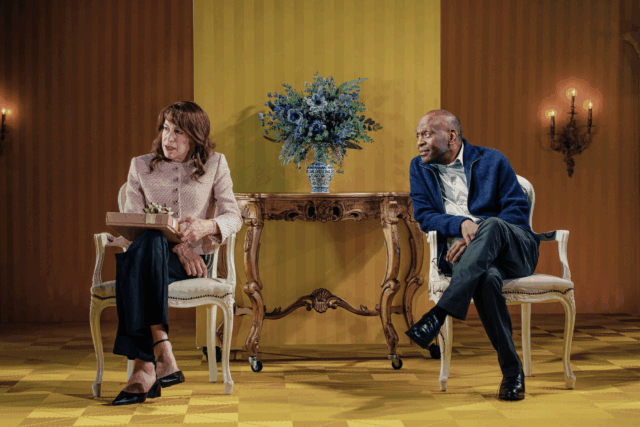
Kate (Rachel Crowl) and William (K. Todd Freeman) face some trouble at home in Jordan Tannahill play (photo by Marc J. Franklin)
The play soon proceeds into what McCrea calls “an act of queer prognostication”: Tannahill builds a gay fantasia in which Prince George (McCrea), now eighteen, is indeed gay, ready to introduce his boyfriend, Dev Chatterjee (Kumar), to his parents (Freeman and Crowl) at their country estate at Anmer Hall. William and Kate bring in communications director Jaqueline Davies (Greenspan) to train George and Dev — who has been outspoken about what he thinks of the British imperial past — on how to deal with the public furor that will come with the revelation of their relationship. George is close with his sister, Charlotte (Stewart), and also gets personal advice from the gay palace butler, Andrew Farmer (Greenspan), who has a unique bond with him, always ready to cover up for George when drugs, alcohol, and strange men enter the mix.
As the story travels from 2032 to 2044, including the possibility of a gay royal wedding, George continually has trouble navigating a challenging life that requires him to balance what he wants with what the monarchy demands, tropes and themes familiar to any avid romance reader.
Several times, Prince Faggot breaks the fourth wall as performers deliver first-person monologues in what appear to be actual private confessions about their lives or the play itself but are actually fictional tales. Crowl, who is trans, discusses how a specific scene in the play made her angry, giving her an “overwhelming feeling of having been denied the experience of being a trans girl.” McCrea recalls being insulted by a teacher for his effeminacy while rehearsing Henry V in college. Legendary downtown performance artist Greenspan delves into gay history — primarily, fisting during the AIDS crisis.
While each of these sidebars is poignant and moving, the interventions disrupt the play in awkward fashion. Tannahill (Botticelli in the Fire, Is My Microphone On?) is squeezing in too much, generating confusion while exploring and celebrating queer characters and performers. It’s difficult to relate to George; Tannahill might be attempting to make George’s issues with his sexuality representative of many people’s experiences, but not everyone’s parents and grandparents are kings and queens and princes and princesses. However, the play does an excellent job of examining childhood queerness and young adult rebellion — a gay royal bildungsroman.
David Zinn’s set consists of two dressing rooms in the back, a central platform stage, and chairs in the wings where the actors sometimes sit and watch when they are not part of the action; a diagonal curtain is pulled across for set changes. Montana Levi Blanco’s costumes go from contemporary casual and regal finery to comic and, well, nothing during one extremely graphic sex scene. (UnkleDave’s Fight-House is the intimacy coordinator, and they have their hands full.) Obie-winning director Shayok Misha Chowdhury (Public Obscenities, Rheology) can’t quite merge the various elements, which also feature an interminable exchange in the rain and more than a glimpse of some BDSM. (Audience members are required to put their phones in a Yondr pouch so they can’t sneak any photos.)
The ensemble is led by standout performances from two-time Tony nominee Freeman (Downstate, Airline Highway), who imbues William with a gentle understanding, six-time Obie winner Greenspan (The Patsy, I’m Assuming You Know David Greenspan), who is touching as Farmer and hilarious as Davies, and, in his off-Broadway debut, Kumar, who portrays Dev with a deep sense of honesty.
“I was very, very femme growing up, and I often felt intimidated and ostracized,” the Pakistani-born, Brooklyn-based Toor also told the New Yorker. Tannahill probes these feelings in a fresh and unexpected setting in Prince Faggot, with some clever twists, but his romantic fantasy, built around the classic tropes of a shocking love between prince and commoner and the conflict between desire and duty, all too often can’t quite bear the weight of what he seeks to achieve.
[Mark Rifkin is a Brooklyn-born, Manhattan-based writer and editor; you can follow him on Substack here.]