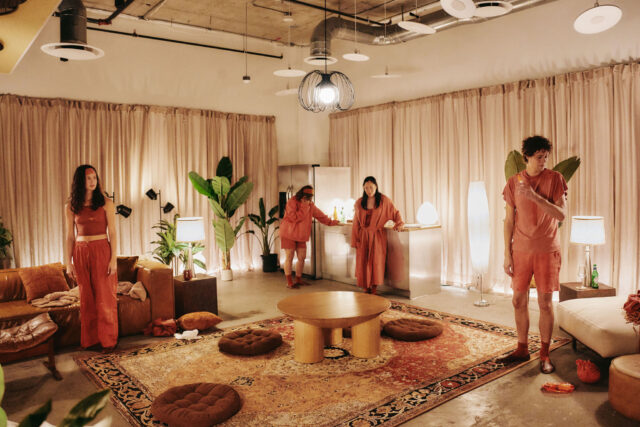
Two couples get more than they bargained for in Kate Vozella’s Machine Learning (photo by Valerie Terranova)
MACHINE LEARNING
Manhattan Neighborhood Network
509 West Thirty-Eighth St. between Tenth & Eleventh Aves.
Through October 30, $52.99-$104.99
littleenginetheater.com
mnn.org
Australian playwright Kate Vozella’s Machine Learning is one of the most pleasant surprises of the fall season.
Presented by Little Engine Theater, a nonprofit founded in 2024 “dedicated to producing bold international plays in unconventional spaces,” Machine Learning is just that: a bold international play in an unconventional space.
The dark comedy is running through October 30 at Manhattan Neighborhood Network on far West Thirty-Eighth St., home to public access television and podcast studios. Set designer Tyler Herald has transformed MNN’s event space into a pristine, glowing living room/kitchen in a research facility, evoking reality-TV locations with chic furniture, a sleek, silvery refrigerator and sink, locked windowshidden by long curtains, a Persian rug, and numerous Akari lamps. Fluorescent tube lights on the floor separate the audience from the actors, except where there is an imaginary door.
The concept is classic futuristic sci-fi: Two couples have agreed to participate in a project in which they will live in this surveilled environment for three months, observed by humanoids behind unseen two-way mirrors. The four people are supposed to be as normal as possible in order to teach the humanoids about love and sex, food and drink, relationships, and everyday interaction.
Complications arise almost immediately when it turns out that Willa (Michele Selene Ang) and Lucia (Emma Ramos), who are married, will be sharing the space with Charlie (Douglas Smith) and Georgia (Delaney Rowe), who are not. Willa, an unemployed teacher, and Lucia, a writer putting the finishing touches on her latest novel, are unhappy about it, while Charlie, a sculptor working as an assistant to a famous artist, and Georgia, a psychologist, are more accepting of the idea.
It soon becomes clear that Will and Lucia are dealing with serious relationship issues, which makes living with another couple in tight proximity less than ideal. Charlie is a somewhat free-wheeling dude who goes with the flow, so he’s open to just about anything, while Georgia seizes the opportunity to use her mean-spirited (lack of) social skills to get under everyone’s skin, which she does with a fierce directness and scary glee.
Hovering over it all is a disembodied AI voice that apparently sees and hears everything, attempting to satisfy their basic needs — so much so that Charlie believes the AI might be flirting with him, which Georgia rejects outright, leading to this key exchange:
Charlie: Look, I just think that this stuff matters. When it’s good, when it’s real, when it’s human, art connects people, it makes them feel. You’ve gotta understand that?
Georgia: What do they feel?
Charlie: I don’t know, like we’re not alone in the world or like the world isn’t such a horrible, fucked up place.
Georgia: We are alone, though, Charlie, and the world is a fucked up place.
Charlie: So let’s just kill ourselves now then, shall we?
Georgia: You first.
Charlie: What’s wrong with you?
Georgia: Me? What’s wrong with you? Why are you still here?
Charlie: What? Because . . . wait, what do you mean? Why are you? I’m not leaving / because I —
Georgia: I’m not leaving!
Charlie: Do you mean the Program, or this relationship?
Georgia: The Program. Obviously.
Charlie: It seemed like you were talking about this relationship.
Georgia: Well, I wasn’t.
As time goes on, alliances shift, secrets bubble to the surface, and all hell breaks loose, putting on quite a show for the humanoid companions, as well as the humans in the audience.
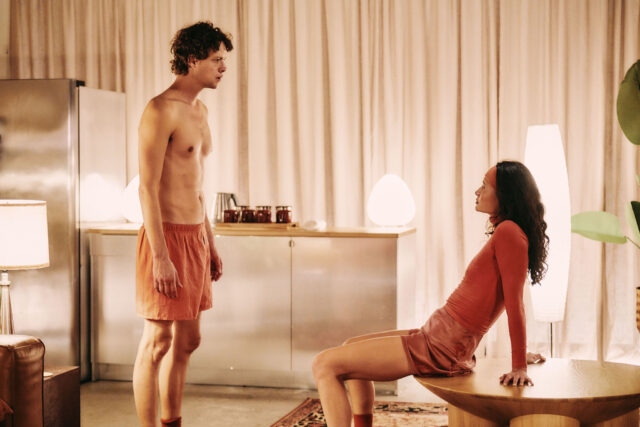
Charlie (Douglas Smith) and Georgia (Delaney Rowe) have very different views of humanity in compelling play (photo by Valerie Terranova)
It’s not like we haven’t been warned. From Isaac Asimov and Rod Serling to Karel Čapek and Ray Bradbury, we have been cautioned in books, films, plays, and television series that artificial intelligence and robots are destined to destroy humanity, in one way or another. Vozella prepares us as we enter the theater; one of the songs welcoming us to our seats is Cerrone’s 1977 disco-funk hit “Supernature,” in which the French composer and producer advises (in lyrics written by Lene Lovich), “Better watch out! / There’s no way to stop it / Now you can’t escape / It’s too late! / Look what you’ve done / There’s no place that you can run / The monsters made / We must pay!”
The cast, in Karen Boyer’s next-generation costumes, is superb, led by Rowe in her striking off-Broadway debut; her portrayal of Georgia as a self-obsessed, seductive, no-filter critical evaluator puts the others on constant edge and drives the story. (Some viewers might call the character a sociopath.) Smith (Punk Rock) is appropriately scatterbrained as the gangly Charlie, Ramos (Scenes from a Marriage, Camino Real) is strong as the determined Lucia, and Ang) (What You Are to Me) is touching as the vulnerable Willa. Christopher Wong’s lighting and Liam Bellman-Sharpe’s sound immerse the audience in this odd, awkward world.
Director Colm Summers injects an engaging sense of humor into the tense narrative, soliciting nervous laughter along with some hardy chuckles and knowing grins from the audience, which is essentially a stand-in for the humanoids. The research facility is a metaphor for the theater, a place where people go to be educated and entertained, where thoughts and conceptions are shared that just might help expand our consciousness if we’re fortunate. Humans have always searched for companionship, and, in the modern era, technology is at the center of it all.
Vozella also considers what is original, particularly the creation of art, the birth of children, and the construction and development of robots. In one scene, the voice sends Charlie a note that asks him to define the word original. The two couples argue about its meaning. Willa says, “Could it be . . . the point she’s making is that nothing is really original?” Lucia responds, “Who says nothing is original?” Later, she adds, “We never know what life is going to throw at us; sometimes we have to adapt from original plans —”
If humanoid companions are going to be carbon copies of actual humans, well, we better watch out, but at least we have such original plays as Machine Learning in the meantime, before it all comes tumbling down.
[Mark Rifkin is a Brooklyn-born, Manhattan-based writer; you can follow him on Substack here.]