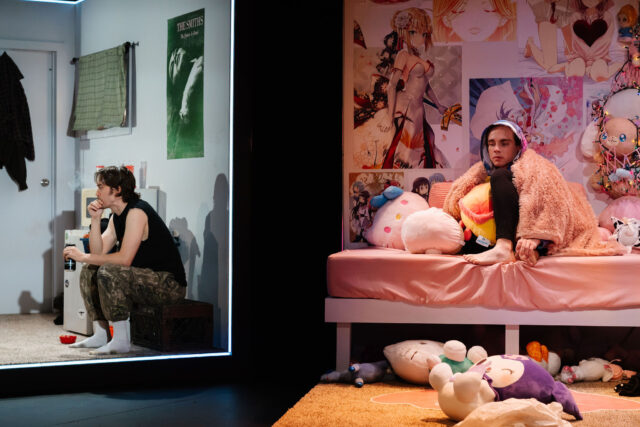
Miller (Zachary W. Desmond) and Target (Christopher Dylan White) are silo’d incels who consider meeting in real life in Degenerates (photo by Jackie Abbott)
DEGENERATES
Playwrights Horizons, Peter Jay Sharp Theater
416 West 42nd St. between Ninth & Tenth Aves.
Tuesday – Sunday through November 1, $125.50-$164.50
playwrightshorizons.org
Playwright Else Went and her partner, director Emma Rosa Went, follow up their groundbreaking five-plus-hour Initiative with the nearly three-hour, three-act Degenerates, another potent investigation into the lives of young people searching for love and meaning in a world growing ever-more dependent on technology. It zeroes in specifically on silo’d incels talking about their dissatisfaction with how women and society in general have turned their back on men.
Sharing their stories are twenty-eight-year-old Miller (Zachary W. Desmond), a white man who lives in his parents’ basement and is the ersatz intellectual ringleader of the virtual group; Kemp (Tyler Nowell Felix), twenty-one and Black, who starts the play by calling a suicide hotline and speaking with a woman while he fiddles with his gun; Serge (Juan Arturo), a brown thirty-three-year-old who is the elder statesman; and Target (Christopher Dylan White), nineteen and white, who is obsessed with Japanese anime. The script describes all four as “terribly alone,” and that at-least-partly self-imposed solitude is palpable.
Serge and Kemp are primarily only heard over the phone; for most of the play, Mikiko Suzuki MacAdams’s vivid set is divided in half: Stage right is Miller’s sad, sparsely decorated room, consisting of a plain desk and chair, a mini refrigerator and microwave, and a poster of the Smiths album The Queen Is Dead, which features such dark and dismal tunes as “I Know It’s Over” and “Never Had No One Ever.” Next to it is Target’s kawaii studio apartment, every inch of which is filled with plushies, posters of female anime characters, and colorful rugs and sheets; even his computer has cool stickers on it.
Issues of race and misogyny, as they try to find someone else to blame for their lack of success in any arena, are raised early in this telling exchange that also establishes the characters:
Miller: It is a well documented fact that if you’re brown in America, you’re fucked. Or unfucked, as the case may be. Do the research: google “tinder racial bias.” I mean, white roasties are still dtf Tyrone cause they got fantasies of the “Violent Negroid” but that’s a whole other thing.
Kemp: Black guys aren’t all violent.
Miller: I’m not saying they are; I’m saying the woke lefty shit wraps all the way around: deep down they want to be punished for being white, y’know? For being “privileged.” They fetishize this oppressed, exotic ~ it’s not even that the dick is dark, it’s that they think dark dick is dangerous. Oh shit say that five times fast. Dangerous dark / dick, dangerous dark dick, dangerous dirk dink ~ fuck!
Serge: Okay no but that is real though. The only females showed me any attention in school — I went to a white school on scholarship and all the Ralph Lauren motherfuckers always tried to hit me up for weed and coke, but the white bitches? The ugg boot barbie-dolls? Wanted to piss off daddy; I could tell that’s what it was: act a fool with the poor brown boy then run home to fuckin, Brayden, / Tanner whatever.
Target: Isn’t that basically like, reparations though?
Serge: Fuck no, that’s being a bitch’s colorway; I’m not letting a bitch wear me like that.
Kemp: I’d let a bitch wear me.
Miller: Genuinely! Genuinely that’s the real thing with race in fucking clown-world leftist America. Oppression is status and status is morality; ergo, fucking the Oppressed makes you a Good Person. It’s all optics it’s all performance. I don’t hate black people; I don’t have a problem with miscegenation but fuck, shouldn’t be a trend. Used to be chihuahua in the Gucci bag, remember that? Now it’s a whole-ass fucking, rapper on the arm, and we see what that does to a man: look what happened to Kanye.
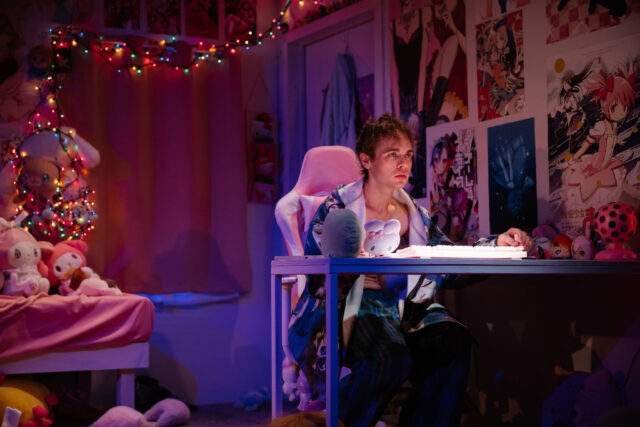
Target (Christopher Dylan White) tries to find his place in a complex world in new play by writer Else Went and director Emma Rosa Went (photo by Jackie Abbott)
While Miller rages against everything, Target, who refers to himself as a mentalcel, has a private gig as a sexy internet cow clown performing for anyone willing to pay. But when Miller, who is attracted to Target’s online persona, suggests they meet in person, the dynamics shift and the plot takes a complex turn.
In the lobby at Playwrights Horizons, where the show has been extended through November 1, is a glossary of more than fifty words and phrases that are unique to this online culture, including “80/20,” “hikikomori,” “LDAR,” “redpill,” and “uwu.” The term “degenerates” itself is defined as “1. a hedonistic person or member of the political left. 2. the offspring of ‘sub-par’ mating, implying a hereditary cause of inceldom.” The Wents are not isolating the characters’ situations, not seeking sympathy for them, celebrating them, depicting them as hateful freaks, or pitying them; instead, they are asking the audience to consider the loneliness these disaffected men and boys are experiencing, since loneliness is something everyone feels at one time or another.
Degenerates is a marvelously unpredictable, moving, and surprising story that gives voice to those in need even as they reject, or are rejected by, so-called societal norms. The first two acts fly by, among the fastest 100+ minutes I can remember in recent theater. It’s as if we all went down the same internet rabbit hole and then were shaken out of it together at intermission, not realizing the time, ready to go back to real life. As in the Wents’ previous work, the story takes a late turn that feels forced, but otherwise the play hits hard and deep.
The Wents employ much of the same team as in Initiative, who again create a potent, involving experience: set by Suzuki MacAdams, costumes by Kindall Houston Almond, sound by Angela Baughman, and projections by S. Katy Tucker, along with actors Barresi and White. Lighting designer Jiyoun Chang fits right in with the electric atmosphere.

Miller (Zachary W. Desmond) spends most of his life online in his parents’ basement (photo by Jackie Abbott)
Desmond (Ivanov, Hooded, or, Being Black for Dummies) is a whirlwind as Miller, often in motion on his wireless microphone, unable to relax; he even burns his mouth when eating a Hot Pocket because he can’t ever just stop. White, who portrayed an unsure loner addicted to video games in Initiative, is gentle and heartbreaking as Target, whose name is, of course, not accidental. Felix (Dungeons & Dragons: The Twenty-Sided Tavern) is touching as Kemp, Arturo (The Taming of the Shrew) adds perspective as Serge and Chad, while Olivia Rose Barresi (Initiative, Unresolved Rage Game) does a good job as all the women in the play as well as reading the stage directions, something that we cannot access IRL.
Perhaps the most important line in the play is expressed by Kemp when he is on the phone with the suicide hotline counselor: “Nobody cares about me.” When it comes down to it, all of us want to be seen, liked, and, more importantly, loved.
As Target tells his sister, “I feel like I don’t really exist. And I never have. Never, and that’s probably why it was so much easier to stay inside and live online, right? Where it doesn’t matter?”
As in Initiative, the Wents make us care, and they show us what matters.
[Mark Rifkin is a Brooklyn-born, Manhattan-based writer; you can follow him on Substack here.]