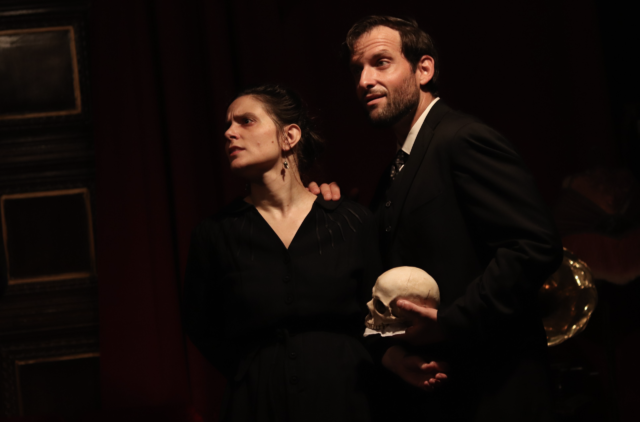
Sara Béraud Conlan (Sara Fellini) and her husband, Kal (Steve Gamble), conjure mystery and mayhem in spit&vigor’s Ectoplasm (photo by Giancarlo Osaben)
ECTOPLASM
spit&vigor tiny baby blackbox theatre
115 MacDougal St.
Thursday – Saturday through October 31, $20-$50
spitnvigor.com
Do you believe in ghosts? That is the question at the heart of Sara Fellini’s spooky Ectoplasm, being remounted by spit&vigor in its upstairs tiny baby blackbox theatre on MacDougal St., above its 2022 venue, the more standard and conventional Players Theatre.
The setup is a classic of the horror genre, evoking such films as Robert Wise’s 1959 The Haunting (based on the Shirley Jackson novel The Haunting of Hill House), William Castle’s 1959 chiller House on Haunted Hill, and John Hough’s 1973 thriller The Legend of Hell House. It’s 1914, and the Byronesque Madame Francine Montfort (Laurel Creighton) has invited into her elegant home the medium Sara Béraud Conlan (Fellini) and her ultraserious husband, Kal Conlan (Steve Gamble); parapsychologist George Crookes (Jesse Metz) and his blood-ritualist wife, Mizka Itō Crookes (Yurika Ohno); Mizka’s suffragist sister, Annette Itō (Azumi Tsutsui); and magician Ira Orinthall (Fedrico Mosttert), who is looking forward to debunking a séance Sara will be conducting (when not trying to fondle the women). Also present is Madame Montfort’s butler, Callum Holes (George Walsh), who has his own secrets.
Sara is prepared to use some of the tricks of the trade in order to convince everyone that her abilities are real, but Kal strongly disagrees. “They always need something tangible, Kal. They never believe it if they can’t touch it,” she explains. She dispenses of a few of them but insists on hiding ectoplasm — a piece of muslin dipped in mayonnaise — under her corset.
Prior to the séance, everyone has drinks and engages in social banter that inevitably turns to science, blood, mysticism, and death as such objects as a dagger and a skull are presented. Both Madame Montfort and the Itō sisters are hoping that Sara will be able to conjure specific souls in the afterlife, even though Sara tells Madame that that’s not necessarily how it works.
This part of the play is a slow build; the story meanders, with some curious decisions and digressions, and the acting is inconsistent in its over-theatricality, but once the characters gather around a table for the actual séance, spit&vigor gets down to what it does best: create creepy, involving productions that depict the darker side of humanity, as in such previous plays as The Wake of Dorcas Kelly, Luna Eclipse, and Nec Spe.
What happens at the séance — well, not even Sara and Kal are quite sure.
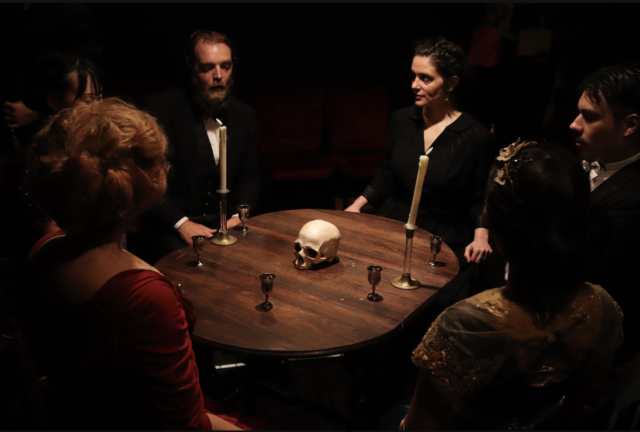
A séance goes better than expected in Ectoplasm (photo by Giancarlo Osaben)
In his article “The Charted Coast V: The Absolute Proof” in the November 1920 issue of The Strand magazine, Sherlock Holmes creator Sir Arthur Conan Doyle, a noted defender of Spiritualism who believed that the living could contact the dead, wrote, “Apart from the frauds, however, discriminating observers were aware that there was a large residuum of cases which were undoubtedly genuine. In examining and reporting these cases, the witnesses averred that certain people, whom they called ‘materializing mediums,’ had the strange physical gift that they could put forth from their bodies a viscous, gelatinous substance which appeared to differ from every known form of matter in that it could solidify and be used for material purposes, and yet could be reabsorbed, leaving absolutely no trace even upon the clothes which it had traversed in leaving the body. This substance was actually touched by some enterprising investigators, who reported that it was elastic and appeared to be sensitive, as though it was really an organic extrusion from the medium’s body. These views were naturally much ridiculed by scientific men, who disposed of them easily upon anatomical and also on general physical grounds. Later investigation has, however, shown, as I hope to demonstrate in this article, that in this as in other matters the early Spiritualists were the pioneers of truth, and that they had come upon the most singular manifestation of matter with which we have any acquaintance.”
Fellini, who makes sure you know that she and her character do not spell her first name with an “h,” uses ectoplasm as a kind of bridge between what people believe and what they don’t, as if it’s the substance that helps bring together audiences and performers in small spaces to engage in these follies of fiction. When Callum welcomes us at the beginning, he refers to the audience — approximately eighteen people in chairs placed against the walls, as if part of the set — as “spirits.” He continues, “Some of you may be surprised that you are dead. I’m so sorry. Please keep your lamentations to a low volume so we can all enjoy the performance.”
Soon Sara walks across the room, her hands outstretched, approaching each audience member as if she can feel their ghostly presence. I was sucked in immediately.
Fellini, the artistic director and cofounder of spit&vigor, is magnetic as the medium; you can’t take your eyes off her in scene after scene. She had me believing she could conjure just about anything she wanted, real or imagined, except that dread final “h.”
[Mark Rifkin is a Brooklyn-born, Manhattan-based writer and editor; you can follow him on Substack here.]