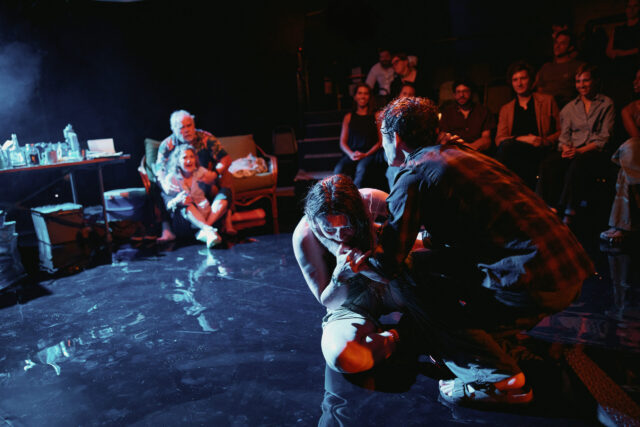
Two couples hunker down for a coming storm in Human Things at the West End Theatre (photo by Emilio Madrid)
HUMAN THINGS
West End Theatre at St. Paul & St. Andrew United Methodist Church
263 West Eighty-Sixth St. between Broadway & West End Ave.
Tuesday – Sunday through October 18, $49-$119
humanthingsplay.com
wetnyc.org
Joshua Owen’s debut play, Human Things, offers the opportunity to see a bravura performance from a two-time Tony winner in a tiny space. Victoria Clark is phenomenal in the bumpy play at Bedlam’s upstairs space at the West End Theatre, which holds a mere seventy-six seats in four rafters on two sides of the staging area, which is essentially the floor. It’s so intimate that you have to walk through the set in order to get to your seat, which is particularly engaging following a major change for the second act.
Margaret (Rebeca Robles) and Greg (Ben Rosenfield) are a married couple living on a remote atoll in the South Pacific; she is an ornithologist studying a bird sanctuary that is experiencing a serious, unaccounted-for decline, while he is an engineer who tinkers with electronics and reads Søren Kierkegaard. Margaret is mad that she slept on the beach the night before and he did not come looking for her, apparently unconcerned that she did not make it home. They bicker for far too long, about that, as well as the future of humankind and the planet.
“I hate feeling like this,” she says. He replies, “Like what?” She responds, “Like I’m a person who is alive and paying attention at the end of the world.”
With nothing better to do, they decide to have sex, but in the midst of their lovemaking, an older man enters their cabin, brusquely calling for help. Bo (Michael Mulheren) explains that he and his wife, Darce (Clark), were sailing when their boat hit a coral reef and she was injured. He demands their help, but Greg is suspicious; he feels the couple may be up to something.
“You think he wants to hurt me? Come on,” Margaret says. “If he were some psycho axe murderer, there are, you know, easier ways than sailing out to the middle of the ocean and crossing your fingers that you find your next victim on some fucking island. Besides, look at him. He’s harmless.”
Bo and Greg bring back Darce, who, with her leg bleeding, is worried that there might be Japanese soldiers around still fighting WWII. When Greg assures her that even if there were, they would be too old, Darce says, “So, what — old people can’t be dangerous?”
Bo and Darce quickly grow extremely comfortable in the cabin while feeling free to treat their saviors with a cynicism and skepticism that annoys Greg. When a severe storm warning is broadcast over the radio, Bo and Greg head to the shed for supplies, leaving Margaret and Darce to contemplate what’s next.
When Darce points out that Margaret only watches the birds but doesn’t do anything to save them from extinction, the ornithologist says, “This is my life and I am an adult woman with agency and with skills and I want to use that agency and those skills to, you know, do something.” The older and wiser Darce answers, “Ahh. The affliction of protagonism. . . . The pathological needs to do things. To change outcomes. To matter. But we don’t really matter all that much. Life is mostly just sitting and watching.”
The storm hits hard, setting the stage for the gripping second act, in which Clark really gets to strut her stuff.
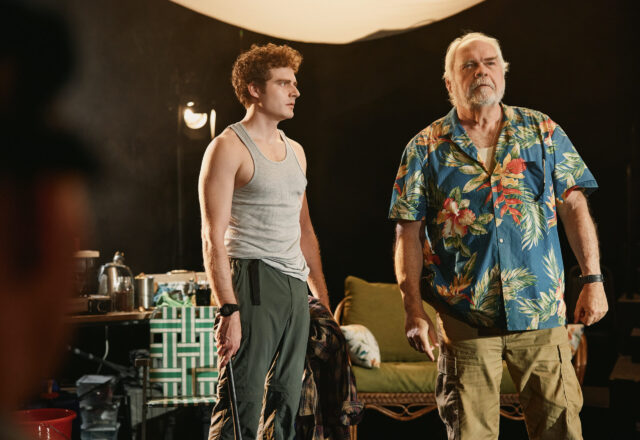
Greg (Ben Rosenfield) is suspicious of Bo (Michael Mulheren) in Joshua Owen’s debut play (photo by Emilio Madrid)
Owen wrote the play while he and his wife, Robles, were sheltering in place during the pandemic, so isolation was on their mind, although Margaret and Greg are not based on their real relationship. The setup is like a reversal of Edward Albee’s Who’s Afraid of Virginia Woolf?, in which a young couple in love visits an older, bickering couple named Martha and George — like Margaret and Greg? It also has elements of Gilligan’s Island, though not nearly as silly — or funny.
The title of the play comes from C. S. Lewis’s 1948 essay “On Living in an Atomic Age,” in which the author of the Narnia series writes, “If we are all going to be destroyed by an atomic bomb, let that bomb when it comes find us doing sensible and human things — praying, working, teaching, reading, listening to music, bathing the children, playing tennis, chatting to our friends over a pint and a game of darts — not huddled together like frightened sheep and thinking about bombs. They may break our bodies (a microbe can do that) but they need not dominate our minds.”
Previously called Gods of Mercy, Human Things considers those options, the atomic bomb being represented by the typhoon, which itself evokes how climate change might kill us all. Neither Darce nor Margaret has kids, so, in a way, they are already looking at the end of the road for them. Darce is in an especially fraught predicament, which causes further disagreement between Margaret and Greg, leading to a crazy finale that furthers the play’s exploration of marriage and motherhood in a way that will confound and confuse many but I found both hilarious and prescient.
Five-time Tony nominee Clark (The Light in the Piazza, Kimberly Akimbo) is a force to be reckoned with, delivering a master class in acting in the second half of the show, one you’ll not soon forget. Tony nominee Mulheren (Bright Star, Kiss Me, Kate) is a fine companion as the bold, bearlike Bo, looking like someone who has just come from a Jimmy Buffett concert. (The costumes are by Amanda Roberge.) Robles, making her off-Broadway debut as a producer and an actor, and Rosenfield (The Nether, Love, Love, Love) are hampered by repetitive dialogue that too often lacks nuance.
Director Rory McGregor makes the most of Jacob Bers’s terrific set, which features two tables, one a mini-kitchenette, the other cluttered with electronics, and some chairs and a couch, while a large white tentlike cloth hovers above the characters and the audience, implicating all of us in the fate of the Earth. Reza Behjat’s lighting, Ian Scot’s sound, and Thomas Jenkeleit’s props create a fantastic low-budget storm that rattles the theater.
Margaret sums it all up when she states, “Everything might be shit but at least I’m here to bear witness.”
What’s more human than that?
[Mark Rifkin is a Brooklyn-born, Manhattan-based writer; you can follow him on Substack here.]