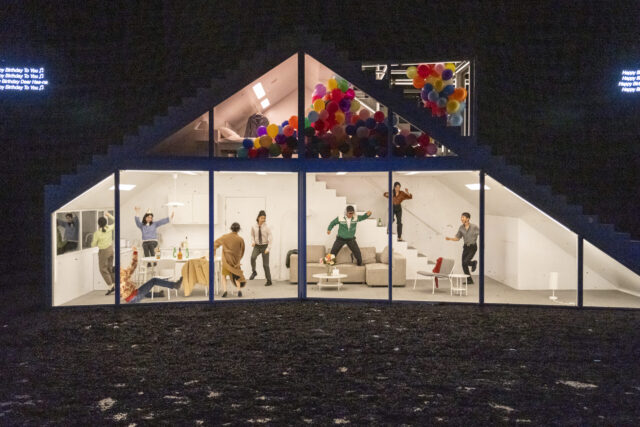
The Song family parties while their company struggles in The Cherry Orchard at Park Ave. Armory (photo by Stephanie Berger)
THE CHERRY ORCHARD
Park Avenue Armory, Wade Thompson Drill Hall
643 Park Ave. at 67th St.
Monday – Saturday through September 26, $95-$295
www.armoryonpark.org
Since 2009, I have seen a handful of major productions of Anton Chekhov’s The Cherry Orchard, in English and Russian, adapted by award-winning directors (Sam Mendes, Simon Godwin, Igor Golyak, Lev Dodin) and playwrights (Stephen Karam, Tom Stoppard), featuring superstars on and off Broadway (Ethan Hawke, Diane Lane, Joel Grey, Mikhail Baryshnikov). But I’ve never truly understood what would be Chekhov’s final play until experiencing Swiss-born Australian Simon Stone’s brilliant reimagination, which is in Korean with often difficult-to-follow supertitles. Running at Park Ave. Armory through September 26, it is a wholly original and utterly dazzling work of art.
Stone, who has thrilled New York with such unique works as Yerma at the Armory in 2018, Medea at BAM in 2020, and Kaija Saariaho’s Innocence at the Metropolitan Opera this past spring, has transported the story to modern-day Seoul, where family matriarch Song Do-young (Jeon Do-yeon) has returned after having spent five years in New York City, a widow recuperating from the tragic loss of her son, Hae-jun, with the help of her younger daughter, Kang Hae-na (Lee Ji-hye), and personal secretary, Lee Joo-dong (Lee Ju-won). Waiting for her back at the compound are her older daughter, the adopted Kang Hyun-sook (Moon Choi); Do-young’s older brother, Song Jae-young (Son Sang-kyu), and cousin, Kim Young-ho (Yoo Byung-hoon); her chauffeur, Shin Ye-bin (Lee Se-jun); and the housemaid, Jung Doo-na (Park Hee-jung). Regular visitors include Byun Dong-lim (Nam Yun-ho), Hae-jun’s tutor, and Hwang Doo-sik (Park Hae-soo), an extremely successful businessman whose alcoholic father had been the family’s chauffeur many years before.
The narrative is an intoxicating mix of K-drama and Succession, as the characters squabble over love and sex, power and money, responsibility and culpability. The family business is a mega-tech conglomerate that has hit hard times, primarily because no one is paying attention, living off a legacy that is in serious danger of collapse. Jae-young spends most of his time with his old record player, trapped in the past, believing everything will end up fine. Young-ho is a broke wastrel who has never worked at a real job and is overly fond of drink. Hae-na is at graduate school at NYU, making experimental films that no one will ever see. And Hyun-sook has never gotten over her inferiority complex at how she was essentially forgotten once her sister was born.
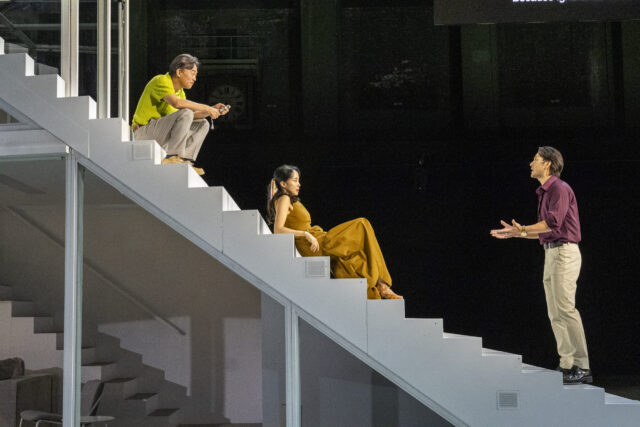
Saul Kim’s set is a marvel in Korean adaptation of Chekhov classic (photo by Stephanie Berger)
Hyun-sook is dating Doo-sik, who keeps warning everyone, especially Do-young, that if they don’t act soon, their company will have to be sold off for for a tiny amount of won, but they refuse to listen to him. Instead, they drink, party, and complain, ignoring their dire circumstances. Meanwhile, Doo-na professes her love for Joo-dong, who prefers to be called Benjamin, after Benjamin Franklin, while stringing along Ye-bin, who loves her; Dong-lim blames himself for not saving Hae-jun and has some issues when Hae-na invites him up to her room; and Do-young is haunted by her actions during her husband’s illness and Hae-jun’s death but develops a fondness for the realist Doo-sik and the idealist Dong-lim, who have a bitter argument over capitalism.
As bankruptcy nears, the family can’t, or won’t, face facts, even as the possibility looms that they will lose everything.
The nearly three-hour play takes place in and around a spectacular glass-fronted two-story sparkling white house designed by architect Saul Kim that is like a character unto itself, beautifully lit by James Farncombe to show off its many assets; it is highlighted by white steps that start on the ground and make their way up one side of the structure, onto the roof, and over the other side, at times hinting at potential danger. In the background, behind and above the set, the armory’s old Tiffany clock, which has no second or minute hands, occasionally glows, reminding us that time is running out on the Songs.
The fabulous cast, dressed in Mel Page’s contemporary costumes, is led by Emmy nominee Park (Squid Game, Hero), who is bold and strong as the conflicted Doo-sik, who does not want the family and corporation to fall apart, and Jeon (The Housemaid, Secret Sunshine), who melds elegance with vulnerability in a part that brought her back to the stage for the first time in twenty-seven years when the play premiered in South Korea in 2024. Jang Young-gyu’s music and sound keep the audience immersed in the proceedings as characters roam in and out of the house, sing, and talk over one another.
The English supertitles can be problematic, as they don’t identify who is speaking, often flash by too quickly, and divert your attention from the wild things that are happening, but you’ll get used to them. A cool transformation occurs during intermission, as snow that looks more like ashes covers the stage, an apt harbinger.
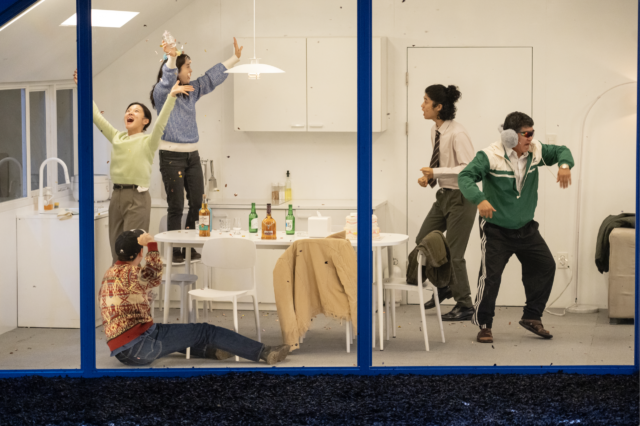
Simon Stone’s reimagination of The Cherry Orchard sheds new light on the oft-performed play (photo by Stephanie Berger)
Chekhov purists should be more than satisfied in how Stone and dramaturg Yi Dan-bi reinterpret and update the tale, remaining true to Chekhov’s intent while making it relevant to today’s society; I’ve never before related to so many of the characters, feeling like I know them.
“This is how Chekhov wrote his plays. While one person is in pain and suffering, another character is feeling joy. This allows the audience to choose whether to follow the journey of the character who is suffering or the joyful journey of the other,” Stone says in an interview in the program. “But if you switch perspectives and watch it again, it will feel like seeing an entirely different performance. People will empathize with different characters depending on their age or personal situation. And when they gather in the lobby afterwards, they will have different opinions on who was right and wrong, and I think that’s where the fun is. I do not want the entire audience to think the same way. I want questions to be raised, and I want the first step towards finding the answers to those questions to start with the audience. However, there are no right answers about who is right and wrong, or who is good and evil.”
That’s about as potent a description of the audience’s relationship to characters as I’ve read, and it’s precisely how I followed Stone’s stirring production.
Stone also helmed a very different, minimalist English-language version of the play in 2013, using Australian idioms; there was a controversy because the play was billed “by Simon Stone after Anton Chekhov.” For this version at the armory, the credits list “Text and Direction” by Stone above “Original Playwrighting” by Chekhov; I, for one, do not have a problem with that.
[Mark Rifkin is a Brooklyn-born, Manhattan-based writer; you can follow him on Substack here.]