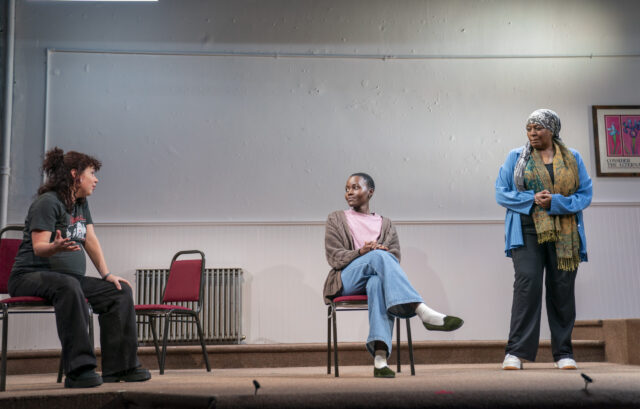
Sarah Steele, Lupita Nyong’o, and Dael Orlandersmith star in Pre-Existing Condition remount (photo by Jessica Kourkounis)
PRE-EXISTING CONDITION
Greenwich House Theater
27 Barrow St. at Seventh Ave. South
Monday – Saturday through January 8, $49-$179
preexistingconditionplay.com
In 2014, the National Women’s Law Center, in response to the passage of Obamacare, announced, “The days of women being treated like pre-existing conditions are numbered. Currently, insurance companies can deny coverage to survivors of domestic violence or mothers who have had a Cesarean section simply by calling these ‘pre-existing conditions.’ But thanks to the new health care law, also known as the Affordable Care Act, this unfair practice is on the way OUT.” That didn’t stop House Republicans in 2017 from trying to price survivors of domestic violence and sexual assault out of the market in its American Health Care Act (AHCA), which was ultimately rejected by the Senate.
Marin Ireland’s debut play, Pre-Existing Condition, being remounted at the Greenwich House Theater after a highly acclaimed 2024 run at the Connelly Theater Upstairs, takes its title from that frightening fact; it is also partly inspired by something that happened to her in 2012. In my review of the previous production, some of which is repurposed below, I called the show “a brutally honest and provocative look at the psychological and bodily wounds that humans inflict and receive.” That still holds true, although the play has lost some of its power and intensity with several tweaks and changes.
It’s been seven months since “A” (Lupita Nyong’o) was brutally struck by her partner. No longer with the man, she speaks with an attorney, a psychiatrist, a few close friends, an old acquaintance, her parents, and others, but no one is able to help, instead only adding to her torment and confusion by subtly blaming her for perhaps provoking the attack and then refusing to take her lover back. She tries to date, but she’s clearly not ready, especially when the men she meets cannot, or will not, understand her situation. (The men and “A”’s mother are played by Greg Keller, while the rest of the women are portrayed by Sarah Steele and Dael Orlandersmith, all three from the original cast.)
“A” finds some respite in group therapy run by two caring women who have developed a support program; during those sessions, the two facilitators talk directly to the audience, as if we are all part of this community, because when it comes down to it, we are; domestic violence can occur at any moment, in any family. Attempting to move forward, “A” continues to question her own responsibility in what happened. It’s harrowing to see the proverbial walls that have been built around her, and that she builds herself, in a system that keeps letting her and other survivors down.
“So what happens now? What do I do?” she says to her best friend, who has grown close with the abuser and expresses sympathy for how hard it has been for him. The shocked “A” shoots back, “Isn’t there supposed to be — there’s supposed to be a system in place, right? I can’t . . . find it. I want to do the right thing and I can’t fucking find it.”
Later, “A” explores another aspect of her feelings that no one seems to get. “I’m so fucking exhausted by all of this. All of this. All of the taking it seriously and the. All of it,” she tells a therapist. “I don’t — okay. I don’t want the big task of my life now to be ‘dealing with this.’ It’s fucking eating up everything.”
When her best friend mentions the possibility of her offering forgiveness, “A” states, “I don’t want to. Forgive. I don’t want to forget it. . . . I don’t also want to be guilty of forgetting it.”
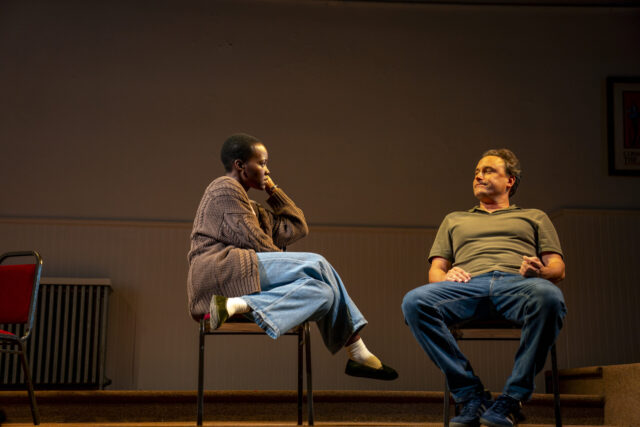
An unnamed survivor of domestic violence (Lupita Nyong’o) speaks with a friend (Greg Keller) in tense play at Greenwich House (photo by Jessica Kourkounis)
In the 2024 production, as the healing process continued, I empathized more and more with “A,” realizing that her pain and trauma could be anyone’s pain and trauma, that any one of us could be sitting in that chair in the middle of the room, being consumed by some type of tragedy. In the current iteration, again directed by Tony nominee and director Maria Dizzia — who, along with Tatiana Maslany (who I saw), Tavi Gevinson, Deirdre O’Connell, and Julia Chan, portrayed “A” two years ago — I identified more with the characters who are trying to do the right thing, who want to help but are not sure how, who keep saying the wrong things.
In the original version, the limited audience sat on three sides of a small, central space, in tightly arranged rising rafters; at Greenwich House, the audience sits in more traditional horizontal rows at the same floor level, looking up at the proscenium stage, making it feel one step removed. At the Connelly, “A” held what appeared to be a spiral-bound copy of the script throughout the play’s seventy-five minutes, sometimes glancing at the words, other times clutching it to her chest like Linus’s blanket in Peanuts. The character essentially never let go of the script, not because the actor had not yet learned the lines but because it was a constant reminder of a horrific, life-altering event in her recent past. That powerful connection is also not present at Greenwich House, where the ending is less dramatic.
Cate McCrea’s set is an empty room with a few movable chairs, an exposed radiator, white walls, and a framed poster offering, “Consider the Alternatives.” Enver Chakartash’s costumes are casual, highlighted by Steele wearing a Blondie T-shirt; Blondie vocalist Debbie Harry wrote in her 2019 memoir about having been viciously sexually assaulted in the 1970s. Lighting designer Isabella Byrd avoids it getting too dark, keeping the audience visible, as if we are all complicit.
Solo specialist Orlandersmith (Spiritus/Virgil’s Dance, Forever) is again wonderfully gentle as various therapists. Keller (Dig, Shhhh) is down-to-earth as several men in “A”’s life, the good and the bad, in addition to her mother. Drama Desk winner Steele (The Humans, I Can Get It for You Wholesale) is charming in multiple roles as she engages with “A” from multiple points of view; Steele is pregnant in real life, with a significantly protruding belly, which references how pregnancy used to be a pre-exisiting condition as well. (She will be replaced by the always terrific Susannah Perkins after October 5.)
Oscar winner and Tony nominee Nyong’o (Ruined, Eclipsed) is mesmerizing as the unnamed woman, maintaining a formidable balance as she tries to go on with her life with this trauma hanging over her head. At one point, she shakes nervously, almost uncontrollably, in a chair; later, she hovers in a corner as if trapped, eyeing people with fear and suspicion. But Nyong’o does not treat “A” like some kind of helpless victim, instead humanizing her with difficult truths about life, love, and the legal system, things that need to be addressed from top to bottom.
The role will later be played by Phillipa Soo, Susannah Flood, Hari Nef, Edie Falco, and Whitney White, who will bring their unique talents to a complex part that also reminds us that domestic violence can happen to anyone, at any time.
[Mark Rifkin is a Brooklyn-born, Manhattan-based writer; you can follow him on Substack here.]