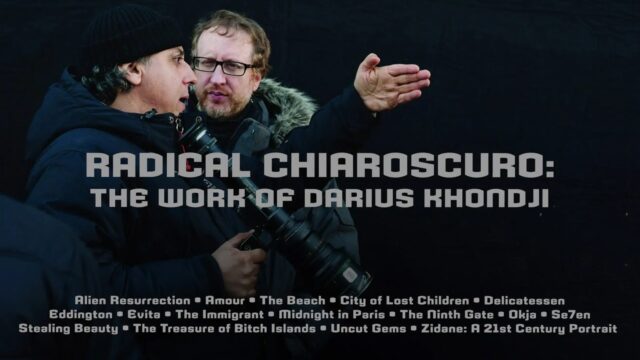
RADICAL CHIAROSCURO: THE WORK OF DARIUS KHONDJI
Metrograph
7 Ludlow St. between Canal & Hester Sts.
Begins September 4
metrograph.com
Eight years ago, Metrograph held a retrospective of the wide-ranging and diverse work of Iranian-born, Paris-raised cinematographer Darius Khondji, and now they’re bringing him back for “Radical Chiaroscuro,” as he continues to make films that capture the imagination of the public and the industry. The series begins September 4 and includes Jean-Pierre Jeunet’s Alien Resurrection (“a very different kind of Alien movie,” Khondji explains in a program note), Danny Boyle’s The Beach (“a very sharp movie, and I always felt the story was like a blade that cuts and causes you to bleed: There’s blood on the sand and sharks in the water, and the people themselves behave like sharks.”), Alan Parker’s Evita (“a very visual movie, and Alan Parker is probably one of the most exciting and visual directors I have ever worked with.”), Bong Joon-ho’s Okja (“represents a departure toward a different type of image, a different texture and look: Something very blue and metallic, with lots of compressed cityscapes and a bit of gold in the flesh tones.”), and F. J. Ossang’s The Treasure of the Bitch Islands (“The shoot was madness, and some of us risked our lives a few times, especially while doing a scene on the edge of this huge volcano. Ossang was really more like a rock star than a film director. . . . I shot the film completely inspired by him and his energy, even if I was sometimes terrified.”).
Also on the bill are David Fincher’s Se7en, Bernardo Bertolucci’s Stealing Beauty, James Gray’s The Immigrant, and the below films. Khondji will be at Metrograph for Q&As following screenings of Douglas Gordon and Philippe Parreno’s Zidane: A 21st Century Portrait on September 19 and Ari Aster’s underappreciated Eddington on September 26 (joined by Aster).
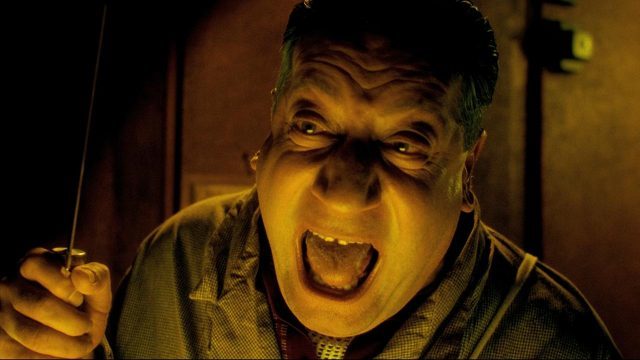
Butcher-landlord Clapet (Jean-Claude Dreyfus) has a unique way of taking care of his tenant-customers in Delicatessen
DELICATESSEN (Marc Caro & Jean-Pierre Jeunet, 1991)
Friday, September 4, 9:35
Monday, September 7, 4:20
metrograph.com
The Metrograph festival kicks off with Marc Caro and Jean-Pierre Jeunet’s epic masterpiece, City of Lost Children, and their delicious debut, Delicatessen. In a bizarre, postapocalyptic future, one apartment complex is surviving via its ground-floor butcher shop, where landlord Clapet (Jean-Claude Dreyfus) carefully wields his giant cleaver, hiring desperate, lonely men to do odd jobs for him before carving them up and selling their flesh and bones to his hungry customers. His latest potential victim is Louison (Dominique Pinon), a mild-mannered clown struggling to get by. But when Clapet’s shy daughter, Julie (Marie-Laure Dougnac), takes a liking to Louison, the butcher has to decide whether someone else should be their next meal. Meanwhile, Aurore Interligator (Silvie Laguna) keeps devising Rube Goldberg-esque ways to kill herself, Marcel Tapioca (Ticky Holgado) tries to prevent Clapet from making mincemeat of his mother-in-law (Edith Kerr), Frog Man (Howard Vernon) has come up with his own curious menu, Clapet gives special treatment to sexpot Mademoiselle Plusse (Karin Viard), and an underground group of Troglodistes are preparing for revolution.
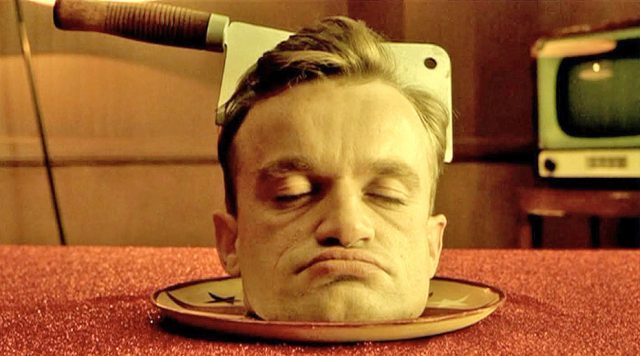
Louison (Dominique Pinon) clowns around in Marc Caro and Jean-Pierre Genet’s brilliant audiovisual feast
Inspired by the work of Terry Gilliam, Delicatessen is a brilliant audiovisual feast, with every sound and image orchestrated for maximum absurdity, courtesy of cinematographer Darius Khondji (Seven, Stealing Beauty), longtime Marguerite Duras composer Carlos d’Alessio (India Song, The Children), and art director Miljen Kreka Klakovic (The Pillars of the Earth, The Order). Caro also did the gorgeous production design and makes a cameo as Fox. Several scenes turn into wildly inventive, hysterical musical numbers with a vaudevillian sensibility. Winner of four César Awards, the film is wickedly funny, taking place in a grim, fantastical, surreal vision of the future that is part Road Warrior, part Brazil, part Monty Python, where even methods of surveillance are downright strange. The cast is appropriately weird, none more so than Caro and Jeunet regular Pinon and his familiar, oddball face. The directors went on to collaborate on the stunning sci-fi gem The City of Lost Children (also screening September 4 and 7) before going their separate ways, Jeunet making such films as Alien: Resurrection, A Very Long Engagement, and Amélie and Caro writing and directing Dante 01.
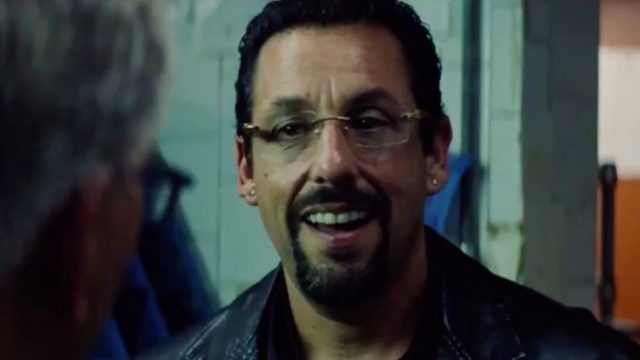
Adam Sandler plays a diamond dealer in danger in Uncut Gems
UNCUT GEMS (Josh Safdie & Benny Safdie, 2018)
Friday, September 11, 10:45
Sunday, September 13, 9:00
metrograph.com
a24films.com
“That was manic, pure mania,” the Safdie brothers narrate at the end of a trailer for Uncut Gems, which itself is a magic gem. The film is a furious, unrelenting movie that sucks you into its claustrophobic frenzy and never lets go. Adam Sandler is a force, reaching new heights as Howard Ratner, a Diamond District dealer with a gambling addiction. He’s deep in debt to Arno (Eric Bogosian), who has sent his two goons, Phil (Keith Williams Richards) and Nico (Tommy Kominik), to make sure Howard knows just how much trouble he is in. His wife, Dinah (Idina Menzel), is fed up with him, not in the least because he has an apartment with his mistress, the much younger Julia (Julia Fox), and is not the most reliable father to their children, Eddie (Jonathan Aranbayev, who was discovered on Forty-Seventh St. in front of his parents’ jewelry store), Beni (Jacob Igielski), and Marcel (Noa Fisher).
Howard has a master plan to break free of all his problems by selling a chunk of Ethiopian black opals at an auction, with the help of one of his assistants, Demany (Lakeith Stanfield), who has lured in Boston Celtics center Kevin Garnett (terrific in his acting debut), who is fascinated by the rare, uncut gems, which sparkle with promise. The last half hour of the film is a brilliant, claustrophobic tour-de-force in which everyone onscreen is physically trapped, just like the audience is pinned to their seats, holding on for dear life. The Safdies, whose father worked in the Diamond District, use a mix of professional and nonprofessional actors as well as famous people playing themselves; the cast includes sports-radio legend Mike Francesa as a bookie, Garment District legend Wayne Diamond as a big-time gambler, Judd Hirsch as Howard’s father, Natasha Lyonne and Tilda Swinton as phone voices, and restaurant owner Nino Selimaj, writer Larry “Ratso” Sloman, actor John Amos, the Weeknd, and others as themselves.
Written by the Safdies (Daddy Longlegs, Heaven Knows What) with longtime collaborator Ronald Bronstein, Uncut Gems, which has been in process for ten years, is anchored by a career-redefining performance by Sandler, who previously revealed his significant acting chops in Paul Thomas Anderson’s 2002 Punch-Drunk Love and Judd Apatow’s 2009 Funny People. In a performance that will make you forgive him for The Waterboy, Big Daddy, Little Nicky, and Mr. Deeds, among other silly effluvia, Sandler is a whirlwind throughout the film’s 135 minutes, which fly by. Darius Khondji’s camera is practically glued to him, Sandler’s unshaven, gruff face a character unto itself, Howard’s eyes always at least one step ahead of what’s happening in front of him. He’s a dreamer, and although you can’t not root for him, he is far from a likable hero. He is singlehandedly responsible for the dangerous mess he’s in, whether he admits it to himself or not. But he is also a kind of everyman, peering through the looking glass (in this case, the seductive, multicolored opals in the stone), trying to survive in a hectic, frenetic world that can be overwhelming and spin out of control at any moment. You can’t just sit back, relax, and enjoy Uncut Gems; instead, you can’t help but be fully immersed in its nonstop, feverish intensity. “It was completely unlike anything I’ve done. I would never have thought I would photograph one day a movie like this. But it ended up being my favorite work, probably,” Khondji says.
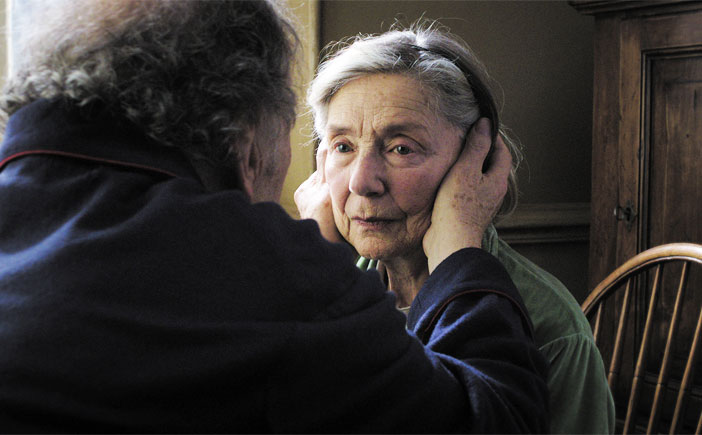
Jean-Louis Trintignant and Emmanuelle Riva play a married couple facing tragedy in Michael Haneke’s brilliant Amour
AMOUR (Michael Haneke, 2012)
Dates to come
metrograph.com
www.sonyclassics.com
Legendary French actor Jean-Louis Trintignant puts an exclamation point on his long, distinguished career with Amour, one of the most beautiful love stories ever told. In his first film in nearly a decade, Trintignant, the star of such classics as Z, My Night at Maud’s, A Man and a Woman, and The Conformist, plays Georges, an octogenarian who is immediately concerned when his wife, Anne (Emmanuelle Riva), suddenly freezes for a few moments, unable to speak, hear, move, or recognize anything. So begins a downward spiral in which Georges takes care of his ailing wife by himself, refusing help from his daughter, Eva (Isabelle Huppert), as he faces the grim situation with grace and dignity. A genuine romance for the ages, Amour is brilliantly written and directed by Michael Haneke, earning the German filmmaker his second Palme d’Or, following 2009’s The White Ribbon. Haneke (Cache, The Piano Teacher) and cinematographer Darius Khondji allow the heartbreaking tale to unfold in long interior shots with very little camera movement, spread across more than two hours.
Despite its length, the film is far from torturous; instead, it is filled with quietly beautiful moments. Trintignant, who was eighty-two when the film was released, is magnificent as Georges, his every physical movement and eye glance rendered with powerful yet gentle emotions, whether he’s preparing food for Anne or trying to catch a bird that has flown into the apartment. It’s an unforgettable performance in an unforgettable film. “I’m actually the one who initially talked to Michael about shooting Amour on digital,” Khondji notes about the film in a Metrograph series note. “I tried to explain to him that for me, Amour was really like a recording, a recording of the lives of these two characters during their final six months together. . . . We could just keep recording with them until the very end.”
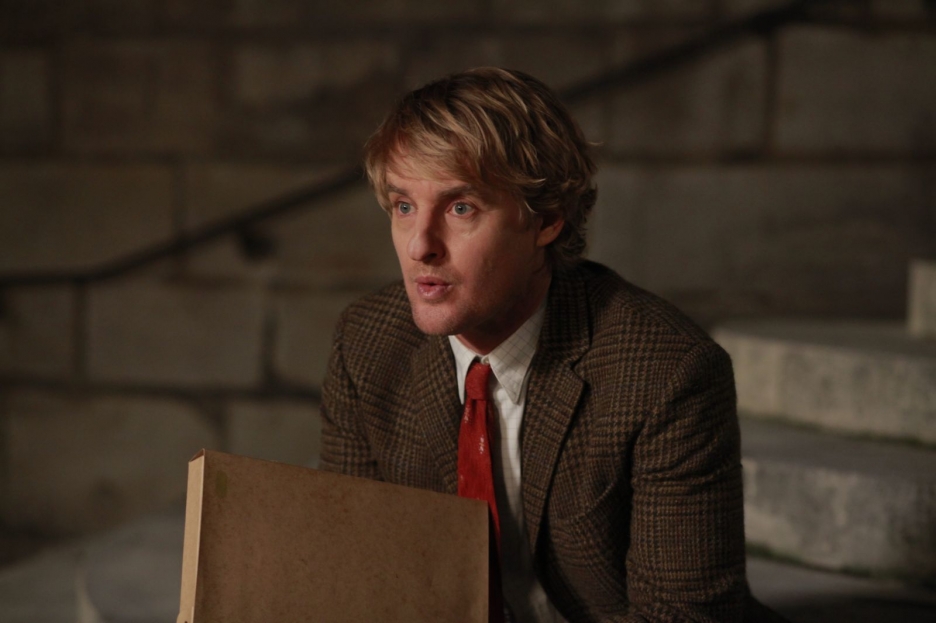
Writer Gil Pender (Owen Wilson) waits to mingle with the Lost Generation in Woody Allen’s Midnight in Paris
MIDNIGHT IN PARIS (Woody Allen, 2011)
Dates to come
metrograph.com
www.sonyclassics.com
In 1979, Woody Allen and master cinematographer Gordon Willis made love to New York City architecture in gorgeous black and white in the stunning opening section of Manhattan set to George Gershwin’s “Rhapsody in Blue.” Allen’s Midnight in Paris begins with Allen and cinematographer Darius Khondji getting intimate with the City of Light in lush color, scanning familiar Parisian landmarks to Cole Porter’s “Let’s Do It, Let’s Fall in Love.” In this beautifully shot love letter to Paris, Owen Wilson stars as Gil Pender, a Hollywood hack screenwriter working on his first novel, about a nostalgia dealer. He and his fiancée, Inez (Rachel McAdams), are vacationing in Paris with her parents, the wealthy, ultraconservative John (Kurt Fuller) and Helen (Mimi Kennedy), who think their daughter can do much better. Gil and Inez bump into their friends Carol (Nina Arianda) and Paul (Michael Sheen), the latter a pedantic know-it-all who begins many an observation with “If I’m not mistaken” and whom Gil can’t stand. Gil is hoping Paris will get his creative juices flowing, and that’s exactly what happens late one evening when he is walking the streets alone at midnight and is invited into an old-fashioned car and taken to what appears to be a throwback party — until he meets F. Scott and Zelda Fitzgerald (Tom Hiddleston and Alison Pill), Cole Porter (Yves Heck), Ernest Hemingway (Corey Stoll), and fashion designer and Picasso muse Adriana (Marion Cotillard). Suddenly he feels more at ease in the swinging ’20s than the 2010s, heading out each night to the same spot, hoping to hang out more with the Fitzgeralds, Hemingway, Gertrude Stein (Kathy Bates), Picasso (Marcial Di Fonzo), and, most importantly, Adriana.
Nostalgia for the past and the promise of the future collide as Gil searches deep inside himself, trying to discover just what it is that he wants and needs out of life. Combining elements of such previous films as The Purple Rose of Cairo, Alice, Everything You Ever Wanted to Know About Sex*, and Everyone Says I Love You with a rather standard Twilight Zone-esque setup and a nod to his mid-’60s Lost Generation joke — in which he hangs out with Hemingway, the Fitzgeralds, Picasso, and Stein talking about art and literature, with a series of punch lines involving Allen getting punched in the mouth — Midnight in Paris is a charming, if at times overwrought and just plain silly, romantic fantasy that evokes Allen’s own fondness for nostalgia and the past. As more and more famous artists keep showing up, it gets more than a tad ridiculous, although it is also kinda fun. Midnight in Paris, which opened the 2011 Cannes Film Festival, follows four Allen films set in London (Match Point, Scoop, Cassandra’s Dream, and You Will Meet a Tall Dark Stranger), one in Barcelona (Vicky Christina Barcelona), and only one in New York (Whatever Works) as Allen continues to travel the world after experiencing a dwindling audience and scandal back home. Wilson is excellent as the nostalgic writer, playing him with an edgy uncomfortablilty that makes him endearing, and Cotillard is sexy and alluring as the quintessential artistic muse. And in an inspired bit of casting, then–French first lady Carla Bruni plays a tour guide who butts heads with the smarmy Paul when discussing Rodin’s The Thinker.
[Mark Rifkin is a Brooklyn-born, Manhattan-based writer; you can follow him on Substack here.]