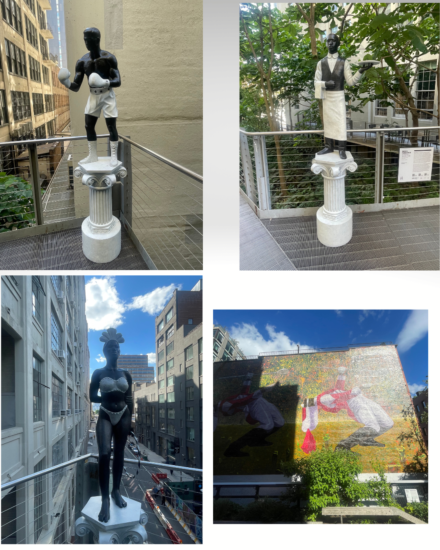
Derek Fordjour will discuss his High Line commissions in an artist talk on August 22 (photos by twi-ny/mdr)
Who: Derek Fordjour, Cecilia Alemani
What: Artist talk
Where: The High Line at Twenty-Second St.
When: Saturday, August 22, free with advance RSVP (walkups as available), 3:00
Why: When I was on the High Line looking at Derek Fordjour’s Archetypes I, II, and III, a trio of painted bronze Black figures on plinths shaped like plantation columns, one of a woman in a burlesque costume performing (Seduction), one of a male waiter in a black vest and white apron (Servility), and a third of a boxer with white gloves, shorts, and lace-up boots (Resilience), I couldn’t help but notice that a series of people were taking pictures of their friends smiling and posing with the works; they clearly did not carefully look at the sculptures or read the accompanying labels. The three sculptures deal with how Black bodies are used in entertainment and service economies, dealing with such issues as power, labor, and control. “Who do these performers serve?” Fordjour asks in an Instagram video.
It made me immediately think of Kara Walker’s 2014 A Subtlety or the Marvelous Sugar Baby: an Homage to the unpaid and overworked Artisans who have refined our Sweet tastes from the cane fields to the Kitchens of the New World on the Occasion of the demolition of the Domino Sugar Refining Plant, sculptures of melting slave children carrying baskets amid an enormous white sphinx, made of foam and refined white sugar, sitting proudly, a highly sexualized mammy figure. At the time, I wrote, “Central to the work are viewers’ reactions. Some are in awe of its beauty and scope, while others pose in front of it for touristy photographs. Some consider the history and mystery that literally surround it, while others smile and pretend to put their arms around one of the slave babies as if they are friends or perform silly acts with the sphinx’s backside and genitalia. Many are so obsessed with taking pictures and video that they never pause, process, and contemplate what they are looking at. Yes, it’s spectacle, but it’s spectacle on a grand order, an unforgettable experience that places a powerful mirror on America’s four-hundred-year history, revealing telling elements that many still refuse to accept.” Walker responded to the public reaction with the Chelsea exhibition Afterword, writing, “Conversation around A Subtlety wound its way across different social media platforms to become an object of contention as well as reverence, and a talking point about historic injustice, artistic hubris, the public gaze, responsible viewership, black audiences vs. white ones, black female representation, aggressive male behavior, self recognition, and ‘selfies.’ . . . It was certainly a curiosity.”
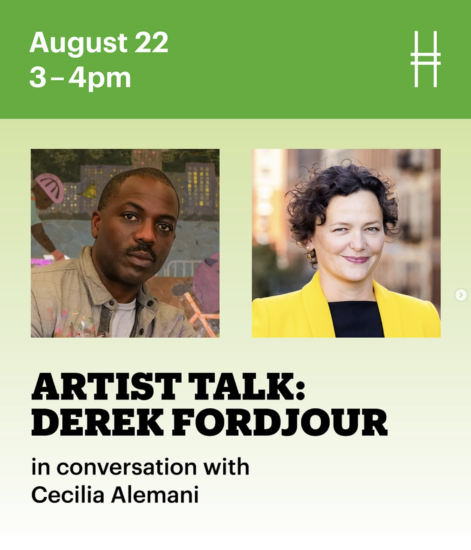
I don’t mean to imply that Fordjour feels the same way about how his installation is being received — it also includes the nearby mural Backbreaker Double, depicting a pair of Black marching band drum majors in the middle of an acrobatic stunt — but most likely he is thrilled that people are engaging with it. You can find out more on August 22 at 3:00 when he sits down with High Line Art director and chief curator Cecilia Alemani for a High Line Wordmark artist talk on the High Line at Twenty-Second St. The advance RSVP line is full but walkups are encouraged.
[Mark Rifkin is a Brooklyn-born, Manhattan-based writer; you can follow him on Substack here.]