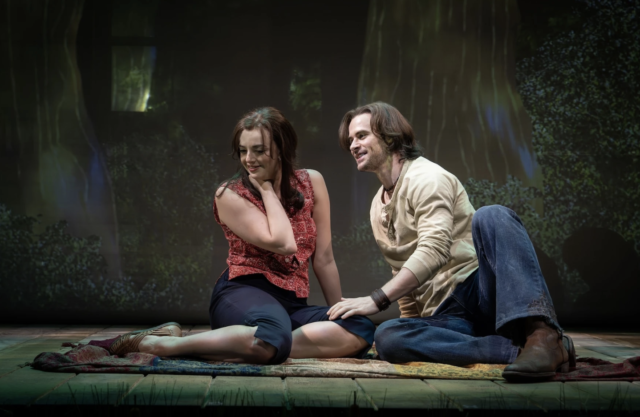
The married Pearl Kantrowitz (Talia Suskauer) considers a summer dalliance or more with blouse man Walker Jerome (Sam Gravitte) in A Walk on the Moon (photo by Joan Marcus)
A WALK ON THE MOON
Laura Pels Theatre
Harold and Miriam Steinberg Center for Theatre
111 West 46th St. between Sixth & Seventh Aves.
Tuesday – Sunday through August 22, $56-$121
awalkonthemoonmusical.com
The summer of 1969 was one of the most provocative, contentious, and exhilarating times in American history. US troops were fighting Communism in Vietnam. The Stonewall Riots took place in Greenwich Village. The Cuyahoga River caught fire. Apollo 11 landed on the moon. The Miracle Mets unexpectedly surged into first place on their way to a world championship. The Manson family murdered actress Sharon Tate and seven others in Los Angeles. Some 400,000 people attended an era-redefining counterculture music festival on a farm in Bethel, New York. The original cast album of Hair topped the charts, while Sly and the Family Stone, Johnny Cash, John Lennon and Yoko Ono, the Doors, Miles Davis, CCR, the Rolling Stones, the Who, and the Isley Brothers released new records. And the ATM made its debut, at a Chemical Bank on Long Island.
That sense of constant excitement is precisely what’s missing from A Walk on the Moon, a pleasant if not thrilling New York premiere continuing at the Laura Pels through August 22.
The 2018 musical is adapted from Tony Goldwyn’s 1999 film, written by Pamela Gray, that starred Diane Lane as Pearl Kantrowitz, a mother of two who is feeling underappreciated by her TV-repairman husband, Marty (Liev Schreiber), and falls for the hot young blouse man, Walker Jerome (Viggo Mortensen), during her family’s annual summer weekend retreats to their bungalow in the Catskills. “Take a deep breath / Fresh air in the mountains / You can’t get this on Flatbush Avenue,” Pearl (Talia Suskauer) sings in the opening number, “Summer of All Summers,” joined by Marty (Max Chernin), their nine-year-old son, Danny (Leo Caravano or Reid Gardner Clarke), Marty’s mother, Lillian (Andréa Burns), and their couples friends, Neil and Rhoda Tanklow (David R. Gordon and Becca Suskauer), Irv and Bunny Gelfand (Andrew Faria and Megan Kane), and Stan and Eleanor Applebaum (Michael Tacconi and Caroline Pernick).
The number is fairly standard, and it doesn’t feel in any way like it’s the summer of 1969, lacking the promise of what’s to come. Perhaps that was on purpose, to display the mundanity of their lives, but it’s not the smartest way to begin a musical. In the second song, “When Did You Know the Moon Was Possible?,” Pearl worries that life is passing her by, addressing astronaut Neil Armstrong, one of the crew members of Apollo 11. “Mr. Armstrong / How did I not know a decade has gone by / And was I even in it / Mr. Armstrong / How did the years run right past / As fast as my teenager is growing / When did you learn / When was that moment of knowing / That there was no limit to how high you could fly?” she wonders. “Mr. Armstrong / In this beginning of a new age / Where am I? / When I never began.”
That all changes when the new blouse man, Walker (Sam Gravitte), arrives, giving Pearl a tie-dye shirt she was eyeing. “My husband would hate it,” she says. Walker replies, “But what’s your opinion, Pearl Kantrowitz?”
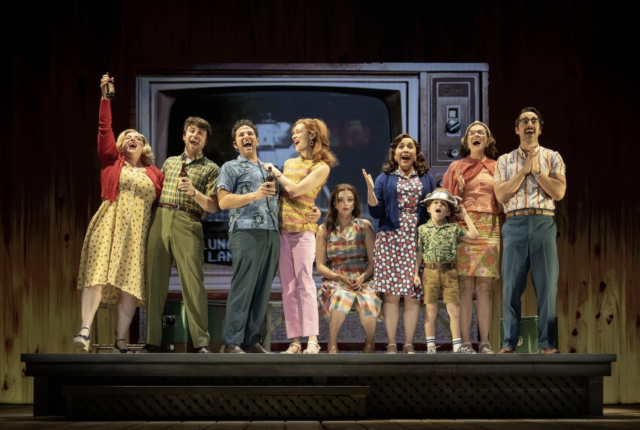
A Catskills bungalow colony is the setting for musical based on 1999 film (photo by Joan Marcus)
Meanwhile, Pearl and Marty’s sixteen-year-old contrarian daughter, Alison (Sophie Pollono), a radical activist, is furious that her father forgot to pack her record player. “I can’t survive without music,” she argues. But she’s soon smitten with seventeen-year-old Ross (Oscar Williams), who goes everywhere with his acoustic guitar and is working on a song in which he declares himself “the Big Jewish Hendrix.” When Ross tells Alison that he is thinking about going to a concert called Woodstock — “It’s supposed be be gigantic, like five hundred people!” — they decide they have to go, especially since her favorite, Joni Mitchell, is scheduled to perform.
With two historic events in the offing, the moon landing and the music festival, Pearl has some difficult decisions to make involving her family and, primarily, herself, whom she has never put first before.
Featuring music and lyrics by Tony and Grammy nominee AnnMarie Milazzo and a book and additional lyrics by Gray, A Walk on the Moon never quite blasts off but is a pleasurable slow glide through the summer of 1969. The orchestrations at the beginning and end are overly traditional; several of the songs in between get closer to capturing the Flower Power feel of the era. The music director is Jillian Zack, with arrangements by Andy Einhorn. Ricky Lurie’s costumes fit the period and Josh Prince’s choreography never gets out of hand, maintaining a playful edge. Tal Yarden’s scenic design tends to be too cardboardy, but his projections, particularly of a giant moon and television, help set the mood.
Talia Suskauer (Be More Chill, Wicked) portrays Pearl with an enticing depth, keeping her from becoming a deceitful villain; instead, she garners understanding from the audience, even those who aren’t rooting for her to schtup the blouse man. Gray and Tony-nominated director Sheryl Kaller (Next Fall, The White Chip) cast no judgments on Pearl or any of the other characters. Among the ensemble, Becca Suskauer, Talia’s sister, stands out, but I may be partial because she is playing a character named after two of my relatives; my last name makes it into the show as well in a brief mention. (My second cousin is a close friend of Gray’s, so it’s not a coincidence.)
I sat next to a pair of alta kockers from the Bronx who had been to the Borsch Belt bungalows, and we agreed that the show was not Jewish enough; I was hoping for something closer to the “We’re Going to the Catskills!” second-season episode of The Marvelous Mrs. Maisel, which takes place at the fictional Steiner Mountain Resort. But maybe that’s just me.
However, I do think that the show missed an opportunity that it is well aware of. In “We’re Girls with Somethin’ to Do,” Rhoda sings, “‘Enjoy the unconventional’ / Well, Betty dear, my hands are full,” quoting from Betty Friedan’s 1963 book The Feminine Mystique.
If only A Walk on the Moon were more unconventional, like the time period it covers.
[Mark Rifkin is a Brooklyn-born, Manhattan-based writer; you can follow him on Substack here.]