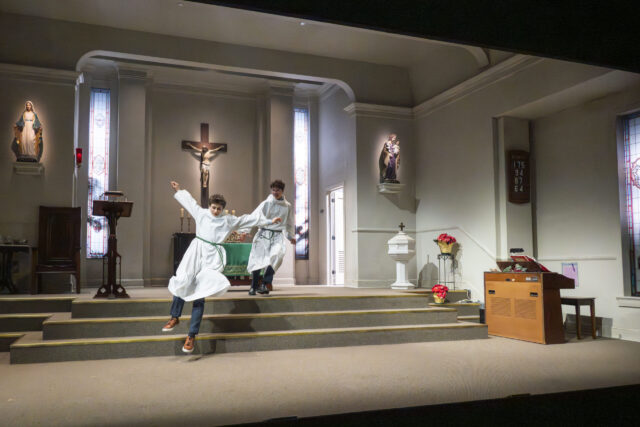
Paul (Julius Rinzel) and Michael (Ivan Howe) experience challenges as confirmation approaches in The Saviors (photo by Ahron R. Foster)
THE SAVIORS
Atlantic Theater Company, Linda Gross Theater
336 West 20th St. between Eighth & Ninth Aves.
Tuesday – Sunday through August 15, $56.50-$111.50
866-811-4111
atlantictheater.org
“I didn’t know you could do that — that you could argue the content of a play in the form of it,” theater director Jack Serio told American Theatre magazine in June 2023 about his reaction to seeing Ivo van Hove’s 2014 Scenes from a Marriage at New York Theatre Workshop, an immersive rendering of the 1973 Ingmar Bergman miniseries.
Over the last five years, Serio has argued the content of a play in the form of it across more than half a dozen unique productions, leading up to his latest success, The Saviors, extended through August 15 at the Atlantic.
Unlike theater, film is a director’s discipline. A movie is almost never identified as belonging to the writer, or even the star, but to the director: Christopher Nolan’s The Odyssey, Paul Thomas Anderson’s One Battle After Another, Wes Anderson’s The Royal Tenenbaums. In those cases, the directors are also the writers.
Quick: Who wrote the screenplay for Alfred Hitchcock’s Psycho, Martin Scorsese’s Goodfellas, Clint Eastwood’s Unforgiven, Steven Spielberg’s Saving Private Ryan, or Ridley Scott’s Alien? Not the directors. Spike Lee hasn’t penned a solo screenplay in more than twenty-five years, Stanley Kubrick and Akira Kurosawa had cowriters on most of their projects, and David Fincher has never been credited as a screenwriter. That does not take away from their filmmaking prowess but merely points out that it is the director who is the guiding force.
The same cannot be said for the stage, where the author is king. A play or musical is almost never never identified as belonging to the director, or even the star, but to the writer: Arthur Miller’s Death of a Salesman, Eugene O’Neill’s Long Day’s Journey into Night, Tennessee Williams’s A Streetcar Named Desire.
Quick: Who directed such Tony winners as Michael R. Jackson’s A Strange Loop, David Ajmi’s Stereophonic, Lin-Manuel Miranda’s Hamilton, or Bess Wohl’s Liberation?
Of course, one of the unique allures of theater is how a director can take an existing play or musical and reshape it, make it their own, whether it’s by William Shakespeare, Anton Chekhov, Tom Stoppard, Noël Coward, or Rodgers & Hammerstein; screenplays are written with very specific action cues, while most plays, aside from those by Samuel Beckett and maybe a handful of others, include few if any stage directions. Awards are given out for best revivals of a play or musical but not for best movie remake.
And then comes Serio.
The NYU Tisch graduate is a master of intimacy and space. For Ken Urban’s Danger and Opportunity at East Village Basement, a limited audience was seated against the walls of a living room. Uncle Vanya took place in a private Flatiron loft for forty people at a time. For Joey Merlo’s On Set with Theda Bara at the Brick, thirty audience members sat around a long, rectangular wooden table surrounded by lamps and mirrors. For Ruby Thomas’s The Animal Kingdom at the Connelly Theater Upstairs, the small audience was packed in so tight it was hard to breathe.
Even with more traditional setups, Serio — and, of course, the scenic designers — creates visceral experiences that feel private and personal, from Rita Kalnejais’s This Beautiful Future at the Cherry Lane, with its curved walls and additional area at the back of the stage, to Samuel D. Hunter’s Grangeville at the Signature, where the two actors felt like they were miles apart when on opposite sides of the spare, dark set.
Last year, Serio teamed with actor Bubba Weiler for Weiler’s stunning debut as a playwright, Well, I’ll Let You Go, a tale of grief and community for ninety-nine people at a time, originally produced at the vast six-thousand-square-foot Space at Irondale, a former church Sunday school.
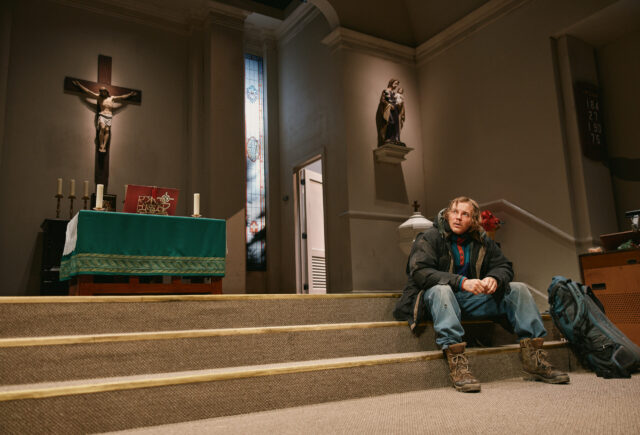
Julian (Stanley Simons), a troubled soul, seeks sanctuary in The Saviors (photo by Emilio Madrid)
Weiler and Serio are now back together for the world premiere of The Saviors at the Linda Gross Theater, housed in a nineteenth-century Gothic Revival building that was formerly the parish house of St. Peter’s Episcopal Church. Three-time Tony winner David Zinn has transformed the theater into a church, with a spare but pristine altar, stained-glass windows, iconographic statuary, an organ, and a hymn board.
Two altar boys in white cassocks run onto the stage, racing to extinguish the candles. Paul (Julius Rinzel), fourteen, and Michael (Ivan Howe), thirteen, are best friends. The names are meant to be biblical: The archangel Michael was a guardian and fierce defender of God, while the apostle Paul was a missionary who wrote between seven and fourteen books of the Bible.
They are preparing for their confirmation project in which they select a saint to honor; Michael is considering Saint George while also suggesting that Paul be Saint Michael and Michael be Saint Paul, but, as we are soon to find out, the two boys are not interchangeable. Michael fantasizes about being a martyr, telling Paul, “Martyrs go straight to heaven and like . . . that’s the whole point. And then maybe I’d even become a saint, which would be like, whoa. And then like fifty years from now some kid would pick me for their confirmation and that would just be. . . . I think about that all the time.” Paul does not.
Their conversation is suddenly interrupted by a loud noise; a ragged man with a backpack has entered the church, coming down the right side of the theater aisle, shocking the audience as well as the boys. About ten years older than Michael and Paul, Julian (Stanley Simons) is clearly distraught and in need of support, especially with a snowstorm about to strike at any minute. (He could be named for the apostate Julian, the fourth-century Roman emperor who rejected Christianity and fought a civil war against his cousin Emperor Constantius II.)
“I just want to pray,” he says. Michael wants him to leave immediately, mentioning that there are nearby Protestant and Presbyterian churches he can try, but Paul offers him shelter, and Julian gratefully accepts, upsetting Michael.
Meanwhile, Michael has chosen “church MVP” Judy (Crystal Finn) as his confirmation sponsor, telling her, “I want someone that could like actually really help me because like — Like I want to take it serious and I was just thinking that your son is like Jesus — and if he’s Jesus then that makes you Mary and Mary is like my favorite person of all time besides Jesus, and so like — who better to sponsor me than Mary?” In the Deuterocanon, Judith is the Jewish widow who saves Jerusalem.
As confirmation approaches, the characters reassess their connections to God, Christianity, and one another.
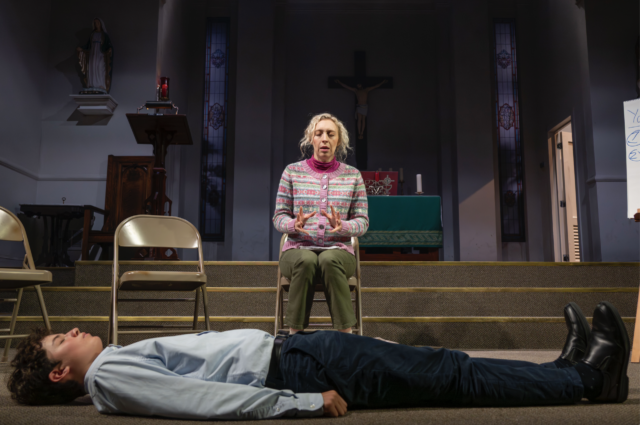
Judy (Crystal Finn) leads Michael (Ivan Howe) through a Christian meditation in world premiere at the Atlantic (photo by Ahron R. Foster)
Theater has long been compared to church. “The theater is a communal event, like church. The playwright constructs a mass to be performed for a lot of people. She writes a prayer, which is really just the longings of one heart,” Pulitzer Prize–wining playwright Marsha Norman said. “The theatre is your pulpit, it is your church, and you want to be a priest in your church and that’s what I believe in,” actor, playwright, and director Steven Berkoff explained to the Telegraph in 2015. Actor Brian Cox told Variety in 2023 that he believes “theater is the one true church, because it’s the church of the human experience. Everything else is about belief systems that we bring in. . . . But the theater is about our relationship directly with something which is so personal, and so immediate, and it’s the effect that it has on the people watching.”
Weiler is a former altar boy who attended Catholic school and now considers himself an agnostic; he and Serio, who also went to Catholic school, met at NYU’s Playwrights Horizons Theater School, where Weiler was Serio’s TA in his freshman playwriting class. Together they have turned the Linda Gross Theater into a holy space that immerses the audience into its aura. Nearly every scene begins with either Michael or Paul changing the numbers on the board, as if what is to come has been crafted from hymns. The seats feel like pews when the characters move through the aisles. Serio makes expert use of every corner of the stage, while Weiler’s angelic dialogue echoes like the Word made flesh. There is a breathtaking twist that helps elevate the ninety-minute play to the next level, although there are a few conventional, dare I say preachy, plot developments that fail to resonate.
The script calls for the roles of Michael and Paul to be portrayed by “age-authentic actors,” and Howe (Eric, Oliver!) and Rinzel (The Antiquities, A Beautiful Voice), respectively, are indeed young teens who capture the nascent spiritual awakening of adolescent boys learning how to make decisions for themselves and whether they can trust adults and religion, from the sheer joy of horsing around to the more serious aspects of responsibility. Finn (Cold War Choir Practice, Birthday Candles) is effective as the church lady hiding a secret, and Simons (The Iron Claw, Mile End Kicks), whose Playbill bio says he has “crippling stage fright,” makes an impressive theater debut as Julian, that fear perhaps assisting him in displaying his character’s deeply felt unease.
Half a millennia ago, French theologian and pastor John Calvin wrote, “The whole world is a theatre for the display of the divine goodness, wisdom, justice, and power, but the Church is the orchestra, as it were — the most conspicuous part of it.”
Wherever Serio sets up his pulpit next, the faithful, including me, are sure to follow him and his orchestra.
[Mark Rifkin is a Brooklyn-born, Manhattan-based writer; you can follow him on Substack here.]