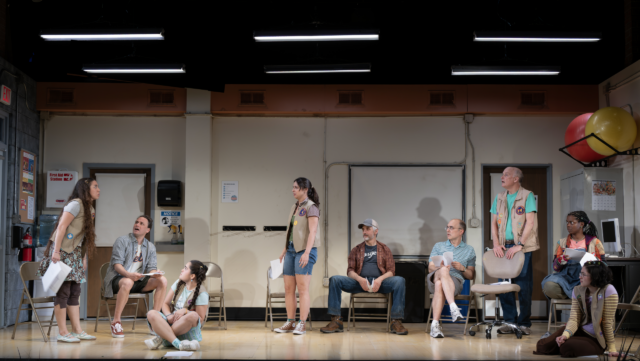
Eliana Theologides Rodriguez’s Indian Princesses takes place at a camp where white fathers try to bond with their children of color (photo by Ahron R. Foster)
INDIAN PRINCESSES
Atlantic Theater Company, Linda Gross Theater
336 West 20th St. between Eighth & Ninth Aves.
Tuesday – Sunday through June 7, $25-$131.50
atlantictheater.org
In November 2018, I was fully delighted by Larissa FastHorse’s The Thanksgiving Play, a wild and woolly farce that took on important indigenous issues — in real life and on the stage — as a school attempts to put on a politically correct show about pilgrims and Native Americans. Nearly five years later, the play, in a different production, premiered on Broadway, where it lost all its charm and inventiveness, instead feeling like so many dried-out leftovers.
Eliana Theologides Rodriguez’s Indian Princesses falls somewhere in between, with wholly original and exciting scenes tempered by awkward turns that throw too many ingredients into the stuffing.
The title comes from a YMCA camp program, begun in 1926 as Y-Indian Guides, renamed Indian Princesses in the mid-twentieth century, and rebranded Adventure Guides in the early 2000s, tailored to create bonds between white fathers and their Native American children. Rodriguez, who is of Yaqui and Tewa heritage on her mother’s side and identifies as Mexican, went to the camp with her father in 2008 when she was ten, during the financial crisis, after he had to take a job out of state. “I was experiencing a coming-of-age moment that I didn’t have the words to explain and my dad didn’t have the tools to understand,” Rodriguez says in a playwright note. “Even the program’s title is a pernicious fiction: The so-called ‘Indian Princess’ is an archetype invented to justify the ongoing brutalities of colonization, acting as a foil to her people and an ally to her colonizers.”
In the play, a new “tribe” has been formed, consisting of three white fathers, one white grandfather, and five girls of color, from nine to twelve years old. The “chief” is Glen (Frank Wood), an evangelical Christian attending with his granddaughter, Samantha (Haley Wong), who is half-Japanese and worries about committing sins. The recently widowed Mac (Pete Simpson) is a conservative construction worker who has brought his half-Mexican daughter, Andi (Rebecca Jimenez), who is keeping the death of her mother from the other girls. The recently unemployed Wayne (Ben Beckley) has let his own issues get in the way of his relationship with his adopted daughter, Maisey (Lark White), who was born in Africa and may have supernatural powers passed down from her ancestors. And the kind, PC Chris (Greg Keller) is there with his step-daughters, Lily (Anissa Marie Griego), who is determined to play Penny Pingleton in Hairspray despite being half-Yaqui and half-Tewa, and Hazel (Serenity Mariana), who feels neglected and inferior.
Glen is the cheerleader as they go through various exercises, including passing around a talking stick, participating in arts and crafts, and taking on their archenemy camp in a talent competition, putting on America the Beautiful the Play.
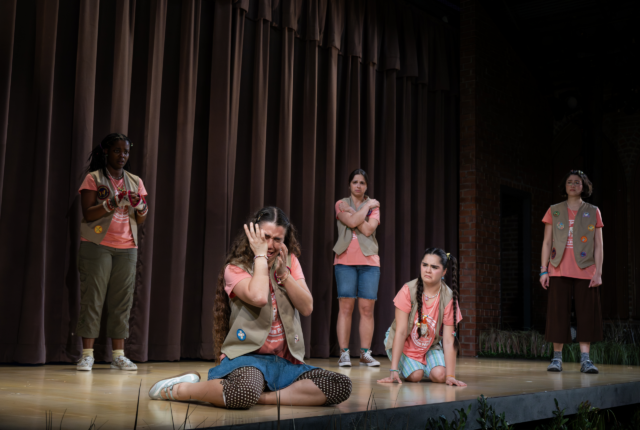
Five adults portray girls between the ages of nine and twelve in Indian Princesses (photo by Ahron R. Foster)
In their off-Broadway debuts, Rodriguez and director Miranda Cornell tread similar ground as such other works as Eureka Day, Grief Camp, The Wolves, and the aforementioned Thanksgiving Play, with mixed success. The general themes of racism, classism, building community through assimilation, the rewriting of history, cultural appropriation, and finding one’s identity are dealt with in intelligent and often potent ways, but there are a lot of bumps in the road, from the staging — it’s too often not clear where the characters are, especially when it comes to the woods the girls like to hang out in — to genre clichés.
The cast is strong, particularly character actors supreme Keller (The Thanksgiving Play, Shhhh), Wood (Sideman, Toros), and Simpson (Infinite Life, Is This A Room), with Wong (The Welkin, Antigone), Jimenez (The Other Americans, Our Dear Dead Drug Lord), and White (Covenant, Grief Camp) standing out among the adults portraying the children.
A coproduction of the Atlantic and Rattlestick, the play is probably about fifteen or twenty minutes too long, with some scenes either dragging or becoming too chaotic, especially in the second half as the conclusion approaches, and several of the characters are not quite fully drawn, with some connecting better than others. But Rodriguez is tackling an important subject while introducing the audience to this surprising camp, which is simply fascinating.
America “stole our heritage from us, then bastardized, stylized, and sold that heritage back to us generations later as a ‘culturally appreciative’ family bonding activity,” Rodriguez continues in her program note, shining a light for all of us to see.
[Mark Rifkin is a Brooklyn-born, Manhattan-based writer; you can follow him on Substack here.]