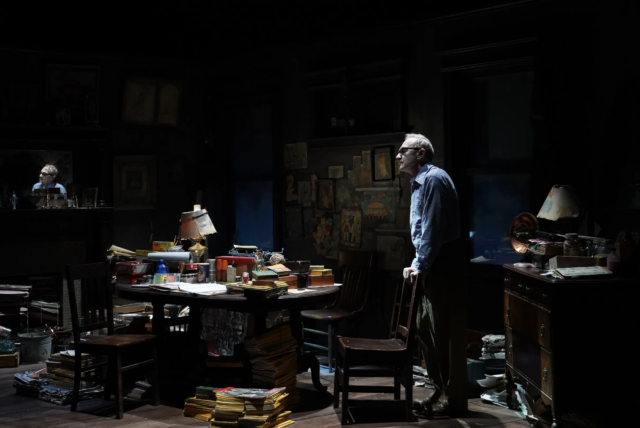
John Kelly stars as Outsider artist Henry Darger in Bughouse (photo by Carol Rosegg)(photo by Carol Rosegg)
BUGHOUSE
Vineyard Theatre
Gertrude and Irving Dimson Theatre
108 East 15th St. between Union Square East & Irving Pl.
Tuesday – Sunday through April 5, $63.72-$118.80
www.vineyardtheatre.org
“Just because there’s questions, that does not mean there are answers,” Kiyoko Lerner, Henry Darger’s last landlady and caretaker of his art, says in Jessica Yu’s 2004 documentary In the Realms of the Unreal: The Mystery of Henry Darger.
The same can be said about Bughouse, an intriguing play about Darger (pronounced with a hard g) conceived and directed by Martha Clarke, written by Beth Henley, and starring solo specialist and downtown legend John Kelly.
An isolated, reclusive, hard-edged man, Darger died in a Chicago nursing home on April 13, 1973, at the age of eighty-one. He never married and had no children. His mother died when he was three after giving birth to a daughter who was put up for adoption. His disabled father, an easygoing tailor, was moved to a poorhouse when Henry was eight; the boy was first sent to an orphanage, then to the Illinois Asylum for Feeble-Minded Children.
He later worked as a hospital janitor and seems to have had only one friend, an immigrant named William Schloeder.
But he left behind a remarkable legacy in his cramped Chicago apartment. Amid piles and piles of newspapers, magazines, books, religious icons, clippings, a crank record player, a radio, a handmade “No Smoking” sign, and art supplies, Kiyoko and her husband, Nathan, discovered large-scale watercolors, a five-thousand-page memoir, a six-volume weather journal, and the fifteen-thousand-page illustrated novel The Story of the Vivian Girls, in What Is known as the Realms of the Unreal, of the Glandeco-Angelinian War Storm, Caused by the Child Slave Rebellion, an epic fantasy set on a different planet, where the Abbieannians, led by the seven Vivian Girls, battle the Glandelinians over their enslavement of children. It was in part inspired by the 1911 abduction of Elsie Paroubek, who Darger transforms into the heroic Annie Aronburg.
Two-time Obie winner Clarke (Angel Reapers, The Garden of Earthly Delights) and Pulitzer winner Henley (Crimes of the Heart, The Miss Firecracker Contest) incorporate those elements and more into Bughouse, which includes Darger sharing his story directly with the audience, typing out his autobiography to prerecorded dialogue, and talking to visions he sees in windows and mirrors. He trudges around his apartment with a slight limp, muttering to himself about history and the weather and relating tales from his past. “Why have you not answered my prayers?” he asks God at the very beginning.
The voices of the Vivian Girls often deliver quotes from Darger’s novel. “I have received warnings that I am in danger of assassination, but as horrible as it is to be murdered in cold blood, I defy my enemies before God to do it,” Annie says. One of the other girls tells him, “All Blengiglomenean Serpents are the greatest lovers of children of all nations, whether good or bad, and children of bad nations have been carried away by these enormous creatures so that their souls would not be ruined by the sinful ways of the government or their parents.”
When Darger talks about his life, black-and-white footage of the Chicago street outside are projected in the back windows. When the girls speak, animated depictions of them, based on Darger’s art, float around the set, their voices emanating from speakers placed throughout the theater. Storms occasionally rattle the space. The lighting is by Christopher Akerlind, with sound by Arthur Solari, projections by John Narun, cinematography by Fred Murphy, and animation by Ruth Lingford. The exquisite set and props are by Neil Patel and Faye Armon-Troncoso, re-creating the controlled chaos of Darger’s strange world.
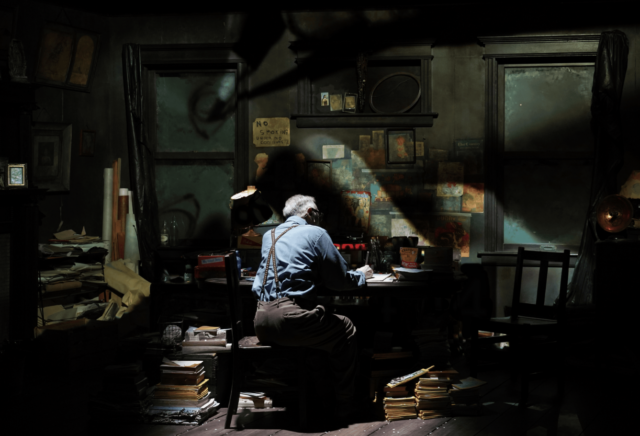
Bughouse re-creates a day in the life of Henry Darger (John Kelly) (photo by Carol Rosegg)
Kelly, a multimedia artist and performer who has portrayed Egon Schiele in Pass the Blutwurst, Bitte, Caravaggio in The Escape Artist, Joni Mitchell in Paved Paradise, Antonin Artaud in Life of Cruelty, and Samuel Steward in Underneath the Skin, embodies Darger with an air of creepy mystery and unsettling angst; Darger is not a man most people would want to spend a lot of time with, and mercifully the play is barely more than an hour.
But as creative as Clarke, Henley, and Kelly are, the play is likely to be difficult for those who don’t know much about Darger. In the lobby are cards that share information about the Vivian Girls and Darger’s life, which are recommended reading for audience members who know little or nothing about either. We never get to see the real images Darger drew, only animated versions, nor his handwriting, which lends insight into his character. The play also forces connections between Darger’s personal experiences and his art, but they are not as direct as Clarke and Henry posit.
I’ve been to several Darger exhibitions and saw the documentary when it came out, and they all left me feeling a combination of disgusted, confused, and blown away by Darger’s sheer talent; unfortunately, the play does not zero in enough on his extraordinary artistic abilities.
The show’s art history consultant, Michael Bonesteel, contributes a biographical program note in which he writes, “Henry Darger is viewed today as probably the greatest Outsider artist in the art brut canon. He was an autodidactic world-builder of the first order and the ultimate poster child for savant syndrome. He will be remembered as an indomitable creative genius who, single-handedly and against all odds, imaginatively transformed his tragic, impoverished life into a mythic wonderland within the confines of his one-and-a-half-room boardinghouse flat.”
You won’t learn much of that from the play itself, but spending an hour in the presence of Kelly is always worthwhile.
[Mark Rifkin is a Brooklyn-born, Manhattan-based writer; you can follow him on Substack here.]