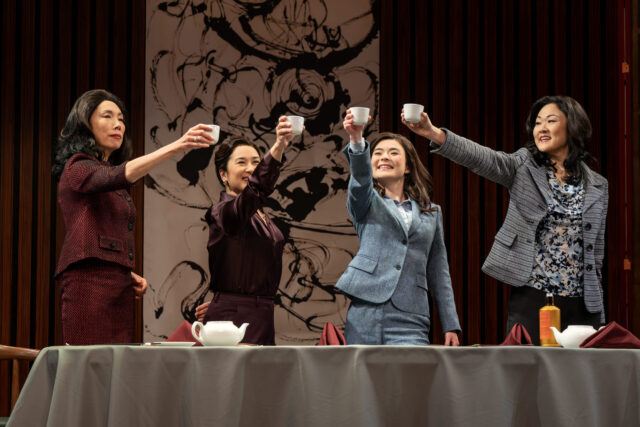
Four businesswomen toast to their success in Alex Lin’s Chinese Republicans (photo by Joan Marcus)
CHINESE REPUBLICANS
Laura Pels Theatre
Harold and Miriam Steinberg Center for Theatre
111 West 46th St. between Sixth & Seventh Aves.
Tuesday – Sunday through April 5, $69-$102
www.roundabouttheatre.org
Despite an intriguing title and a promising premise, Alex Lin’s Chinese Republicans turns out to be a disappointing, clichéd, problematic melodrama with ill-defined characters and subplots.
In a September 2022 study, the Association of Asian American Investment Managers reported that “more than 80% of Asian American and Pacific Islander (AAPI) women say the bamboo ceiling effect is real. Additionally, 65% of AAPI women disagree that opportunities for advancement are equitable regardless of race or gender. This new report aims to reveal the unique challenges faced by AAPI women who struggle to break through the ‘bamboo glass ceiling.’”
In the ninety-five-minute Roundabout production, making its world premiere at the Laura Pels Theatre through April 5, it’s 2019, and four politically conservative women who work at the Friedman Wallace investment bank meet every third Tuesday of the month at the Golden Unicorn in Chinatown in an “affinity group” one of the members calls “Asian Babes Changing the Game.” Phyllis Ong (Jodi Long) is an elegant but tough-talking sixty-five-year-old bad-ass who was the first Chinese woman to be managing director in New York City and has no time for bleeding-heart liberals. Her protégée, forty-eight-year-old Chinese American Ellen Chung (Jennifer Ikeda), initially joined the firm to help Chinese people who don’t speak English, like her parents, with loans, mortgages, credit, and other financial needs; she is divorced and childless, concentrating fully on her career, even Anglicizing her name from Ailin in order to fit in and eventually make partner. Iris (Jully Lee) is a thirty-one-year-old Chinese immigrant and software engineer in America on an H1b visa who’s preparing to apply for a green card, so she is not seeking any trouble. Twenty-four-year-old Chinese American Katie Liu (Anna Zavelson) is the new kid on the block, a former intern who is eagerly and excitedly on the fast track to success.
They sit at a table in front of a black-and-white calligraphic painting and show they can be just as snarky and vindictive as their male counterparts, needling one another on their Mandarin, their personal lives, and even how they treat the waiter (Ben Langhorst). An early exchange sets the tone.
Iris: Oh my god, your Mandarin is so bad. It sounds like diarrhea in your mouth —
Ellen: Just get it —
Iris: Why —
Ellen: Katie’s a vegetarian now.
Iris: Since when?
Phyllis: Are animal products slowing her down?
Ellen: No, she’s on the up and up! Hired straight from intern to research associate level two last year — and already up for a promotion — doesn’t happen every day. Get the turnip cake, too, that’s her favorite.
Iris: Turnip cake has meat, Ellen.
Phyllis: Just don’t tell her.
Ellen: Tricking a vegetarian into eating meat, sounds real ethical.
Phyllis: She needs to build strength. Or her annual review will grind her to dust.
Ellen takes Katie under her wing, much as Phyllis did with her, stressing the important tenet, “You can’t help others if you can’t help yourself.” But where Ellen envisions a future in which the firm is renamed Friedman Wallace Chung Liu, Phyllis is critical of Katie’s desire to have a life and a boyfriend along with her career.
“Honestly, I feel bad for your generation. All you want is instant gratification — ‘You can have it all!’ Yeah, they pulled the same stunt with me,” Phyllis tells Katie. “They’ll throw you a bone by paying you a little more or make you feel safe with these little affinity groups. But you still have to wear makeup, don’t you? You still have to fix your hair, wear the right shoes, be feminine enough without being a woman — and don’t even get me started on having kids. . . . The moment you think the world is making progress is the moment you become outdated.”
In addressing that progress, the play itself is outdated.
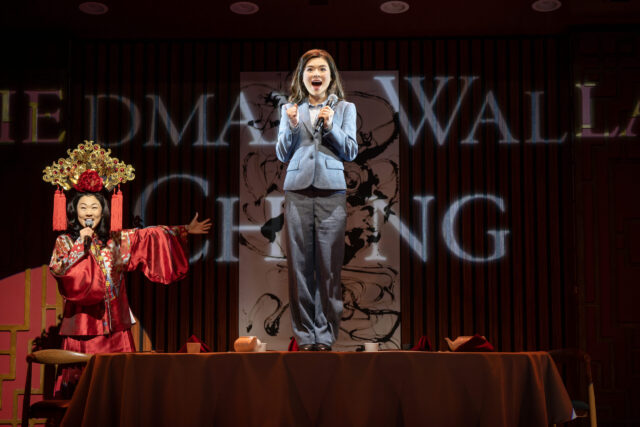
A game-show dream sequence tests the proper usage of Mandarin (photo by Joan Marcus)
The title, Chinese Republicans, feels more like click bait than a good name for the play. The women do praise Ronald Reagan and Rudy Giuliani and disparage Barack Obama, Bill de Blasio, and “weird PC crap,” and Phyllis notes, “Once a Democrat, always a Democrat,” when Ellen admits that she was blue until 2001, but Lin (Laowang: A Chinatown King Lear, Bad Chinese Daughter), who made 2026’s Forbes “30 Under 30” list in the Hollywood & Entertainment category (along with Mikey Madison, Chase Infiniti, and Emma Myers) focuses far more on their being Chinese than GOP cheerleaders. And the plot takes a bizarre diversion when Katie becomes a rabble-rousing Libertarian-Socialist Conservative intent on unionizing the company. “You guys, all of the greatest Republicans in America have been Socialists!” she declares.
Oddly, there is no mention of Donald Trump, who had a lot to say about the financial sector and, particularly, China even before the pandemic.
Director Chay Yew (Mojada, Good Enemy) stumbles through Lin’s choppy narrative as Wilson Chin’s set revolves between the restaurant — which recalls David Mamet’s toxic-masculinity-heavy Glengarry Glen Ross, although the women here are not so profane and desperate — and inside and outside Friedman Wallace, where one-on-one discussions take place. The four women are sharply dressed in Anita Yavich’s costumes, with unobtrusive lighting by Jeanette Oi-Suk Yew and original music and sound by Fabian Obispo. Hanah Kim’s projections get out of hand during a surreal game-show scene about Mandarin usage that takes place inside Ellen’s mind. That strange dream sequence and several moments involving some of the women going into the kitchen to chastise the waiter are unnecessary, adding to the erratic structure.
The quartet of Ikeda (Vietgone, BAD NEWS! I was there . . .), Lee (KPOP The Musical, Hannah and the Dread Gazebo), Emmy winner Long (Flower Drum Song, Fern Hill), and Zavelson (The Notebook, Masquerade) never achieve the kind of rhythm or balance among the characters; it’s difficult to understand what the women get out of the meeting, except for Phyllis, who revels in dishing out verbal abuse.
While the play attempts to tackle such issues as bigotry, misogyny, partisan politics, assimilation, and intergenerational conflict, it runs roughshod over itself as it loses control and becomes more and more scattershot and disorganized.
As Phyllis likes to say, “Thanks, Obama.”
[Mark Rifkin is a Brooklyn-born, Manhattan-based writer; you can follow him on Substack here.]