
General Caius Martius (McKinley Belcher III) faces a political crisis in The Tragedy of Coriolanus (photo by Hollis King)
THE TRAGEDY OF CORIOLANUS
Theatre for a New Audience, Polonsky Shakespeare Center
262 Ashland Pl. between Lafayette Ave. & Fulton St.
Tuesday – Sunday through March 1, $95-$125
www.tfana.org
The Tragedy of Coriolanus has never been one of William Shakespeare’s most popular plays. It has never made it to Broadway, had been presented at the Public’s free Shakespeare in the Park summer series only twice (in 1965 and 1979), and has been adapted into a film just once, by Ralph Fiennes in 2011.
But then the Trump era started taking shape, and the problem play found new life. In 2016, Michael Sexton and Red Bull set the story amid the Occupy movement and involved the audience in the tale of the shifting power relationship between a conquering hero and the common people. In 2019, Daniel Sullivan directed a riveting version at the Delacorte, making it feel deeply relevant to what was happening in the United States without wearing its heart on its sleeve.
Now Ash K. Tata takes it on for Theatre for a New Audience at the Polonsky Shakespeare Center, in a bewildering production that had a not-insignificant number of theatergoers leaving at intermission at the preview I attended.
Afsoon Pajoufar’s set features an angled one-story facade, partially torn protest signs pasted all over it, declaring, “Corn at Cost” and “Price of Grain Is Too High.” Under a balcony and inside a narrow hallway is the unseen Roman senate, where General Caius Martius (McKinley Belcher III) is welcomed home as a champion for defeating the Volscians at Corioli and is christened Coriolanus; he is supported by his loyal right-hand man, the Roman consul Menenius Agrippa (Jason O’Connell), who watches his interaction with the people carefully, as Rome is undergoing plebeian reforms. Coriolanus suddenly and inexplicably is unwilling to treat the commoners, or rabble, with any kind of respect and refuses to pay heed to Menenius’s warnings.
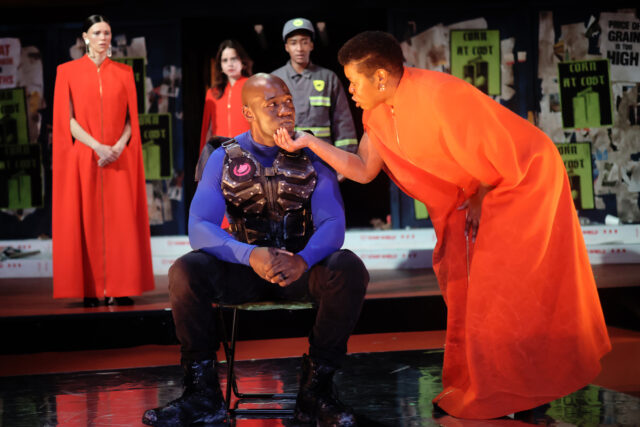
Volumnia (Roslyn Ruff) tries to instill sense in her son (McKinley Belcher III) in confusing adaptation (photo by Hollis King)
Coriolanus alienates the people, who are led by Sicinius Velutus (William DeMeritt) and Junius Brutus (Zuzanna Szadkowski), as well as the senate and military, under commander in chief Cominius (Barzin Akhavan), resulting in his banishment. Meanwhile, his family — devoted mother Volumnia (Roslyn Ruff), wife Virgilia (Meredith Garretson), and son Martius (Merlin McCormick) — is confused by his choices, especially when it is reported that he may have joined forces with his archenemy, Tullus Aufidius (Mickey Sumner), the spy Adrian (Kevin Alicea), and the traitor Nicanor (Jack Berenholtz).
Despite Coriolanus’s potential treachery, Menenius continues to defend him, believing he will ultimately do what’s best for Rome.
“His nature is too noble for the world. / He would not flatter Neptune for his trident, / Or Jove for’s power to thunder. His heart’s his mouth. / What his breast forges, that his tongue must vent, / And, being angry, does forget that ever / He heard the name of death,” Menenius tells a fellow senator (Pomme Koch), Sicinius, Brutus, and a group of other citizens. Sicinius asks, “Where is this viper, / That would depopulate the city, and / Be every man himself? . . . He shall be thrown down the Tarpeian rock / With rigorous hands. He hath resisted law, / And therefore law shall scorn him further trial / Than the severity of the public power, / Which he so sets at nought.”
Tata tries to make the story of one man’s descent into ego and power, being above the law, relate to today’s America, but instead of delving further into the characters and celebrating Shakespeare’s language, he attempts to transform the play into a living, breathing video game; through the entire show, surveillance cameras project the action on a central three-sided mini-Jumbotron, although the images are blurry and the pixels often break up, accompanied by digital text and targets that are nearly impossible to decipher. In addition, all military maneuvers are projected across the stage and onto the building, accompanied by screeching noise, which quickly becomes repetitive and invasive. (The lighting is by Masha Tsimring, sound by Brandon Bulls, original music is by David T. Little, and projections by Lisa Renkel and POSSIBLE.)

Coriolanus (McKinley Belcher III) and Aufidius (Mickey Sumner) are at each other’s throats in gimmicky Bard production (photo by Hollis King)
Among the other puzzling elements are the wide range of Avery Reed’s costumes, from Virgilia’s striking, sexy red dress and Volumnia’s half-modern, half-ancient-Greek outfit to the armies’ paramilitary uniforms and the dress of the rabble, with bright reds, yellow, and blues popping out as if part of the play is in Technicolor; the inconsistent use of either knives or rifles in combat; the switching of Aufidius’s gender to create an unlikely romance; how some characters use a passage in the back to enter and exit while others go through a cutout in a long curtain; and the green-and-white beach chair Coriolanus sits in as he tosses cans of PBR to the commoners.
Tata never achieves a steady flow to the narrative; instead it stops and starts, with bumps and lags that drag it down. During intermission, messages are projected on the mini-Jumbotron as if there is a live chat going on, with such posts as “So glad the Tribunes stood up to this clown,” “Give us the grain and leave, patrician trash,” and “He literally called us rats. I’m done.”
I wish I cared enough to add my own contribution.
Though I guess I have here.
[Mark Rifkin is a Brooklyn-born, Manhattan-based writer; you can follow him on Substack here.]