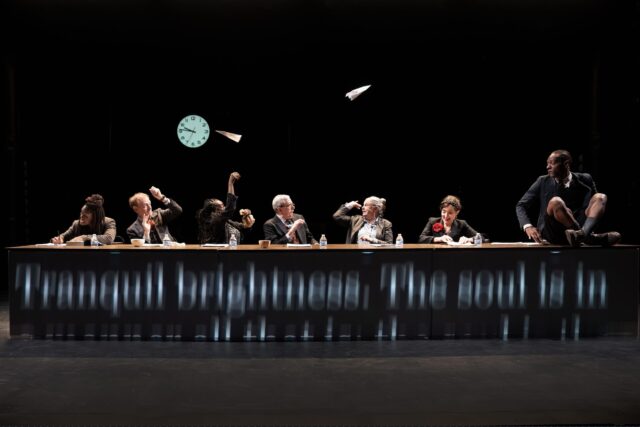
Elevator Repair Service adaptation of Ulysses is fun frolic through 1920 masterpiece (photo by Joan Marcus)
ULYSSES
The Public Theater, Martinson Hall
425 Lafayette St. by Astor Pl.
Tuesday – Sunday through March 1, $109
www.publictheater.org
www.elevator.org
Who knew that Ulysses was such raunchy fun? Certainly not me, who, like many others, have cracked open but never fully read James Joyce’s 1920 masterpiece.
Since 1991, the downtown avant-garde theater troupe Elevator Repair Service has been staging unique adaptations, from Shakespeare’s Measure for Measure and Chekhov’s The Seagull to Euripides’s The Bacchae and Albee’s Who’s Afraid of Virginia Woolf? The daring company now continues its reinterpretations of classic literature, which include William Faulkner’s The Sound and the Fury, The Select (Ernest Hemingway’s The Sun Also Rises), and Gatz, an eight-hour extravaganza featuring every single word of F. Scott Fitzgerald’s The Great Gatsby, with a frisky frolic through what is considered to be one of the greatest books ever written.
“Hello and welcome to Ulysses,” longtime ERS cast member and codirector Scott Shepherd announces at the beginning. “Get ready. As one critic said, not much happens in Ulysses, apart from everything you can possibly imagine.” Shepherd prepares the audience by explaining that Joyce purposely filled the novel with enigmas and puzzles and experimental turns, writing many chapters in different styles, in order to “keep the professors busy for centuries arguing about what he meant, and that’s how he would insure his immortality. And like many things Joyce said, it’s a joke, but also not a joke, because here we are, more than a hundred years later, and the professors are still arguing.”
The set, by the collective known as dots, is centered by a long table in the front, where seven actors playing forty characters often sit before getting up and participating in absurdist scenes. A clock on a far wall keeps track of the time, which goes back and forth on Thursday, June 16, 1904, in Dublin. Shepherd and codirector John Collins have trimmed the story down to a lean 165 minutes with intermission; whenever they skip a few sentences, paragraphs, or pages, the words are speedily projected on the table and/or wall, initially accompanied by screeching sounds that eventually calm down a bit as the actors grab on to the table, as if the time jumps have them holding on for dear life.
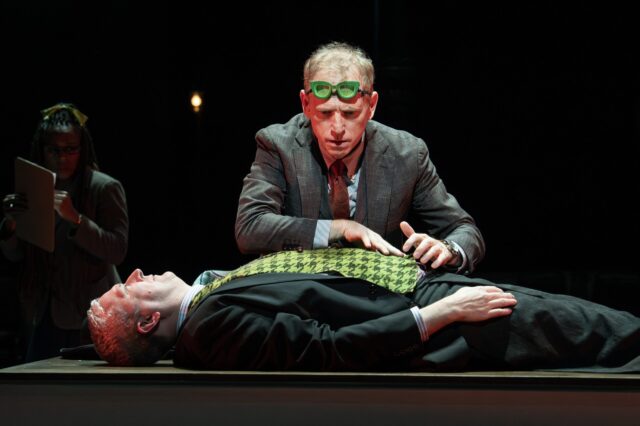
Dr Malachi Mulligan (Scott Shepherd) examines “bisexually abnormal” asylum escapee Dr Bloom (Vin Knight) in Ulysses (photo by Joan Marcus)
The narrative consists of eighteen episodes, from “Telemachus” and “Nestor” to “Ithaca” and “Penelope,” reimagining Homer’s eighth-century BC saga The Odyssey, adding references to King Lear and Hamlet. The action travels from Eccles St., Essex Bridge, and the post office to Davy Byrne’s pub, the library, and the Ormond Hotel, following the (mis)adventures of protagonist Leopold Bloom (Vin Knight), a simple man married to Marion, also known as Molly (Maggie Hoffman), a singer who is having an affair with her goofy manager, Blazes Boylan (Shepherd), who struts around with his silly locks of hair spewing out from under his straw hat, and Stephen Dedalus (Christopher-Rashee Stevenson), who previously appeared in Joyce’s A Portrait of the Artist as a Young Man and returns here as a deeply pensive history professor mourning the loss of his mother (Stephanie Weeks) while avoiding his father, Simon (Kate Benson).
Among the other figures who pop in and out of the less-than-neatly-laid-out plot are university students Armstrong (Dee Beasnael) and Haines (Benson), Dr Punch Costello (Weeks), the expert spitter known as the citizen (Benson), newspaper editor Myles Crawford (Benson), antisemitic headmaster Mr Deasy (Knight), pub gossipers Joe Hynes (Stevenson) and John Wyse Nolan (Weeks), Nosey Flynn (Weeks) from Dubliners, and medical student Buck Mulligan (Shepherd), who is the subject of Joyce’s beloved opening: “Stately, plump Buck Mulligan came from the stairhead, bearing a bowl of lather on which a mirror and a razor lay crossed. A yellow dressinggown, ungirdled, was sustained gently behind him on the mild morning air. He held the bowl aloft and intoned: ‘Introibo ad altare Dei.’”
Don’t try to get caught up in the plot, as it’s not the point, although Odyssey fans are likely to spot numerous similarities between Homer’s and Joyce’s characters; instead, Ulysses, in the book and in this vastly entertaining ERS staging, is about human consciousness and the love of language, with tongues firmly in cheeks. Exquisite verbiage pours forth at any moment — “Ah! Godblazeqrukbrukarchkrasht!” Boylan declares to Marion, who responds, “O! Weeshwashtkissinapooisthnapoohuck?” — as well as spectacular, unforgettable lines, such as when Stephen says, “History is a nightmare from which I am trying to awake.” Also showing up are such fab phrases as “the scrotumtightening sea,” “ineluctable modality of the visible [and the audible],” “Shut your eyes and see,” “the incipient intimations of proximate dawn,” and “the heaventree of stars hung with humid nightblue fruit.” Oh, and let’s not forget “He kissed the plump mellow yellow smellow melons of her rump, on each plump melonous hemisphere, in their mellow yellow furrow, with obscure prolonged provocative melonsmellonous osculation.”
Here is an exemplary passage, the narration divided between two of the performers:
SW: Mr Leopold Bloom ate with relish the inner organs of beasts and fowls.
KB: He liked thick giblet soup,
SW: nutty gizzards,
KB: a stuffed roast heart,
SW: liverslices fried with crustcrumbs,
KB: fried hencods’ roes.
SW: Most of all he liked grilled mutton kidneys which gave to his palate a fine tang of faintly scented urine.
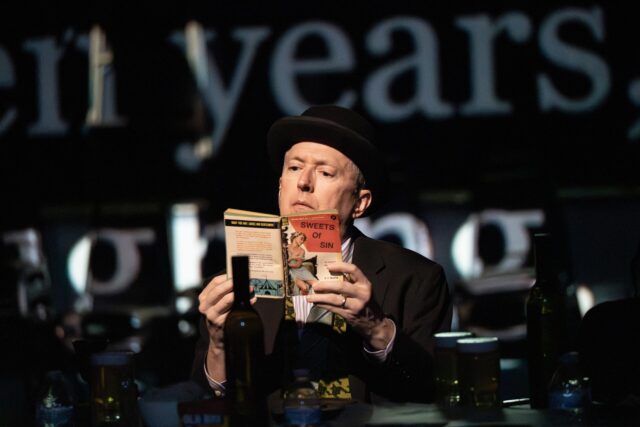
Leopold Bloom (Vin Knight) takes a gander at the dirty Sweets of Sin in ERS adaptation (photo by Joan Marcus)
“The pity is, the public will demand and find a moral in my book — or worse they may take it in some more serious way, and on the honour of a gentleman, there is not one single serious line in it,” Joyce told Djuna Barnes in a 1922 interview for Vanity Fair. “In Ulysses I have recorded, simultaneously, what a man says, sees, thinks, and what such seeing, thinking, saying does, to what you Freudians call the subconscious — but as for psychoanalysis, it’s neither more nor less than blackmail.”
ERS takes that spirit and runs with it, from Enver Chakartash’s playful costumes, Marika Kent’s mischievous lighting, and Ben Williams’s brash sound to Matthew Deinhart’s text projections and Patricia Marjorie’s hilarious props, which range from paper airplanes to doll babies. The six actors hit just the right note throughout as they switch in an instant from one character to narrator to another character, never missing a beat.
You don’t have to have read the book or seen Joseph Strick’s 1967 film adaptation to understand what is going on, since nothing happens, and everything. Just sit back, relax, and enjoy the wild, unpredictable shenanigans as ERS celebrates another literary treasure as only it can.
As Stephen says early on, “When one reads these strange pages of one long gone one feels that one is at one with one who once . . .”
[Mark Rifkin is a Brooklyn-born, Manhattan-based writer; you can follow him on Substack here.]