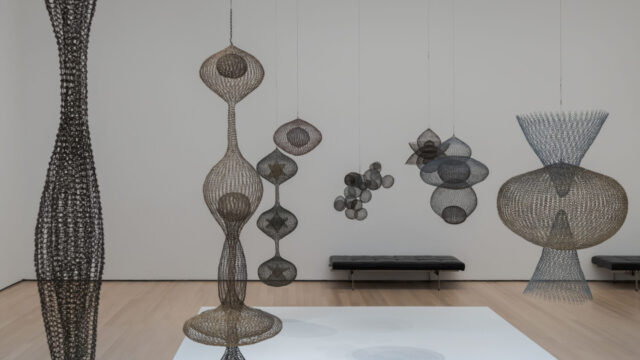
Installation view, “Ruth Asawa: A Retrospective” (digital Image © 2025 the Museum of Modern Art, New York / photo by Jonathan Dorado / artwork © 2025 Ruth Asawa Lanier, Inc. / courtesy David Zwirner)
RUTH ASAWA: A RETROSPECTIVE
Museum of Modern Art
The Steven and Alexandra Cohen Center for Special Exhibitions
11 West 53rd St. between Fifth & Sixth Aves.
Through February 7, $17-$30
www.moma.org
ruthasawa.com
“To watch you at work on a wire sculpture is to see how a single line is transformed into a network of interconnectedness. It’s an expression of the Heart Sutra: form is emptiness, and emptiness is form,” author, filmmaker, and Zen Buddhist priest Ruth Ozeki writes in a letter to the late Ruth Asawa in the catalog of the outstanding MoMA exhibition “Ruth Asawa: A Retrospective.” She continues, “It’s a performance of eternal and infinite nonduality, in which inside is out, and outside is in, and there is no start, no finish, and no separation between these continuous and continually related moments of being.”
“Let the medium express itself.”
On view through February 7, the show features approximately three hundred wire sculptures, bronze casts, drawings, paintings, prints, class notes, a Guggenheim fellowship application, a letter of patent, and public projects. Asawa was born in California in 1926, was sent to an internment camp in Arkansas in 1942 (her parents were Japanese immigrants), studied at Black Mountain College in North Carolina with Josef Albers, Jacob Lawrence, John Cage, Merce Cunningham, Willem de Kooning, and Buckminster Fuller, and helped create the San Francisco School of the Arts, which was renamed the Ruth Asawa San Francisco School of the Arts in 2010. That background led to a career making wide-ranging works that combine movement, architecture, color, and music into something wholly new. She died in 2013 at the age of eighty-seven.
“I hold no hostilities for what happened; I blame no one. Sometimes good comes through adversity. I would not be who I am today had it not been for the internment, and I like who I am.”
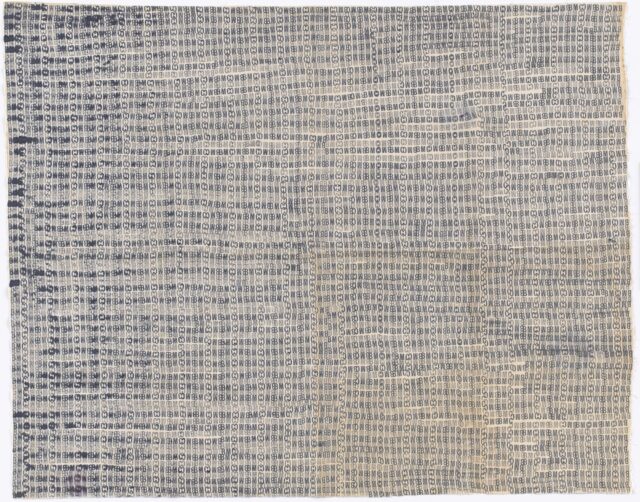
Ruth Asawa, Untitled (BMC.145, BMC Laundry Stamp), stamped ink on fabric sheeting, ca. 1948–49 (© 2025 Ruth Asawa Lanier, Inc. / courtesy David Zwirner)
Among the pieces to watch out for are the oil on masonite We Five and Fourteen, the ink and crayon on paper Untitled (MI.121, Chair with Straw Bottom), the ink on paper Untitled (PT.128, Plane Tree), clay life masks, a glazed ceramic plate and persimmon, gentle watercolors, carved doors, lithographs of children, the ceramic Untitled (S.806d, Everyone’s Favorite City: The Golden Gate Bridge, the Cable Car, and the San Francisco Victorian House), bronze body parts, a series of flower lithographs from 1965, index cards, sketchbooks, archival photographs, and a wedding ring made for Asawa by Fuller. There are also works by Albers, Hazel Larsen Archer, Elizabeth Jennerjahn, Imogen Cunningham, Ray Johnson, Merry Renk, and Marguerite Wildenhain.
“I am able to take a wire line and go into the air and define the air without stealing it from anyone. A line can enclose and define space while letting the air remain air.”
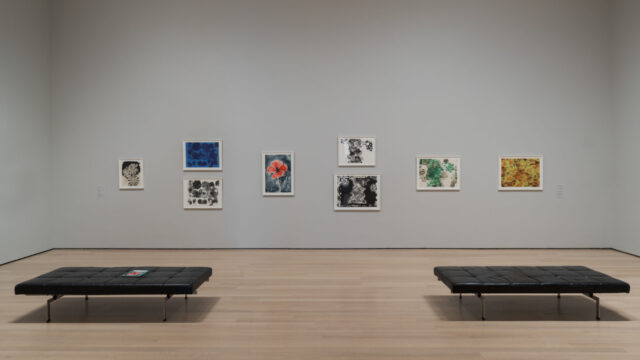
Installation view, “Ruth Asawa: A Retrospective” (digital Image © 2025 the Museum of Modern Art, New York / photo by Jonathan Dorado / artwork © 2025 Ruth Asawa Lanier, Inc. / courtesy David Zwirner)
But mostly there are Asawa’s dazzling wire sculptures, mounted on bases and walls and hanging from above, intricate constructions of interlocking spheres and continuous organic forms within forms based on nature. They cast shadows as you walk around them, and some spin ever so slowly, but they all nimbly dance between positive and negative space.
“An artist is not special. An artist is an ordinary person who can take ordinary things and make them special.”
[Mark Rifkin is a Brooklyn-born, Manhattan-based writer and editor; you can follow him on Substack here.]