
John Wilson, Maquette for Martin Luther King, Jr. (United States Capitol, Washington, DC, bronze, 1985 (collection of Julia Wilson / courtesy of Martha Richardson Fine Art, Boston / photo by twi-ny/mdr)
WITNESSING HUMANITY: THE ART OF JOHN WILSON
Met Fifth Avenue
Metropolitan Museum of Art
1000 Fifth Ave. at 82nd St.
Through February 8, $17-$30
www.metmuseum.org
“I wanted people to recognize him, but also I wanted to suggest the intangible energy and strength, this sense of dogged strength he had that allowed him to carry out these impossible campaigns,” John Wilson (1922–2015) said of the Rev. Dr. Martin Luther King, Jr. “He was able to use his verbal skills to convince masses of ordinary people to do these extraordinary things . . . all of that is what I’m trying to put into a head.”
Several depictions of Dr. King are included in the revelatory and necessary exhibition “Witnessing Humanity: The Art of John Wilson,” featuring more than one hundred paintings, lithographs, drawings, sculptures, and children’s books by artist and educator John Wilson, on view at the Met through February 8. Talking about his monumental bust of Dr. King, Wilson further explained, “King’s head is titled forward — not bowed — so that someone standing below will have a kind of eyeball-to-eyeball confrontation with him. I wanted to show that kind of brooding, contemplative, inner-directed person that’s the essence of the man.”
Born in Roxbury, Massachusetts, in 1922, Wilson was driven by community activism against racial injustice, creating works that detailed the Black experience in America. “An artist is ipso facto critical of society . . . constantly dissecting,” he noted. “I want my art to reach people. I want people to get the message that my art has. I want their social attitudes to change as a result of the things I do.”
The exhibition is splendidly curated by the Met’s Jennifer Farrell, Maryland Institute College of Art’s Leslie King-Hammond, and the MFA’s Patrick Murphy and Edward Saywell, with detailed information and lots of powerful quotes by Wilson, who died in Brookline in 2015, leaving behind a remarkable legacy that is finally reaching people, getting the attention it deserves. On January 23 at 6:00, printmaker Karen J Revis will present an “Artists on Artworks” talk on the exhibit, and on February 3 at 6:00, the Met is hosting the free program “A Celebration of John Wilson” in Grace Rainey Rogers Auditorium with Lisa Farrington, Lowery Stokes Sims, Derrick Adams, and King-Hammond.
Below are Wilson’s own words accompanying several important works.
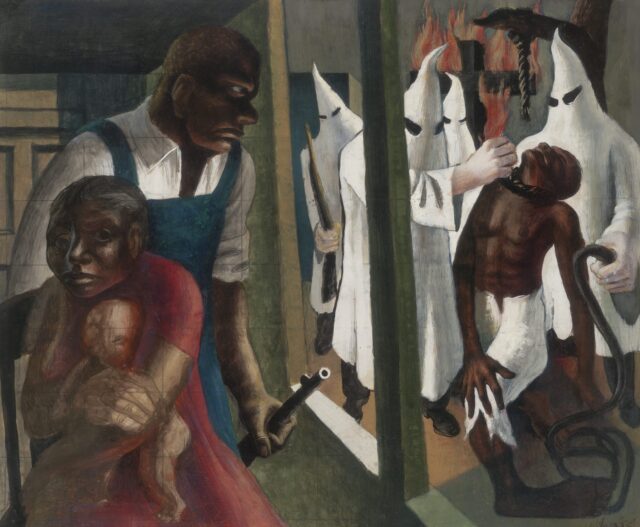
John Wilson, study for the mural The Incident, opaque and transparent watercolor, ink, and graphite, 1952 (Yale University Art Gallery [courtesy the Estate of John Woodrow Wilson] / licensed by VAGA at Artists Rights Society (ARS), New York)
“He put into words what I wanted to express visually, the struggle of African Americans to maintain their human dignity in an oppressive world,” Wilson said of Richard Wright.
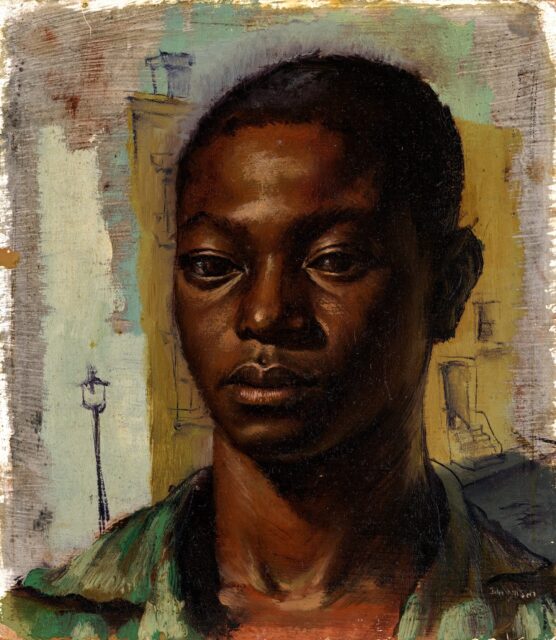
John Wilson, My Brother, oil on panel, 1942 (Smith College Museum of Art / courtesy the Estate of John Wilson)
“I am a Black artist. I am a Black person. To me, my experience as a Black person has given me a special way of looking at the world and a special identity with others who experience some injustices. . . . Themes I have dealt with are not because I sat down and said I wanted to make a political statement but because of emotional experiences.”
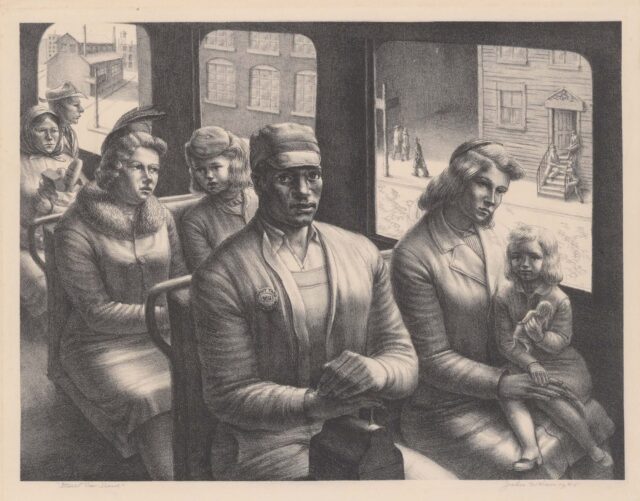
John Wilson, Streetcar Scene, lithograph, 1945 (the Metropolitan Museum of Art / courtesy the Estate of John Wilson)
“I drew scenes of the world around me which reflected the sense of alienation I felt as a Black artist in a segregated world. I saw no examples of art that depicted the people and the realities of the Black neighborhood I lived in.”
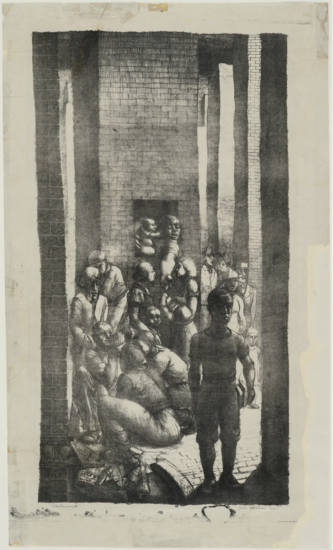
John Wilson, Adolescence, lithograph, 1943 (courtesy the Estate of John Wilson/Artists Rights Society (ARS), Museum of Fine Arts, Boston)
Adolescence is “an imaginative interpretation of the street I lived on . . . [an attempt to express] the bewilderment and search for understanding of a Negro boy growing up in the midst of the inconsistencies, the squalor, and the cramped poverty-stricken confusion of life in a typical North American Negro ghetto. . . . I don’t even know if I was conscious of that boy in the foreground as a self-portrait or not. But I look back on it, [and] clearly it’s a self-portrait.”
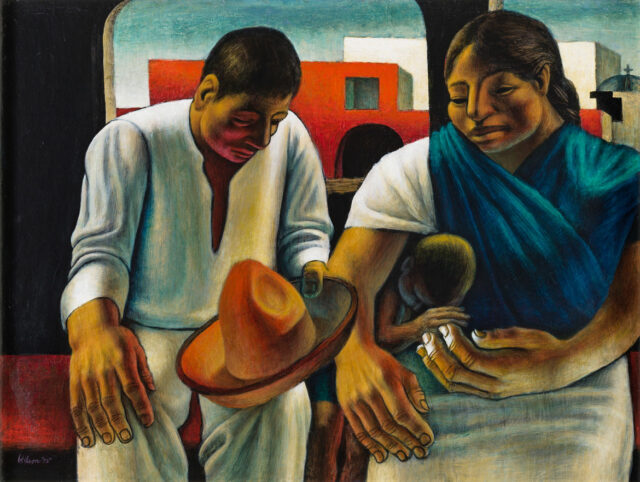
John Wilson, Campesinos (Peasants), oil on paper mounted on board, 1953 (private collection, Boston / © Estate of John Wilson / photo © Museum of Fine Arts, Boston)
“The aim of the Mexican muralist movement was to be spokespeople for the common man. They wanted to create works of art expressing the reality of the forgotten ones, revealing their history, their celebrations, and struggles. . . . Through Mexican art I began to experience a sense of how to depict my reality.”
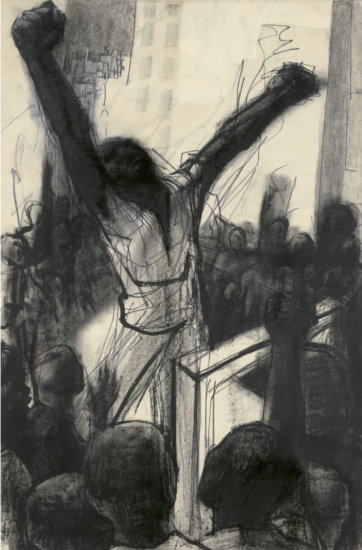
John Wilson, Oracle, ink, chalk, and collage on paper, 1965 (courtesy the Estate of John Wilson / licensed by VAGA at Artists Rights Society (ARS), New York)
“As a Black art student in 1940–41, I became increasingly aware that the illustrations in art history books and the great works in this museum which were statements of profound truth and beauty did not include images of Black people. By omission this seemed to be saying that Black people were not significant. I lived in a world in which the only public images of Blacks were stereotypical, dehumanized caricatures. These were the only images that I saw of Blacks in the newspapers and films and all public media of that time.”
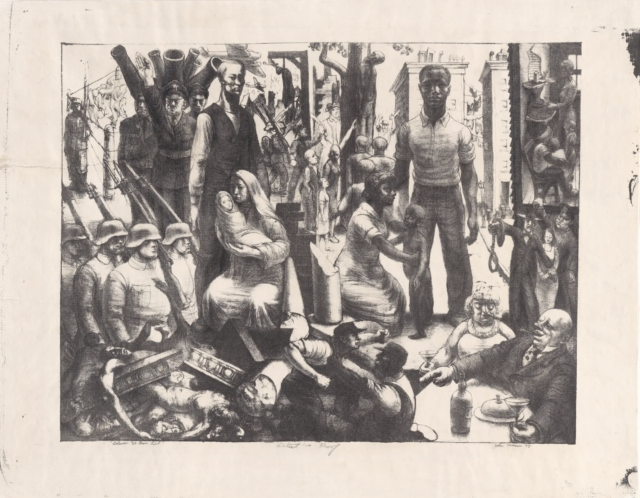
John Wilson, Deliver Us from Evil, lithograph, 1943 (courtesy the Estate of John Wilson/Artists Rights Society (ARS), New York)
“I was an idealistic young African American art student, struggling to find a way to express my fears and anger about the oppression of African American people in America. For me, the ruthless, efficient, invincible German storm troopers became a symbol of all-powerful forces of oppression, in which individuals were modeled into collective killing machines, fueled by ideologies of hate and racial superiority. I identified with the victims of this [Nazi] army, and [War Machine] is my attempt to make a graphic image of the terror engendered by these troops.”
“This business of the terror that was used to keep Black people in their place really worked. I wasn’t born in the South, but the South was a microcosm. There was actual physical lynching in the North. . . . I heard someone make a speech once in which he said, ‘Well, this lynching and the threat of lynching is what keeps Black people in their place.’”
[Mark Rifkin is a Brooklyn-born, Manhattan-based writer and editor; you can follow him on Substack here.]