
Anat Maltz’s Real Estate screens January 21 at the New York Jewish Film Festival
THIRTY-FIFTH ANNUAL NEW YORK JEWISH FILM FESTIVAL
Walter Reade Theater, Film at Lincoln Center
165 West 65th St. between Broadway & Amsterdam Aves.
January 14-28
www.filmlinc.org
thejewishmuseum.org
The New York Jewish Film Festival is now celebrating its thirty-fifth year of bringing narrative features, documentaries, and shorts dealing with Judaism, Israel, and the Jewish diaspora, from romantic comedies and poignant dramas to hard-hitting looks at the state of the world amid ever-growing antisemitism. As I’ve noted before, it sometimes feels like a political statement just to attend the festival.
A joint production of the Jewish Museum and Film at Lincoln Center, the 2026 edition runs January 14-28, consisting of twenty-nine works from the United States, France, Germany, Spain, Belgium, Argentina, the Netherlands, Switzerland, Poland, Canada, Denmark, Uganda, and Israel, including many New York premieres. The festival opens with Ken Scott’s Once Upon My Mother, about a Moroccan family in Paris with a matriarch determined to ensure her son lives a happy life, based on an autobiographical novel by Roland Perez, who will participate in Q&As following both screenings. The centerpiece selection is Guillaume Ribot’s All I Had Was Nothingness, which follows director Claude Lanzmann during his twelve years making Shoah. NYJFF26 concludes with actor Matthew Shear’s writing and directing debut, Fantasy Life, in which a schlubby but endearing schlemiel/schlimazel/shmegege/shmendrik becomes a manny for an actress, her rock musician husband, and their three young daughters, starring Amanda Peet, Judd Hirsch, Andrea Martin, Bob Balaban, Alessandro Nivola, Jessica Harper, and Zosia Mamet.
Among the other highlights are Abby Ginzberg’s Labors of Love: The Life and Legacy of Henrietta Szold, about the founder of Hadassah; Marisa Fox’s My Underground Mother, who finds out that her mother was a spy and freedom fighter against the Nazis; Anat Maltz’s Real Estate, which takes place over the course of one day as a young couple about to have a baby are forced out of their Tel Aviv apartment; and a restoration of Aleksander Marten’s 1936 I Have Sinned, the first Yiddish sound film made in Poland. And this year’s winner for best title is Emily Lobsenz’s A Bit of Everything and Matzoh Balls Too.
Below are several films to watch out for; most screenings throughout the festival will be followed by a discussion with directors, producers, subjects, cast members, or experts.

All I Had Was Nothingness follows Claude Lanzmann as he makes Shoah
ALL I HAD WAS NOTHINGNESS (Guillaume Ribot, 2025)
Walter Reade Theater
Thursday, January 22, 2:30 & 7:45
www.filmlinc.org
mk2films.com
In 1985, Claude Lanzmann’s extraordinary nine-and-a-half-hour epic, Shoah, changed the discussion surrounding the Holocaust, as Lanzmann, a French Jew, traveled around the world interviewing survivors, witnesses, collaborators, and perpetrators. In honor of the fortieth anniversary of Lanzmann’s award-winning magnum opus, French director and photographer Guillaume Ribot, who is not Jewish, has made All I Had Was Nothingness, a remarkable documentary, produced by Claude’s widow, Dominique Lanzmann, that follows Lanzmann on his journey, filled with self-doubt, doors slammed in his face, and a lack of funds that constantly threaten the project. Ribot and editor Svetlana Vaynblat went through two hundred hours of unused footage to put the film together, with Ribot adding narration taken directly from Lanzmann’s writings, primarily from his 2009 memoir, The Patagonian Hare. Even though we know that Shoah gets released to widespread acclaim — and is followed by such other Holocaust films as Sobibor, 14 October 1943, 4 p.m., The Last of the Unjust, and Shoah: Four Sisters before Lanzmann died in 2018 at the age of ninety-two — the story plays out like a gripping, intimate thriller.
“Making Shoah was a long and difficult battle,” Lanzmann (voiced by Ribot) says early on. “I wanted to film, but all I had was nothingness. The subject of Shoah is death itself. Death and its radicality. On some evenings it felt like senseless suffering, and I was ready to give up. But during those twelve years of work, I always forced myself to stare relentlessly into the black sun of the Shoah.”
Among the people Lanzmann meets are Abraham Bomba, who survived Treblinka, where he was forced to cut the hair of women who were gassed to death; Simon Srebnik, a Chelmno survivor whose father was killed in the Łódź Ghetto and whose mother was murdered in a gas van in the concentration camp; SS commander Gustav Laabs; convicted Treblinka exterminator Franz Suchomel; locals who lived next to concentration camps and claim to have not known what was going on inside; Treblinka train engineer Henryk Gawkowski; Heinz Schubert from the Einsatzgruppen; Treblinka survivor Richard Glazar; Einsatzgruppe Obersturmführer Karl Kretschmer; and Yitzhak “Antek” Zuckerman, deputy commander of the Warsaw Ghetto Uprising. “Daily, we tackled a new prey,” Lanzmann notes as he attempts to “deceive the deceivers.”
Along the way, Lanzmann obtains a fake passport under the name Claude-Marie Sorel, quarrels with his cameraman William Lubtchansky (whose father was gassed in Auschwitz), wonders what the overall message of the film will be, uses a special hidden camera, and is unable to raise a single dollar from potential American investors. He also smokes a lot of cigarettes.
Ribot, whose previous films include Le Cahier de Susi, inspired by the discovery of a notebook by an eleven-year-old girl who was murdered in Auschwitz, and Treblinka, je suis le dernier Juif, about camp survivor Chil Rajchman, turns the focus on Lanzmann and the lengths documentarians will go to tell their stories. All I Had Was Nothingness is a valuable addition to films about the Holocaust, but it is much more than that in its search for the truth, which can be so easily hidden, while providing a behind-the-scenes look at the making of a masterpiece.
“I could have been one of the victims. I knew nothing of it, truly,” Lanzmann says about his knowledge of the Holocaust prior to doing his research for the film. “My knowledge was nil. Nothing but a statistic, an abstract figure.” Through such necessary films as Shoah and, now, All I Had Was Nothingness, the world knows.
Lanzmann often lingers on his own eyes and the eyes of his subjects, penetrating shots that are emotionally and psychologically powerful. “My journey has led me to capture eyes that have seen horror. The eyes that saw, I saw them too,” he says. And now we can seem them as well, bearing witness.
(All I Had Was Nothingness is screening January 22 at 2:30 and 7:45, with Vaynblat on hand for Q&As.)

Actor, writer, director, activist, and family man Charles Grodin is subject of fascinating documentary
CHARLES GRODIN: REBEL WITH A CAUSE (James L. Freedman, 2025)
Walter Reade Theater
Sunday, January 25, 6:15, and Monday, January 26, 1:00
www.filmlinc.org
charlesgrodinfilm.com
James L. Freedman’s Charles Grodin: Rebel with a Cause reveals that the man best known to the general public for the Beethoven movies and his oddball, awkward, but hilarious talk-show appearances was in fact a deeply beloved, respected, and humble husband, father, and grandfather, a hugely successful actor, director, and writer on the big screen, the small screen, and the stage, and a fierce fighter of injustice.
“Robert Kennedy once said, ‘Each time a man stands up for an ideal, or strikes out against injustice, he sends forth a tiny ripple of hope,’” writer, director, producer, and narrator Freedman says at the beginning of the documentary. “Charles Sidney Grodin, inspiring, cajoling, and annoying people every step of the way, unleashed a tidal wave of hope.”
Grodin was born in Pittsburgh in 1935 to Orthodox Jewish parents; his maternal grandfather was a talmudic scholar from Belarus, and he was estranged from his difficult father. He was impeached as fifth-grade class president and thrown out of Hebrew school. Deciding to become an actor after seeing George Stevens’s 1951 classic A Place in the Sun, Grodin left college and moved to New York City, where he worked as a cabdriver and a nightwatchman while studying acting with Uta Hagen and Lee Strasberg. By the late 1950s, he was appearing on episodic television, including numerous Westerns, made his Broadway debut in 1962, and starred in the long-forgotten Sex and the College Girl in 1964; his big breaks came in 1968, when he played Dr. Hill in Roman Polanski’s Rosemary’s Baby and directed Lovers and Other Strangers on the Great White Way. In archival interviews, he talks about turning down the role of Benjamin Braddock in The Graduate, battling Polanski on set, being fired three times from Candid Camera, directing the controversial television special Simon & Garfunkel: Songs of America, and the failure of his first marriage.
Then, in the 1970s, he made it big with such films as Catch-22, The Heartbreak Kid, and Heaven Can Wait and the Broadway hit Same Time, Next Year. Among those singing his praises as a performer and friend are Robert De Niro (Midnight Run), Marlo Thomas (Thieves), Martin Short (Clifford), Ellen Burstyn (Same Time, Next Year), Lewis Black (Madoff), Jon Lovitz (Last Resort), Carol Burnett (Fresno), Alan Arkin (Catch-22), Art Garfunkel, and director Martin Brest (Midnight Run).
“He was a phenomenal actor. There is no actor better than him,” says Elaine May, who directed Grodin in The Heartbreak Kid. Marc Maron calls him a “cranky comedic genius.” Steve Martin (The Lonely Guy) points out, “None of us could do what he did.” Richard Kind (Clifford) explains, “Chuck was the most caring, loving narcissist.” Television executive Henry Schlieff and producer Julian Schlossberg discuss their positions on Grodin’s ever-changing top-ten-friends list. Grodin’s second wife, Elissa, a journalist he met when she was doing a story on him, notes, “He was unbelievably annoying, and I adored him.” Freedman also speaks with Grodin’s son, Nick, and daughter, Marion.
The documentary takes a fascinating shift when it turns its attention to Grodin’s extensive work for unjustly imprisoned people serving long sentences because of the Felony Murder Rule and the Rockefeller Drug Laws. He helped free Elaine Bartlett, June Benson Lambert, Randy Credico, and Jan Warren, all of whom participate in the film. “He rescued me,” Warren states. Elissa Grodin says, “He was always defending underdogs.” He brought his activism to The Charles Grodin Show, which ran on CNBC from 1995 to 1998; he was hired by Roger Ailes, who later founded Fox News.
Freedman and editor Frank Laughlin interweave new interviews with home movies, news reports, and lots of film clips of Grodin — who died in 2021 at the age of eighty-six — in films and on talk shows (Jon Stewart declares him “the best talk show guest ever . . . ever!”). It’s a joyful celebration of an extraordinary human being, a supremely talented and endlessly inventive individual whose impact on everyone he met was profound.
De Niro sums it all up when he says, “Chuck was a very special person.”
(Charles Grodin: Rebel with a Cause is screening January 25 at 6:15 and January 26 at 1:00, both followed by Q&As with Freedman.)
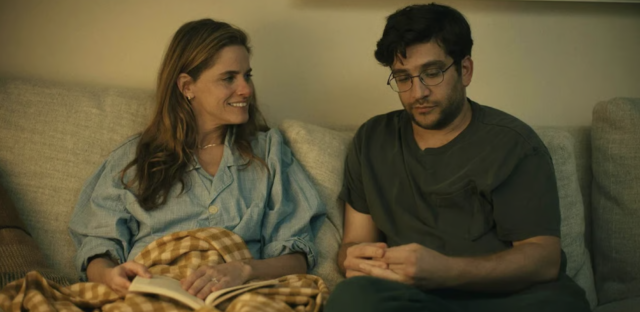
Amanda Peet and Matthew Shear star in Shear’s Fantasy Life, the closing night selection of NYJFF26
FANTASY LIFE (Matthew Shear, 2025)
Walter Reade Theater
Wednesday, January 28, 1:15 & 7:15
www.filmlinc.org
After losing his job, Sam (Matthew Shear) becomes a manny for actor Dianne (Amanda Peet), rock bassist David (Alessandro Nivola), and their three young girls (Riley Vinson, Romy Fay, Callie Santoro), and a touching hilarity ensues as Sam contemplates his future, not always making the best choices. Judd Hirsch and Andrea Martin play David’s parents, Bob Balaban and Jessica Harper are Dianne’s father and mother, and Holland Taylor makes a cameo as a therapist. Peet is in top form, building a gentle and tender chemistry with Shear, in his debut as a writer-director. Fantasy Life closes the festival on January 28 at 1:15 and 7:15, preceded by Jack Feldstein’s six-minute Animated New Yorkers: Joel and followed by a Q&A with Shear and Peet.
[Mark Rifkin is a Brooklyn-born, Manhattan-based writer and editor; you can follow him on Substack here.]