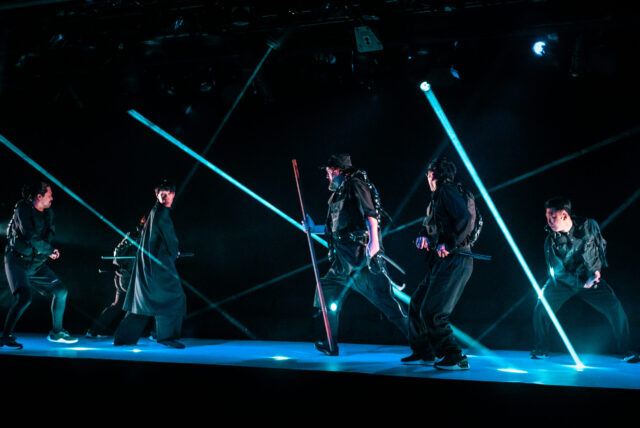
Kinoshita Kabuki offers a modern take on an 1840 classic at Japan Society (photo © Ayumi Sakamoto)
UNDER THE RADAR: KANJINCHO
Japan Society
333 East 47th St. at First Ave.
January 8–11, $63
japansociety.org
utrfest.org
Kinoshita Kabuki makes its North American debut at Japan Society with a rousing adaptation of the 1840 Kabuki classic Kanjincho (“The Subscription List”), reimagining it as a contemporary hip-hop and pop-culture-infused theatrical experience.
Based on the Noh play Ataka, the original Kanjincho was written by Namiki Gohei III, with nagauta songs by Kineya Rokusaburo IV and choreography by Nishikawa Senzo IV. Company founder Yuichi Kinoshita has modernized the text, with a new score by Taichi Kaneko and movement by Wataru Kitao, resulting in a tense and thrilling eighty-minute drama about loyalty, revenge, and the borders that separate people not only geographically but by race, gender, class, and power in the past and present.
Inspired by actual twelfth-century events, Kanjincho tells the story of half brothers Lord Minamoto-no Yoritomo and General Minamoto Yoshitsune around the time of the Genpei War. Yoritomo has become the first shogun of the Kamakura shogunate, but he distrusts the motives of the military hero Yoshitsune (Noemi Takayama) and has demanded his capture. Yoshitsune, disguised as a porter, heads out on the seldom used Hokurokudō road with the brave and loyal Benkei (Lee V) and four shitenno (armed retainers), Kamei Rokuro (Kazunori Kameshima), Kataoka Hachiro (Hiroshi Shigeoka), Suruga Jiro (Yuya Ogaki), and Hitachi (Yasuhiro Okano), who are pretending to be mountain priests collecting donations on their way to repair Todaiji Temple in Nara. In fact, they are seeking safety in Michinoku with the Fujiwara clan.
When they reach the Ataka Barrier checkpoint, one of many set up throughout Japan to stop Yoshitsune, they are met by Mr. Togashi (Ryotaro Sakaguchi) and his four guards (Kameshima, Shigeoka, Ogaki, and Okano), who are determined to bring Yoshitsune back and behead him in front of Yoritomo. Togashi has been told that Yoshitsune is traveling with a group of fake mountain priests, so he is suspicious of them. “I’m gonna make every last damn mountain priest grovel at Mr. Togashi’s feet!” one of the guards declares.
Togashi decides to test Benkei with a series of questions about their mission and Buddhism that turns into a sensational verbal duel in which Benkei shows off his considerable mental acuity, impressing Togashi, who is leaning toward letting them pass even as one of his guards believes that the lowly porter is Yoshitsune. The cat-and-mouse game continues through a picnic with a transistor radio and contemporary snacks, the four shitenno breaking out into a J-pop boy band, and Benkei enjoying a whole lot of sake.
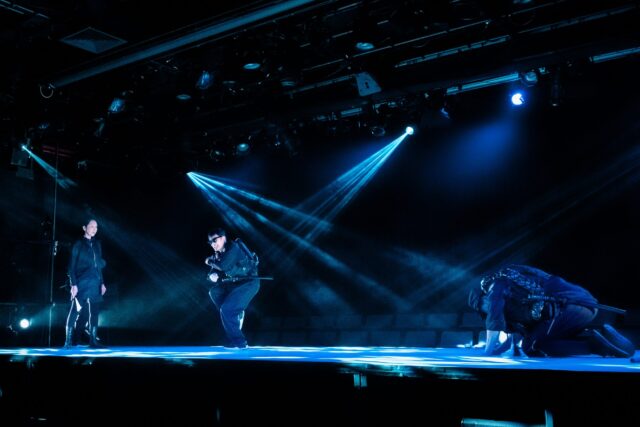
Kinoshita Kabuki’s Kanjincho features sensational lighting effects and characters dressed in all black (photo © Ayumi Sakamoto)
Beautifully directed and designed by Sugio Kunihara (Tokaido Yotsuya Kaidan, Shin Suikoden), Kanjincho — the English title, “The Subscription List,” refers to the scroll of supposed temple donors Togashi asks Benkei to reveal — takes place on a raised horizontal hanamachi (“flower path”) platform behind which two rows of the audience sit. The characters are dressed by Haruki Okamura in modern-day black militaristic gear except for Yoshitsune, who wears a wide-brimmed hat and carries a large walking stick, and Togashi, who is in more regal attire. The sound, by Daisuke Hoshino and Chiharu Tokida, includes moments of silence amid forest noises and Kaneko’s loud electronic and rap score.
Lighting designers Masayoshi Takada, Arisa Nagasaka, and Naruya Sugimoto nearly steal the show with spectacular effects, from pinpoint laserlike beams, slow, shadowy atmospheres, and an occasional subtle white bar on the floor that represents the numerous barriers separating the characters. “No matter how much I care about you / I can’t hold on to you / because of the borderline / You’re right next to me / but still so far away,” the pseudo–boy band sings in Japanese, except for the word borderline, which they say in English, connecting East and West. The East-West relationship is further developed by Kitao’s choreography, which incorporates traditional kabuki (primarily by Takayama) and hip hop, as well as by the casting of Benkei, portrayed by the outstanding Lee V, a caucasian poetry slam champion who was born in the United States; he evokes David Harbour as Sheriff Hopper in Stranger Things.
At its heart, Kinoshita’s adaptation attempts to break down barriers without preaching, even as the shitenno proclaim, “Equality for all!” and “Everyone’s the same! No more discrimination!” Having the same four men play the shitenno and the guards, running from one side of the stage to the other to indicate who they are without changing costumes — one actor apologizes for coughing first as a shitenno, then as a guard, equating the two despite their being enemies — packs a powerful message, especially in America today, as ICE agents patrol the streets of major cities rounding up citizens and legal and illegal immigrants alike.
Kunihara and Kinoshita may be delivering a warning, but they do so with a masterful sense of fun that transcends all our differences.
[Mark Rifkin is a Brooklyn-born, Manhattan-based writer and editor; you can follow him on Substack here.]