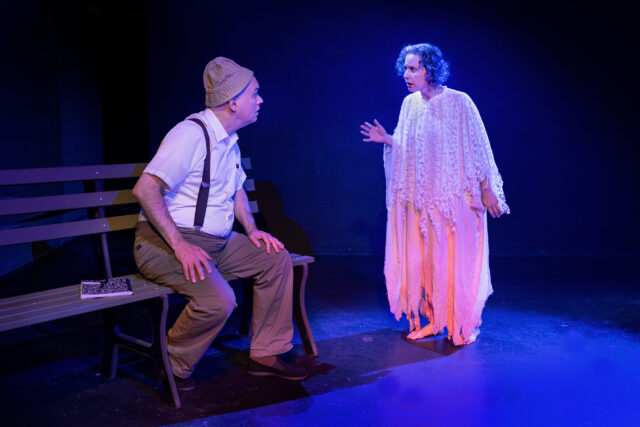
Shane Baker and Miryem-Khaye Seigel star in four spooky tales by Avrom Sutzkever (photo by Jeffrey Wertz)
NIGHT STORIES: 4 TALES OF REANIMATION BY AVROM SUTZKEVER
the wild project
195 East Third St. between Aves. A & B
Tuesday – Sunday through January 11, $54.22
thewildproject.com
www.congressforjewishculture.org
The wonderful duo of Shane Baker and Miryem-Khaye Seigel have again teamed up with directors Moshe Yassur and Beate Hein Bennett, this time for Night Stories: Four Tales of Animation, a quartet of short works by Smorgon-born Yiddish poet Avrom Sutzkever, a leader of the Jewish Resistance and a Vilna ghetto survivor who wrote and spoke often about the Holocaust; the play is a follow-up to last December’s Bashevis’s Demons, which dramatized three Yiddish tales by Nobel Prize winner Isaac Bashevis Singer and was also produced by the Congress for Jewish Culture.
Running at the wild project through January 11, the sixty-five-minute Night Stories features supernatural fantasies that are reminiscent of The Twilight Zone and Night Gallery but lack the final twist; in fact, the audience couldn’t tell when several of them had concluded. In addition, although each is told poetically amid an appropriately ominous atmosphere, unfortunate choices about the space can interfere with sight lines, resulting in the opening setting me off course from the start.
In the brief “A Child’s Hands,” Baker and Seigel stand at opposite sides at the front of the stage, emotionless as they perform the text in Yiddish. However, from my seat, Baker was blocking part of the supertitles, which are projected at the top back, behind him and Seigel. I had to shift quickly to the right and left to read the translation but even then could make out only some of it. The woman in front of me actually got up and changed her seat in the first row so she could see the words, adding to the distraction. Thus, it was hard to concentrate on what appeared to be an intense story about handprints on the frosty window of a cellar that holds a horse’s head and scraps from a women’s prayerbook.
“Lupus” is a solo piece in which Baker portrays a writer fed up with the spread of electricity, preferring to stay safely inside his apartment with his trusted old lantern. “Electricity is electric wires, electric chair. Maybe tomorrow they’ll make an electric bed, electric bride and groom, and electric children will be born. Or die,” he mutters to himself. “But the old lantern is like another living being. It’s my first appraiser. By night I read it my creations and according to the lantern’s expressive flame, I understand clearly which pieces can go to hell and which — to heaven.” He is soon joined by an orphaned shadow that he has resurrected, like his own Frankenstein’s monster, except this one, a former cyanide dealer called Lupus, wants him to “unalive” him. Instead, the writer reads from his manuscript, explaining, “I have a good memory because I’m not strong enough to forget.” Baker sits at a small table stage left, next to a divider onto which his shadow becomes Lupus. Although Baker does a good job using his voice to differentiate between the two characters, and Cameron Darwin Bossert’s lighting maintains the haunting feeling, the supertitles do not delineate who is saying which lines, so it’s often difficult to know who is speaking. And then the audience didn’t know it was over until the furniture began being rearranged.
In “There Where the Stars Spend the Night,” a man in a hat and suspenders (Baker), sitting on a park bench with his composition notebook, is joined by a woman (Seigel) who thinks he is the dead Volodya. “A miracle! How can you be alive, when your soul is no longer within you?” she declares. Deciding to go along with it, he responds, “I’ve been alive since I was born, maybe longer. And no one ever suggested such a divorce. True, I’ve never seen my soul, but I can swear it’s buried inside me safely and no sophisticated soul-thief has stolen it.” It’s an engaging exchange that also feels like more is to come.
The evening finishes with “Portrait in Blue Sweater,” about a writer who proudly wears the sweater his mother made him for Chanukah while he describes his friendship with real-life Vilna painter Chaim Urison. “A quiet type, his minimal speech was a pale imitation of his silence,” the writer says about the artist. “But his painting was eloquent, with an authenticity that shone out from underneath the colors, as if they were overpainted. Like clouds overpaint the sunset before a storm.” Evil spirits, souls, and a duel to the death are discussed until an image puts an exclamation point on it all.
Baker once again proves that he is a gem of Yiddish theater, as he has in such previous shows as God of Vengeance, Tevye Served Raw, and Waiting for Godot. There’s an elegant grace to the way he performs in Yiddish, a celebration of the language and its unique poetry, and he has a fine accomplice in Seigel, who is also a successful Yiddish singer-songwriter and music and culture scholar.
A program note points out, “The stories you will witness require your full sensory attention.” It also quotes Yiddish literature expert Professor Ruth R. Wisse, who writes in her introduction to the 1989 Sutzkever collection Prophecy of the Inner Eye, “For Sutzkever everything hangs on the precision of each Yiddish word. It is the supreme validation of reality and of his authentic powers as its prophet.” In addition to the problem I had following the English surtitles of “A Child’s Hands,” there were some dropped props and a few other minor distractions that impacted my overall enjoyment of the show, but I’m glad I saw it, and I will keep on going to anything Baker is involved with as he continues to resurrect the glory of Yiddish theater.
[Mark Rifkin is a Brooklyn-born, Manhattan-based writer and editor; you can follow him on Substack here.]