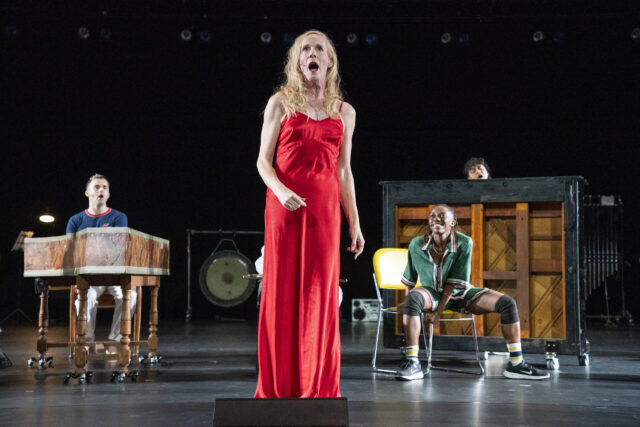
Kit Green leads a multitalented cast in disappointing North American premiere at Park Ave. Armory (photo by Stephanie Berger)
THE FAGGOTS AND THEIR FRIENDS BETWEEN REVOLUTIONS
Park Avenue Armory, Wade Thompson Drill Hall
643 Park Ave. at 67th St.
December 2-14, $40-$165
www.armoryonpark.org
The continuing attempted reclamation of the longtime gay slur “faggots” continues with the North American premiere of Ted Huffman and Philip Venables’s parable The Faggots and Their Friends Between Revolutions, running at Park Ave. Armory through December 14. In this case, it’s a lost cause.
Jordan Tannahill’s Prince Faggot, about queerness and the British royal family, just received yet another extension at Studio Seaview. In September, Baryshnikov Arts Center presented Kevin Carillo’s Figaro/Faggots, a mashup of Larry Kramer’s satirical 1978 novel, Faggots, and Mozart and Da Ponte’s 1786 opera, Le nozze di Figaro. And in August, TheaterLab staged Topher Payne’s Angry Fags, an election tale that deals with queer stories in a post-Trump world.
A baroque fantasia with music ranging from folk to medieval to opera to dance, The Faggots and Their Friends Between Revolutions was adapted from writer Larry Mitchell and illustrator Ned Asta’s 1977 book, when the F-word in question was much more a part of rampant homophobia and gay-bashing; the fifteen-member cast says “faggots” about a hundred times in a hundred minutes, but that doesn’t necessarily make its use sting any less, depending on one’s history with it.
The performers are already congregating on Rosie Elnile’s wide open set as the audience enters the massive Wade Thompson Drill Hall, building a sense of community. On three sides of the neatly arranged platform stage are numerous unmatched chairs, a clothes rack, a few tables, and such instruments as a harp, a gong, a cello, and several pianos on wheels. The show begins with the following declaration, complete with surtitles projected on a small screen hanging from above:
“It’s been a long time since the last revolutions / and the faggots and their friends are still not free. / There still exists a faint memory of the past when the faggots and their friends were free. / The memory lives in the faggots’ bones. / It appears late at night when their bones are quietest. / When the memory visits them, the faggots know / that they must find each other in order to survive. / So while the men are sleeping, they emerge from the corners of the devastated city / and they go searching for other faggots in the hidden places: / in alleyways and abandoned piers and empty parks and unlit warehouses. / And there, in the moonlight, the faggots will enact the ritual of the brief encounter.”
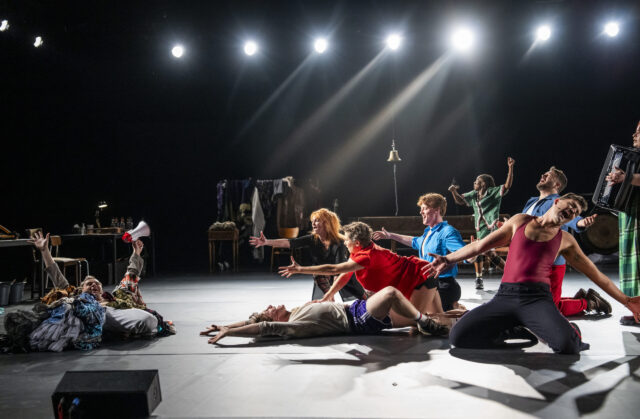
The Faggots and Their Friends Between Revolutions is based on a 1977 illustrated gay parable/manifesto (photo by Stephanie Berger)
The show is constructed like a healing ritual as the performers, all of whom participate in the storytelling and play an instrument, hold hands, hug, dance, form a circle, and offer warm, caring smiles to one another and the audience. Olivier Award–winning transdisciplinary artist Kit Green, wearing a series of tight-fitting, colorful gowns and skirts with high heels (the otherwise casual costumes are by choreographer Theo Clinkard), serves as a kind of host and narrator, leading the festivities, along with her right-hand colleague, Yandass, who stands out in a dynamic solo dance. The rest of the energetic, multitalented cast consists of soprano Tamara Banješević, accordionist Valerie Barr, plucked-string instrumentalist Kerry Bursey, cellist Jacob Garside, chamber musician Conor Gricmanis, woodwind doubler Rianna Henriques, soprano Mariamielle Lamagat, baritone Themba Mvula, pianist and music director Yshani Perinpanayagam, transdisciplinary artist Meriel Price, countertenor and multi-instrumentalist Collin Shay, baritone Danny Shelvey, and harpist Joy Smith.
The book was inspired by Mitchell and Asta’s time living in the Lavender Hill gay and lesbian commune outside of Ithaca that they helped found in 1970, partly in response to the Stonewall riots. “People in gay liberation tended to talk about [how] gay male culture of the 1960s really centered on ideas of isolation and loneliness, and this was going to be what gay communes solved,” Yale historian Stephen Vider says in the 2014 documentary short Lavender Hill: a love story.
Unfortunately, the various components don’t come together to form a cohesive whole, unable to bear the weight of such an underwhelming narrative and never capturing the joy in Asta’s black-and-white line drawings. The Faggots and Their Friends is a fable/manifesto that pits “the faggots” against “the men,” essentially all white cis males who live in and rule the land of Ramrod, led by Warren-and-his-Fuckpole. (Ramrod may have been named for the famed Greenwich Village gay leather bar, where three years after the book was published the West Street Massacre took place, in which a former transit cop shot eight men, killing two.)
The faggots, whose friends include the fairies, women who love women, and the queens, are kind, sweet, good-natured souls filled with empathy and compassion, while the men are corrupt, violent, mean-spirited villains who worship “papers” (money); there is no middle ground, no bad faggots, no admirable men. There is no nuance, too much telling and not enough showing, no dynamic flow or tension in the story and no growth in the characters despite there still being so much hate in America in 2025 amid the rollback of so many rights that were fought for, especially in the 1960s and ’70s.
Adapter and composer Venables and director Huffman, who previously collaborated on such projects as 4.48 Psychosis, Denis & Katya, We Are the Lucky Ones, and My Favourite Piece Is the Goldberg Variations, essentially remain faithful to the book, but what might work on the page falls flat on the stage, and the changes, including repeating phrases, are too didactic, preaching to the choir, overselling the points that are being made, as in the following missive, which was adjusted slightly from Mitchell’s original:
“They attacked anyone unlike them. / After the men triumphed, all that was other from them was considered inferior / and therefore worthy only of abuse and contempt and extinction. / The men decided who was to be hated: / those without cocks, / those whose skin didn’t match their own, / those who were hungry involuntarily, / those who came from other lands, / those who refused to be over-worked, / those who loved their own kind. / These are the ones the men decided to hate.”
They also cut out the characters in the book, such as Heavenly Blue, Loose Tomato, Mildred Munich, Pat, Lee, and Meredith, instead giving us nameless people we know nothing about — except for Green, who delivers a moving, fourth-wall-breaking improvisatory monologue about herself that is cut short by an extended singalong of a difficult melody with pedantic lyrics.
On opening night, there were noticeably few bursts of spontaneous applause from the audience, and there was only a scattered standing ovation at the end, even though it’s become de rigueur for everyone to get up and cheer. In fact, at one point in the show, Green actually told the audience to clap.
That’s never a good sign, particularly when you have the excited crowd already on your side from the very start.
[Mark Rifkin is a Brooklyn-born, Manhattan-based writer and editor; you can follow him on Substack here.]