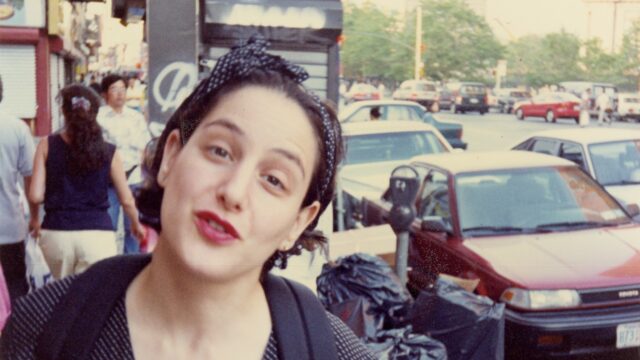
Award-winning filmmaker Alan Berliner explores the life and career of Benita Raphan in new documentary
BENITA (Alan Berliner, 2025)
DCTV Firehouse Cinema
87 Lafayette St.
November 28 – December 4
www.dctvny.org
alanberliner.com
Shortly after learning of his friend and longtime collaborator Benita Raphan’s suicide on June 10, 2021, documentarian Alan Berliner was asked by her family if he would complete the film she was working on when she died, at the age of fifty-eight. They gave him full access to her extensive archives, comprising notebooks, outtakes, drawings, photographs, and other ephemera. Berliner spent a year doing research and ultimately decided instead to make a film about her, in an attempt to better understand Betina as a person and filmmaker and, perhaps, why she hanged herself.
“Think of this film as an experiment in collaboration,” Berliner says at the start of the aptly titled Benita. “Benita left behind thousands of pieces; my job was to splice them together, to make a mash-up of our different filmmaking styles, to do whatever it takes to bring Benita’s creative spirit to life. But as much as anything, I also just wanted the joy of being able to work with Benita, one final time.”
Berliner conducted new interviews with more than a dozen people from Betina’s private life and professional career, including her mother, Roslyn Raphan; her friends Lucy Eldridge, Shari Spiegel, Miriam Kuznets, and Eric Latzky; her former boyfriend Eric Hoffert of the Speedies; composers Hayes Greenfield and Robert Miller, and SVA chair Richard Wilde. Together they paint a portrait of an eclectic, unusual, and caring avant-garde artist who was able to charm people into participating in the creation of her films — for free. Among the numerous words they use to describe her are “complex,” “serious,” “charismatic,” “a singular soul,” “a nonconformist,” “unpredictable,” “an irregular verb,” “nervous,” “anxious,” “intense,” “incredibly humble,” “fragile,” “vulnerable,” and “a scientist in an artist’s body.”
“I want to work on fun stuff, and her stuff is fun,” sound designer Marshall Grupp says.
“I wanted to help her, I wanted her to succeed,” notes postproduction facilitator Rosemary Quigley.
Producer, director, writer, editor, and narrator Berliner incorporates scenes from about half of Benita’s thirteen short films, focusing on ones that explore creativity, intelligence, and mental illness: 2002’s 2+2 (mathematician John Nash), 2004’s The Critical Path (architect Buckminster Fuller), 2008’s Great Genius and Profound Stupidity (author Helen Keller), and 2018’s Up to Astonishment (poet Emily Dickinson).
“Benita’s films aren’t really meant to be understood,” Berliner (First Cousin Once Removed, Intimate Stranger) explains. “She’s more interested in helping you make connections and stirring up feelings about her subjects using abstraction, layering, and rapid editing, sometimes all at once, to express things that can’t always be put into words, things like dreams, stream of consciousness, or visual metaphors. When Benita takes us inside the complicated minds of her subjects, she’s also trying to show us what it’s like inside her own.”
The film excerpts reminded me of the work of experimentalists Hollis Frampton, Stan Brakhage, and Maya Deren and such surrealists as Luis Buñuel and Salvador Dalí yet wholly original. Clips in which Benita is filming her shadow as she walks down the sidewalk or crunching on ice are poetically beautiful and memorable.
A 2019 Guggenheim fellow, Benita wrote down such thoughts as “Don’t be afraid to have bad ideas,” “Mistakes are an opportunity to start again & do it right,” and “Celebrate the confusion.” However, her more recent words ranged from “afraid” and “lost” to “I’m not myself” and “falling apart.”
She spent more time by herself near the end, dedicating many of her days to her dogs, including one who had severe psychological issues and another she named Rothko, after abstract painter Mark Rothko, who committed suicide in 1970 at the age of sixty-six. “Dogs don’t repeat any of your secrets,” she wrote.
Berliner captures Benita’s inner strength and unique style, but it’s not always possible to figure out why someone chooses death over life; mental illness is too often too difficult to diagnose, especially among friends and relatives.
Benita, which had its world premiere at the recent DOC NYC festival, is screening November 28 to December 4 at DCTV Firehouse Cinema, with Berliner, the recipient of last year’s DOC NYC Lifetime Achievement Award, on hand for Q&As following one showing each night, with such guests as Firehouse Cinema’s Dara Messinger and filmmakers Deborah Shaffer, Doug Block, and Caveh Zahedi in addition to several special short films on December 1, 3, and 4.
[Mark Rifkin is a Brooklyn-born, Manhattan-based writer and editor; you can follow him on Substack here.]