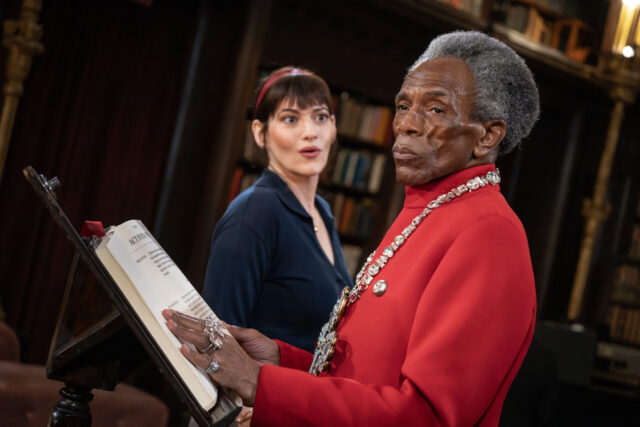
Cleante (Hannah Beck) has plenty of reason to not trust Tartuffe (André De Shields) in playful revival (photo by Joan Marcus)
ANDRÉ DE SHIELDS IS TARTUFFE
House of the Redeemer
7 East Ninety-Fifth St. between Fifth & Madison Aves.
Through November 23, $72 – $162
www.tartuffenyc.com
www.houseoftheredeemer.org
Two classic plays dealing with power and control are currently running off Broadway, one wisely built around its beloved star, the other celebrating the author but detracting from the story.
Star power needs to shine in a suitable setting, and André de Shields has one befitting his resplendence in the House of the Redeemer. Built in 1914–16, the mansion was originally owned by Edith Shepard Fabbri, a great granddaughter of Commodore Cornelius Vanderbilt, and her husband, Ernesto Fabbri, an associate of J. Pierpont Morgan’s. By midcentury it was deeded to the Episcopal Church, run by the Sisters of St. Mary until 1980, and designated a New York City Landmark in 1974.
Today it is home to concerts, Bible study, yoga, morning and evening prayers, cancer patients from Sloan-Kettering, and, through November 23, the gallantly titled and playfully rendered André De Shields Is Tartuffe. The scandalous 1664 French farce is being presented to a limited audience of one hundred a night in the historic library, which was constructed in an Italian ducal palace in the early 1600s and transported in two parts to New York City from Italy during WWI, serving as the centerpiece of the mansion.
The audience, sitting on three sides of the action, does not get to see the centerpiece of the show until the third act. Upon arriving at the House of the Redeemer, ticket holders are led into a salon with portraits, lenticular photos of Tartuffe, and a note from him that reads, “Tonight’s exorcism will redeem you as my true sycophants. The hour is upon you to seek within the sacred shelves of this salon and library six keys, six crosses, and six scrolls which will quicken your souls to a new dawn, a new day, a new life, and a new way . . . of . . .” There are also copies of D. H. Lawrence’s Lady Chatterley’s Lover, Jonathan Swift’s A Modest Proposal, and other books in the room, setting the literary mood. In the library, music director Drew Wutke is playing such sing-along pop songs as Billy Joel’s “Only the Good Die Young,” Journey’s “Don’t Stop Believin’,” and the Proclaimers’ “I’m Gonna Be (500 Miles)” as the cast interacts with the audience, effectively shifting the tone.
Under Keaton Wooden’s whimsical direction, Ranjit Bolt’s 1991 verse translation unfurls on Kate Rance’s elegant set: just a few chairs, a pink couch, a lectern, and a Persian carpet. A long table at one end boasts seasonal decorations and a few more open books. The play begins with the characters introducing themselves: patriarch Orgon (Chris Hahn), who is hiding financial difficulties from his family; his second wife, Elmire (Amber Iman); his children, Damis (Tyler Hardwick) and Marianne (Alexandra Socha); his mother, the aristocratic Mme. Pernelle (Todd Buonopane), who goes everywhere with her (stuffed) dog, Flipote; the all-knowing housemaid, Dorinne (Phoebe Dunn), who never hesitates to speak her mind; Valère (Charlie Lubeck), who is engaged to Marianne; and Cleante (Hannah Beck), Elmire’s philosophical sister who is in love with Damis’s sibling.
Orgon and his mother have fallen under the spell of a man the others refer to as an “evil, scheming, cleverly charismatic, pretty sleazy, and potentially ruinous priest” named Tartuffe (De Shields). The stage is set early on, in this wonderful piece of dialogue:
Mme P: I’ve heard you say things that were sane. / And yet, to me, this much is plain: / My son should bar you — drive you hence. / He would if he had any sense. / You stand on shaky moral ground, / The mode of life that you expound / Is one that no one should pursue — / No decent person, in my view.
Damis: Your friend Tartuffe would jump for joy . . .
Mme P: You should pay him more heed, my boy. / Tartuffe’s a good man — no, the best, / And if there’s one thing I detest / It is to see a fool like you / Carping at him the way you do.
Damis: The man is a censorious fraud / And yet he’s treated like a lord! / He’s seized control, that’s what he’s done / No one can have an ounce of fun / Do anything but sleep and eat / Unless it’s sanctioned by that creep.
Dorine: Name just one thing he hasn’t banned, / Condemned as “sinful,” out of hand — / We have some harmless pleasure planned / And straight off he prohibits it, / The pious, pompous, piece of —
Mme P: – SHHHHH! / How else are you to get to Heaven? / He should ban six things out of seven / And you should love him, all of you — / In fact, my son should force you to.
Orgon is besotted with Tartuffe, who he claims has changed his life and set him free; he declares with no remorse, “Yes, I could see my family die / And not so much as blink an eye.” When he announces that he is going to give Marianne to Tartuffe instead of to Valère, no one is happy, especially Marianne, but she lacks the ability to defy her father’s wishes. And Orgon’s devotion to Tartuffe only grows more intense and problematic as time goes on.
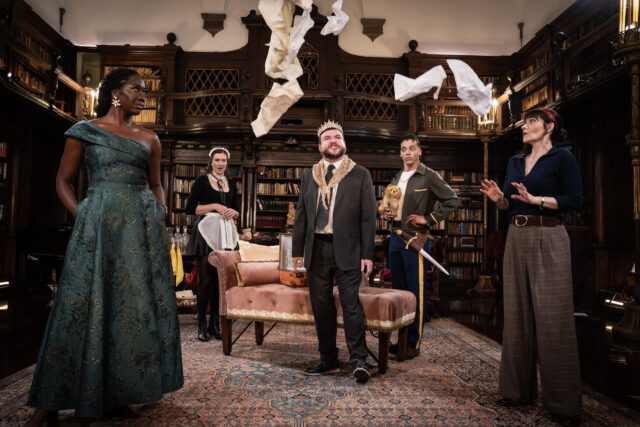
A family is torn apart by a con man in André De Shields Is Tartuffe (photo by Joan Marcus)
Ah, yes, and then there’s De Shields himself. He is once again given the most grand of grand entrances, as he was in Cats: The Jellicle Ball. I wrote at the time about the Tony, Obie, and Grammy winner, “This is André De Shields’s world; we only live in it.” Tartuffe only reinforces that statement.
“Here comes Tartuffe!” Dorine declares, but she is really proclaiming, “Here comes André!” In the script, it merely says, “Tartuffe enters. It deserves its own page.” There is nothing else.
Twin doors open, and there is he, Tartuffe, in a spectacular cardinal-like floor-length red robe, a giant bejeweled cross around his neck and chest, shiny rings on almost every finger, and dark sunglasses. (The costumes, a mix of period chic and standard contemporary, are by Tere Duncan.) He preens to the audience as he prepares to chew as much scenery as possible through the rest of the play, with Tartuffe making bold confessions, secretly seeking romance, and lying through his teeth, his personal hypocrisy evoking that of the Catholic church and the upper classes. He is a magnetic con man — with fantastic silver hair — who knows precisely how to play the game, ready to improvise as necessary.
When Damis tells Orgon how the priest tried to seduce Elmire, Tartuffe admits, “Why should I try to hoodwink you? / Brother, your son speaks true: I am / A sinner, yea, a wicked man! / My rank iniquities are rife / And every instant of my life / Is foul with sin! Yes, all the time / I add another heinous crime / To a long list. I roll among / The other swine in swathes of dung! / Small wonder Heaven is content / To sit and watch my punishment. / Whatever charge he wants to lay, / Nothing, not one word, will I say / In my defense — I lack the pride. / Let me be loathed and vilified. / Believe him! Give your wrath full rein! / Cast me into the street again / Like any felon. Shame? Disgrace? / I merit them in any case, / Lay ignominy at my door, / I’ve earned it, fifty times and more!” But Orgon attacks his son as his love and respect for Tartuffe intensifies.
The show is a hilarious romp, with stand-out performances by Tony, Emmy, and Grammy winner De Shields, Tony nominee Iman, and Dunn, who is always worth watching, even when Dorinne is not in a scene. It can get a little goofy at times, and if you’re in the second or third row you might have some trouble seeing every detail, but it’s all so sweet-natured that you can forgive it its minor sins.
Among those who have previously portrayed Tartuffe onstage and on film are Raúl E. Esparza, Emil Jannings, Gérard Depardieu, Antony Sher, and John Wood; later this month, Matthew Broderick will play Tartuffe in a new adaptation by Lucas Hnath at New York Theatre Workshop. None of them get to have their name in the title.
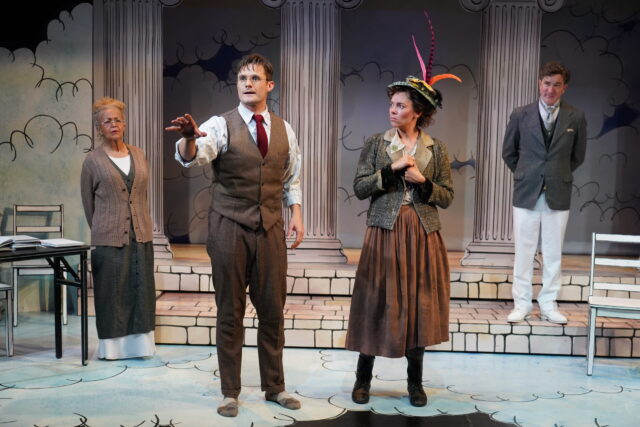
Professor Henry Higgins (Mark Evans) has plans for Eliza Doolittle (Synnøve Karlsen) in Gingold production Bernard Shaw’s Pygmalion (photo by Carol Rosegg)
BERNARD SHAW’S PYGMALION
Theatre Row
410 West 42nd St. between Ninth & Dyer Aves.
Wednesday – Sunday through November 22, $36.50 – $92.50
gingoldgroup.org
bfany.org
Upon entering the theater to see Gingold Theatrical Group’s twentieth anniversary production of Bernard Shaw’s Pygmalion — yes, the playwright’s name is part of the title — audience members are greeted by a series of posters featuring Al Hirschfeld drawings of George Bernard Shaw, including Shaw standing on the shoulders of William Shakespeare and Shaw painting a self-portrait with a colorful background. Lindsay Genevieve Fuori’s set is like a Hirschfeld tableaux, with a few chairs and tables, two steps leading to the facade of an opera house / temple with four ionic columns, a gable, and a raking cornice, and clouds with a hint of blue; in addition, there is a gold phonograph and a black recording machine that uses wax cylinders.
Hovering above is a caricature of Shaw as a winged angel, looking down as if he is a puppet master pulling all the strings. Several times during the show, thunder and lightning emerge from Shaw, reasserting his power and control over the proceedings. It comes off more as distraction than homage, artificially interrupting the narrative. Also disturbing any sense of flow is the intermittent appearance of four gods (Carson Elrod, Teresa Avia Lim, Lizan Mitchell, and Matt Wolpe, in multiple roles) who address the audience directly. They are based on a framing concept Shaw had drafted for the 1938 film adaptation but eventually scrapped; the dialogue Gingold founding artistic director David Staller uses is verbatim from the 1945 production with Gertrude Lawrence and Raymond Massey.
“Once upon a time, when we gods had a little more respect, you humans loved us. You built temples to us. We were always with you. Watching. Weaving our spells. And laughing at you,” Goddess 1 (Mitchell) says at the beginning. Goddess 2 (Lim) concurs, adding, “We laughed at you a lot. We still do.” There are not many laughs in this romantic comedy, and the satirical social commentary gets lost in the shenanigans.
The play, famously turned into the beloved 1956 musical My Fair Lady by Alan Jay Lerner and Frederick Loewe, was inspired by the Greek myth of the sculptor Pygmalion, a lonely man who carves a statue of a perfect woman he calls Galatea and then begs the gods to make real, which they do, but, as Goddess 1 explains, “There was a catch. A clause. A little hiccup that Pygmalion hadn’t thought to negotiate. The statue came to life, but with her own thoughts and feelings, with her own will. This possibility had somehow never occurred to Pygmalion. Oh, you funny humans. You men, in particular. And this, people: This is the story of that artist as reimagined by our friend, Mr. George Bernard Shaw.”
In Pygmalion, professor Henry Higgins (Mark Evans) is a persnickety phonetician lacking manners or social skills. When he encounters a poor, raggedy flower seller named Eliza Doolittle (Synnøve Karlsen) who speaks in what he considers a low-class Cockney accent, he makes a bet with his only friend, the far more practical Col. Pickering (Elrod). “You see this creature with her kerbstone English: the English that will keep her in the gutter to the end of her days,” he says to Pickering, right in front of Eliza, as if she’s not a person but a piece of clay. “Well, sir, in six months I could pass that girl off as a duchess at an Ambassador’s Garden Party.”
And so Higgins goes about molding Eliza into what he believes will be an honorable and respectable woman of society without paying attention to what Eliza wants, which is just to run her own flower shop. She defends herself by repeating over and over, “I’m a good girl, I am!” but that has no impact on Higgins, who treats her like she’s nothing more than a scientific experiment, referring to her as “so deliciously low. So horribly dirty. . . . I shall make a duchess of this draggle-tailed guttersnipe.”
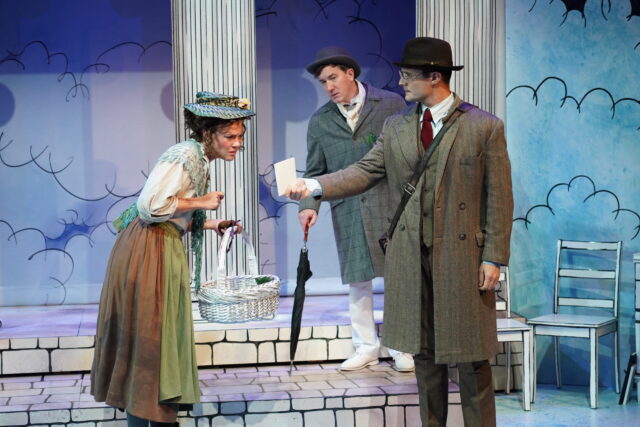
Professor Henry Higgins (Mark Evans) has something to show Eliza Doolittle (Synnøve Karlsen) as Freddy (Matt Wolpe) looks on (photo by Carol Rosegg)
Meanwhile, Higgins’s mother (Mitchell) is not a fan of her son’s plan, pointing out to him and Pickering when they discuss the problem of transforming Eliza into a lady, “No, you two infinitely stupid male creatures: the problem of what is to be done with her afterwards.” Eliza’s estranged father, Alfred (Wolpe), is seeking a payoff to look the other way. Higgins’s housekeeper, Mrs. Pearce (Mitchell), insists that Higgins treat Eliza like a woman with her own mind. And Freddy (Wolpe), the sister of the prim and proper Clara (Lim), takes a shine to Eliza.
However, in inventing a new Eliza, Higgins gets more than he bargained for.
Goddess 1 strikes at the heart of the play when she says, “This is about human nature and human ridiculousness. It’s about . . . what is it about? About how easy it is to hide from ourselves. To hide from life. To wear the mask.” But Staller, who has previously helmed productions of such Shaw works as Mrs. Warren’s Profession, Heartbreak House, Arms and the Man, and Caesar & Cleopatra, with mixed results, can’t capture the essence of Shaw’s words in his staging. The humor falls flat, the acting is inconsistent, and the movement is too stagnant.
Staller might be among the most knowledgeable Shaw scholars on the planet — Gingold’s Project Shaw has presented all-star readings of every Shaw play, including “The Shewing-Up of Blanco Posnet” with André De Shields — but Bernard Shaw’s Pygmalion feels like a piece of marble that still requires a lot of chiseling and forming. Cue the lightning and thunder.
[Mark Rifkin is a Brooklyn-born, Manhattan-based writer and editor; you can follow him on Substack here.]