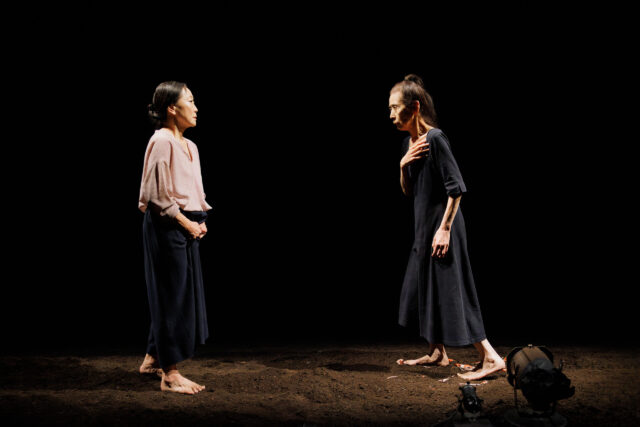
Wen Hui and Eiko Otake share personal moments involving war in moving piece at BAM (photo by Maria Baranova)
WHAT IS WAR
BAM Fisher, Fishman Space
321 Ashland Pl.
October 21-25, $55, 7:30
www.bam.org/whatiswar
“Why, eighty years after the end of the Second World War, do we still have wars?” Eiko Otake and Wen Hui’s What Is War posits.
It’s a potent question, one that the two interdisciplinary artists explore in the powerful seventy-minute presentation, continuing at BAM’s Fishman Space through October 25. There’s purposely no question mark after the title because the show does not intend to provide any answers; instead, it’s more about personal experience.
Eiko, who was born and raised in postwar Japan and has lived in New York City since 1976, and Wen, who grew up in China during the Cultural Revolution and is based in Frankfurt, Germany, have been friends for thirty years. During the pandemic, they made the award-winning video diary No Rule Is Our Rule, after Eiko’s visit to China to collaborate with Wen was cut short.
They are now out on the road touring What Is War, which combines text, movement, and film to tell each of their stories and how they overlap. The show begins with a video clip of the two talking, projected on the large back wall. After a few minutes, Eiko humorously checks with Wen to make sure she is recording their conversation, admitting that she sometimes forgets to flip the switch and ends up having to do it all over again. It’s the last laugh of the evening.
The two women then appear at opposite sides of the black box theater, Eiko in a long, dark dress, Wen in a light blouse and long black skirt. Both barefoot, they walk agonizingly slowly toward each other across a narrow strip of dirt, a kind of graveyard where they meet in the middle, digging up the past. In front of archival footage, Wen explains how her grandmother died during the Japanese bombing of Kunming in December 1941; Wen’s mother was only five at the time. “I never had a chance to meet my grandmother,” she says. “I did not even know her name.”
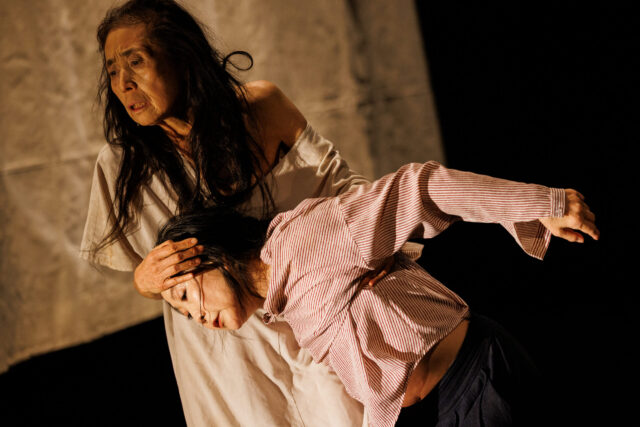
Eiko Otake and Wen Hui come together and break apart in What Is War (photo by Maria Baranova)
Eiko shows a photo of her parents’ wedding, projected onto an angled hanging cloth at stage right. “They married on August 10th, 1945, one day after the atomic bombing of Nagasaki and five days before Japan’s surrender,” she says, detailing how her father pretended to have tuberculosis to avoid military service. “Wen Hui, when I visited you in China and spent time with your mom, I felt really glad my father lied.”
Throughout the piece, which is dramatically lit by David A. Ferri, Eiko and Wen come together and drift apart, sometimes tenderly, sometimes with more force, as Eiko discusses the bombing of Tokyo by America, which killed one hundred thousand Japanese in six hours; Wen goes to a hospital to cheer up wounded soldiers during the Sino-Vietnamese War; Eiko points out the antiwar statements in Japan’s postwar constitution; and Eiko and Wen travel to the Lijixiang Comfort Station in Nanjing, where sex slaves were made available to the Japanese army. (Today the facade of one of the buildings is covered with contemporary photos of the women.)
At times, the performers push a horizontal mirror on wheels around the stage, which provides provocative reflections while also implicating the audience in the action.
In one of the most harrowing moments, Eiko recalls the late Japanese writer Kyoko Hayashi, who grew up in Shanghai, asking her, “Bodies I saw on August 9 had no outlines. Otake-san, when you perform, can you please think of such a body, a body without outlines?”
What Is War is a hard show to watch; Eiko and Wen pull no punches as they bare their souls and their bodies, using the past as a way to try to build a better, safer, more caring future, probably in vain if current events are any evidence. Any metaphors are in the movement itself; everything else unfolds as a bold, direct accusation of man’s seemingly never-ending thirst for battle, power, and domination.
Fortunately, each performance concludes with a catered gathering in the downstairs lounge, where Eiko and Wen are eager to speak with attendees and hear their thoughts on the work and on war, with plenty of smiles and hugs.
[Mark Rifkin is a Brooklyn-born, Manhattan-based writer and editor; you can follow him on Substack here.]