Elizabeth Lo is given remarkable access to a love triangle in award-winning documentary Mistress Dispeller
MISTRESS DISPELLER (Elizabeth Lo, 2024)
IFC Center
323 Sixth Ave. at West Third St.
Opens Wednesday, October 22
www.ifccenter.com
In her debut feature-length documentary, 2020’s Stray, Elizabeth Lo tracked a remarkable homeless canine named Keytin as the golden mutt lived a dog’s life on the streets of Istanbul, allowing Lo to capture his every move, telling the dog’s story from his perspective.
Lo has followed that up with Mistress Dispeller, in which the participants in a love triangle allow Lo to capture their every move, telling their story from each of their unique perspectives.
Taking inspiration from Chantal Akerman’s Jeanne Dielman, 23 Quai due Commerce, 1080 Bruxelles and Akira Kurosawa’s Rashomon, Lo’s film explores a relatively new “love industry” in China, mistress dispellers, who, for fees of tens of thousands of dollars and more, are hired by women who believe their husbands are having an affair; over the course of two or three months, the dispeller, using a false identity, ultimately convinces the mistress to end the illicit romance through a structured technique. They do so in a calm, unobtrusive way, treating all three parties with dignity and respect.
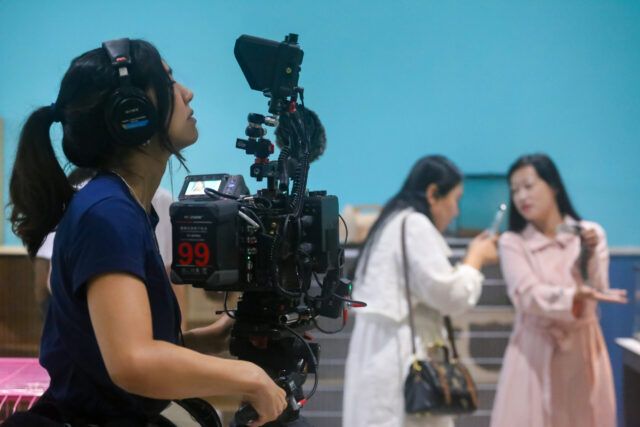
It took three years for Lo to find mistress dispeller Wang Zhenxi, then get permission to document one of her cases, in which Mrs. Li wants to end her husband’s affair with the younger Fei Fei. Wang poses as a cousin of Mr. Li’s who is interested in learning the married couple’s favorite pastime, badminton. Wang carefully orchestrates various meetings in which she spends time alone with the mistress, studies her motivations and emotions, and comes up with a plan. Lo’s mounted, still camera is in every room, every car — but not necessarily Lo, who sometimes leaves the camera recording as she exits the space, permitting her subjects to talk more openly without her watching. “I am just a vessel in their lives,” Wang says, and so is Lo. (Lo had previously interviewed Mrs. Li’s younger brother, who was a dispelled male mistress and recommends Wang in the film.)
Although it is made clear from the start that this is not some kind of game, there are winners and losers. “It’s just like a war. You either win or lose everything,” Wang explains. Fei Fei admits, “Winning or losing isn’t the question. Actually, neither is important to me anymore. Because there are many more important things than winning.” But later she states, “I can’t keep losing though, right? Everyone wants to win. Why can’t the winner be me?”
Lo directed, produced, and photographed the film in addition to writing and editing it with Charlotte Munch Bengtsen. She gives equal weight to Mr. Li, Mrs. Li, and Fei Fei while delving into Wang’s methods. Time and money is never discussed; instead, Lo focuses on the care Wang employs in her business, determined to achieve a satisfying result for all involved. The access Lo is supplied is astounding; of course, only Mrs. Li knows what’s happening at first, but soon Mr. Li understands as well, while Fei Fei discovers the deception only at the conclusion.
Lo does not seek to elicit any judgments, but she includes several scenes in which Mrs. Li and Fei Fei carefully tend to their personal style, taking care to dress well and get their hair done, while Mr. Li, the object of each woman’s affection, is not exactly a fashion plate or a great conversationalist. However, the film does not ask us to question the love — and we know from the start that Wang’s goal is to restore the marriage, with the mistress out of the picture.
In a program note, Fei Fei says, “I am willing to participate in filming because, considering the long river of life, this is a small part of it. But it’s also something that’s significant to me right now. I see this as a documentary of my life. It is also a portrait of love. From the beginning of our encounter, to the middle of the relationship, and the end, it’s all part of this process of love. . . . Love doesn’t disappear, it just diverts. It’s just a process of love moving around. It’s quite meaningful to make time to recall and witness the process for yourself — whether the path you take is right or not. . . . When others see this film, they might gain some insights from it.”
Meanwhile, Mrs. Li explains, “Teacher Wang taught me a lot. About love, and other things. She said, ‘Look, you are going through this, this difficulty, and we should film it, so more women, more people, can face their families and learn how to handle a situation like this. . . .’ I want more people to know that love doesn’t come easy, especially for people at our age. Don’t give up so easily.”
The film also touches on aspects of contemporary Chinese dating, from matchmaking seminars and fairs to online channels. Lo occasionally cuts away for drone shots of cities and mountainous landscapes, incorporating all of China into the narrative, merging the inner and outer worlds of the people and the country.
Mistress Dispeller opens October 22 at IFC Center, with Lo on hand for Q&As at the 6:35 screenings on Wednesday with Penny Lane and Thursday with Constance Wu; Lo and Wu will also deliver an extended introduction before the 9:00 show on Saturday.
[Mark Rifkin is a Brooklyn-born, Manhattan-based writer and editor; you can follow him on Substack here.]