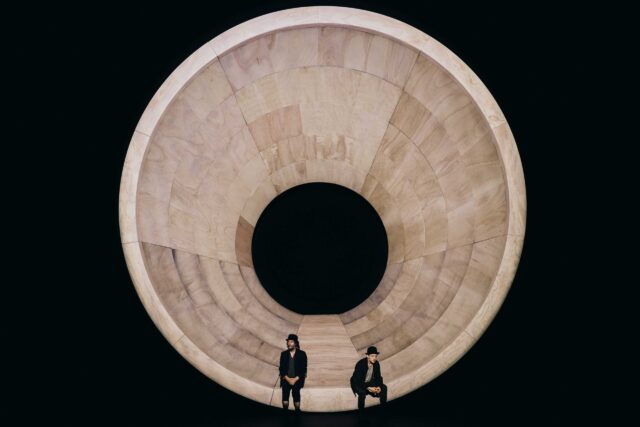
Keanu Reeves and Alex Winter star in Broadway smash version of Samuel Beckett’s Waiting for Godot (photo by Andy Henderson)
WAITING FOR GODOT
Hudson Theatre
141 West Forty-Fourth St. between Sixth & Seventh Aves.
Tuesday – Sunday through January 4, $98.56-$558.88
godotbroadway.com
www.thehudsonbroadway.com
“There’s nothing to do,” Vladimir tells Estragon in Samuel Beckett’s 1953 masterpiece Waiting for Godot.
There’s plenty to do for Beckett fans in New York City right now, much but not all of it a most excellent adventure.
The talk of the town is Keanu Reeves and Alex Winter reprising — well, channeling? — their roles from 1989’s Bill & Ted’s Excellent Adventure and the 1991 and 2020 sequels in Godot at the Hudson Theatre. Action star Reeves is making his Broadway debut as Estragon (Gogo) in Jamie Lloyd’s bumpy adaptation, while Winter returns to the Great White Way for the first time in forty-four years as Vladimir (Didi).
Reeves and Winter follow in the formidable footsteps of such duos as Michael Shannon and Paul Sparks, Ian McKellen and Patrick Stewart, and Robin Williams and Steve Martin and, for the most part, hold the audience’s attention. Gogo and Didi usually find themselves in a strange, dark wasteland, with only a single bare tree, a country road, and a solitary stone as they contemplate life and death, heaven and hell, and existence and humanity, but Lloyd and set designer Soutra Gilmour locate them inside a giant tube that is part tunnel, part circular skateboard ramp, part existential void in space. Resembling abandoned vaudevillians in all black, sporting impressive bowlers (the costumes are also by Gilmour), they sit at the edge of the tube, feet dangling, waiting for the mysterious Godot to arrive and, perhaps, bring meaning to their sad, pathetic lives.
They are visited instead by the loud, blustery Pozzo (Brandon J. Dirden) and his menial, an apparent servant named Lucky (Michael Patrick Thornton). Pozzo usually leads Lucky around by a rope around his neck — evoking master and slave, circus ringleader and animal performer while referencing the rope Gogo had mentioned earlier when he and Didi considered hanging themselves — but here Lloyd has the verbally abusive Pozzo pushing Lucky, who is in a wheelchair, altering their dynamic. Curiously, Lucky breaks the fourth wall several times, acknowledging the audience and encouraging them to clap after he does his dance (with his head and hands). In addition, a young boy (Eric Williams or Zaynn Arora) shares important information with Gogo and Didi.
Lloyd (A Doll’s House, Sunset Blvd.) has slimmed down the show to just over two hours including intermission, so the pacing works well. Lloyd’s decision to get rid of nearly all the usual props, including a key carrot that Gogo chews in an annoying manner, seems like overkill. There’s a perpetual droning hum of doom hovering over the proceedings (the sound is by Ben and Max Ringham), contrasting Jon Clark’s subtle lighting shifts, highlighted by dazzling surprises at the end of each act.
Reeves and Winter may not display a wide range of emotions, but they avail themselves well enough to keep the audience engaged. At one point Didi says, “This is not boring you I hope,” looking out at us, and we essentially answer no.
Bill and Ted enthusiasts may whoop when Gogo says, “Back to back like in the good old days,” and the two actors stand back to back and play air guitar, echoing what they do in the film series, but the reference feels out of place in a show that exists in a barren emptiness and is about nothing (and everything).
“The only true wisdom consists in knowing that you know nothing,” Bill says in the first movie, quoting Socrates. Ted responds, “That’s us, dude.”
Party on, dudes!
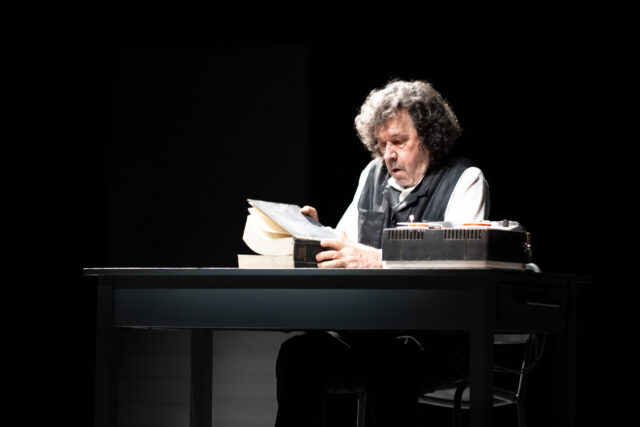
Stephen Rea is mesmerizing as a man listening to his past in Krapp’s Last Tape (photo courtesy Patricio Cassinoni)
KRAPP’S LAST TAPE
NYU Skirball Center for the Performing Arts
566 La Guardia Pl.
Through October 19, $83-$130
nyuskirball.org
“Nothing to say,” an old man declares in Samuel Beckett’s 1958 autobiographical classic, Krapp’s Last Tape, a fascinating kind of companion piece to Waiting for Godot.
In 2012, Irish actor Stephen Rea decided to go into a studio and perform the prerecorded sections of Krapp’s Last Tape, in case he was ever asked to do the one-man show, in which a dissatisfied man listens to tapes his younger self made thirty years before. Rea is now touring the play, which continues at the NYU Skirball Center through October 19.
Jamie Vartan’s spare set features a desk in the center, an overhead hanging light, and a door at the back, stage right. Paul Keogan’s shadowy lighting maintains an old-fashioned vaudeville black-and-white feel. The past is present in both Vicky Featherstone’s taut staging and the theme of the play.
The show begins with Krapp slowly opening a hilariously long drawer and removing a banana. He eats the fruit — the yellow of the banana stands out from the otherwise colorless gloom — and tosses the peel onto the floor, where, of course, he soon slips on it. He does not make the same mistake twice.
To celebrate his birthday, he is going to listen to one of his old reel-to-reel tapes, the one he made when he turned thirty-nine, discussing his life. He brings in the machine and a stack of tapes, carefully searching for box three, spool five, taking great delight in saying the word “spool” over and over again. “Thirty-nine today, sound as a bell, apart from my old weakness, and intellectually I have now every reason to suspect at the . . . crest of the wave — or thereabouts,” he listens to his old self explain. “Good to be back in my den, in my old rags. Have just eaten I regret to say three bananas and only with difficulty refrained from a fourth. Fatal things for a man with my condition. Cut ’em out! The new light above my table is a great improvement. With all this darkness round me I feel less alone. In a way. I love to get up and move about in it, then back here to . . . me. Krapp.”
Not much has changed in those thirty years; his loneliness in the darkness is palpable. He looks up the meaning of “viduity,” sings, and recalls a romantic evening on a lake. But the tape does not provide him with happiness; he barks out, “Just been listening to that stupid bastard I took myself for thirty years ago, hard to believe I was ever as bad as that. Thank God that’s all done with anyway.”
What’s next? Well, the play’s French title is La Dernière Bande, or “The Last Tape.”
Krapp’s Last Tape has previously been performed by such actors as Patrick Magee, Harold Pinter, Brian Dennehy, and Michael Gambon; I’ve seen it with John Hurt at BAM and, earlier this year, F. Murray Abraham at the Irish Rep. The play, a haunting examination of time, memory, and the futility of language, works best in more intimate quarters; it gets a bit lost at the Skirball, even at only about fifty minutes.
Rea (A Particle of Dread, Cyprus Avenue) inhabits the character with a graceful elegance despite Krapp’s pathetic, sad-sack circumstances, at times recalling Buster Keaton, one of Beckett’s favorites. It’s a bravura performance that I would have loved to see in a significantly smaller venue.
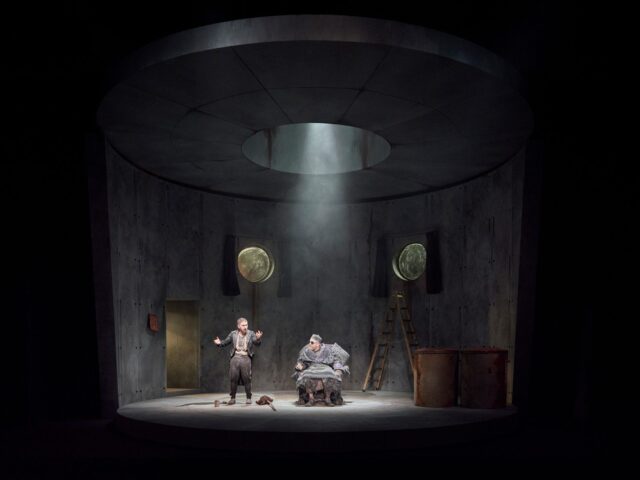
Druid production of Samuel Beckett’s Endgame comes to Irish Arts Center for monthlong run (photo by Ros Kavanagh)
ENDGAME
Irish Arts Center, JL Greene Theatre
726 Eleventh Ave. between Fifty-First & Fifty-Second Sts.
October 22 – November 23, $25-$86
irishartscenter.org
“Nothing is funnier than unhappiness,” Nell tells Nagg in Samuel Beckett’s 1957 chess-inspired Endgame, which takes place during some kind of apocalypse as four characters contemplate their fate in a dingy basement dungeon, two of them living in garbage cans.
In a conversation in the Skirball program for Krapp’s Last Tape, Stephen Rea tells director Vicky Featherstone and Dr. Tanya Dean, “Endgame is a tough thing. I remember Beckett saying he loved Endgame, and he didn’t like Waiting for Godot. And I said, ‘Well, it’s been absorbed.’”
Rea played Clov in the 1976 Royal Court production of Endgame; I’ve seen the show twice, in 2008 at BAM with Max Casella, Alvin Epstein, Elaine Stritch, and John Turturro, and in 2023 at the Irish Rep with John Douglas Thompson, Bill Irwin, Joe Grifasi, and Patrice Johnson Chevannes. From October 22 through November 23, Galway’s Druid theater company will be presenting Endgame at the Irish Arts Center, with Tony winner Marie Mullen, Bosco Hogan, Aaron Monaghan, and Rory Nolan, directed by Tony winner Garry Hynes. As with Soutra Gilmour’s set for Waiting for Godot on Broadway, Francis O’Connor’s scenic design for Endgame also emphasizes the circularity of life.
Monaghan, who plays Clov, previously starred as Estragon opposite Marty Rea (no relation to Stephen) in Druid and Hynes’s Waiting for Godot at Lincoln Center’s 2018 White Light Festival. Hynes also helmed a stunning Richard III starring Monaghan in 2019 as well as The Beauty Queen of Leenane at BAM in 2017, with Marty Rea and Mullen.
Endgame is part of Druid’s fiftieth anniversary celebration. In the play, Clov shouts, “The end is terrific!” But luckily for theatregoers, the end appears to be nowhere in sight for Druid, or for seeing Beckett in New York.
[Mark Rifkin is a Brooklyn-born, Manhattan-based writer and editor; you can follow him on Substack here.]