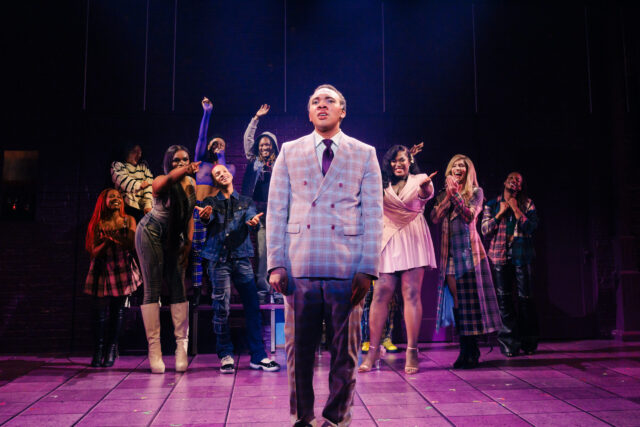
Ulysses (Bryson Battle) finds himself living a double life in Saturday Church (photo by Marc J. Franklin)
SATURDAY CHURCH
New York Theatre Workshop
79 East Fourth St. between Second & Third Aves.
Tuesday – Sunday through October 24, $63-$129
www.nytw.org
Tony winner J. Harrison Ghee is glorious as Black Jesus in the world premiere of Saturday Church at New York Theatre Workshop. The same cannot be said for the rest of the show.
Adapted by Emmy nominee Damon Cardasis from his 2017 film — he has written the book and additional lyrics with Pulitzer winner and Tony nominee James Ijames — Saturday Church feels like something you’ve already seen, Choir Boy filtered through Cats: “The Jellicle Ball” with a heavy dash of The Voice and RuPaul’s Drag Race and a touch of Godspell. Which is to say, there is little new to the story or the production.
Boston Conservatory graduate Bryson Battle makes his professional debut as Ulysses, a teenager grappling with his sexuality shortly after his father’s untimely death. At church, he prays for his mother, Amara (Kristolyn Lloyd), and wishes he could join the choir, where his father excelled, but his aunt Rose (Joaquina Kalukango) thinks he’s “too much.” Ulysses says, “I see the way she looks at me and the way people talk . . . But I feel completely free when I’m singing in church. I just wish I could fit in . . . oh, and I’d love a Gucci belt. Thanks.”
While Amara works crazy hours at the hospital in order to pay the rent and put food on the table, Aunt Rose babysits him and worries that he is too “flouncy.” Ulysses expresses his frustration with his aunt but Amara just says, “I don’t have time for this. You two figure it out.”
Aunt Rose takes the matter up with Pastor Lewis (Ghee), who agrees with her, telling Ulysses, “We expect the men in the choir to comport themselves in a righteous way, like your dad. And I think some of your flamboyance might be distracting.”
On the subway, Ulysses meet-cutes Raymond (Jackson Kanawha Perry), a confident young man who suggests that he come to Saturday Church, where “everyone’s welcome. Gay. Queer. Trans. Straight kids that like queer kids, kids that just want a meal, and kids with no place to live. That’s me.” Ulysses is clearly considering Raymond’s invitation but is not ready to admit that he might be one of them.
At the Christopher Street Pier, Ebony (B Noel Thomas), who runs Saturday Church and is mourning the loss of her close friend Sasha, is dancing at a wild gathering with Heaven (Anania) and Dijon (Caleb Quezon). Dijon suddenly cries out, “Yes, Ebony! Let loose. Just because Sasha died doesn’t mean we have to!” Everyone stops and Heaven says, “Girl. You have the worst timing.” An angry Ebony declares, “You keep living it up, but I’m gonna warn you. Life ain’t a fucking party and by the time you figure that out, shit might be too late. Step up. ’Cause I’m done.” Ebony leaves Saturday Church, placing the much-less-competent Heaven and Dijon in charge.
After being lectured to by Pastor Lewis and getting bullied by classmates on the subway, Ulysses is visited by the majestic Black Jesus, who shows off their fabulous shoes and instills in Ulysses the confidence to contact Raymond and join him at Saturday Church, a kind of makeshift space by the pier. Ulysses is blown away by what he sees, people in outrageous clothing, singing, dancing, rejoicing in being themselves — and making him feel included.
As the Saturday Church ball approaches and Aunt Rose and Pastor Lewis want him to help with the Saturday night youth group, Ulysses finds himself caught in the middle, wanting to please both his family and his new friends while no longer hiding who he is.
“Living a double life takes a toll,” Black Jesus advises him.
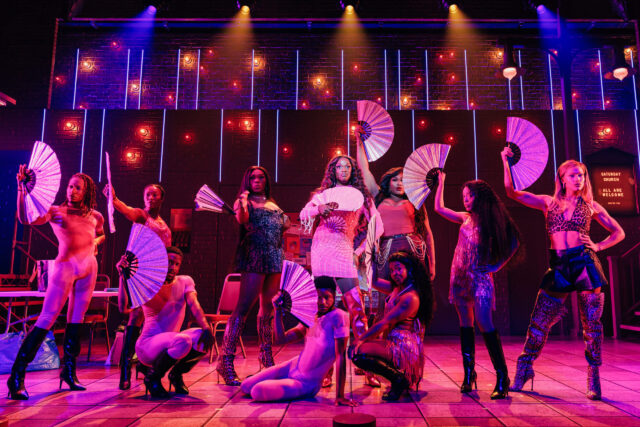
Music and passion are always in fashion at New York Theatre Workshop world premiere (photo by Marc J. Franklin)
Saturday Church is “too much” — but not in the way Aunt Rose meant. At 140 minutes (with intermission), it is too long and too repetitive, overloaded with too many songs (by Sia and DJ Honey Dijon). Clichés abound throughout as the show tries to figure out just what it is, going over the top in attempting to present the story of a teenager, named after the hero of Homer’s Odyssey, trying to figure out who he is.
The diverse cast cuts loose, but Battle is too static in the lead role, his transformation lacking dramatic impact. Inspired by a St. Luke in the Fields program for at-risk LGBTQ youth, the show panders to the audience in self-celebration; it’s more a party than a play, and judging by the enthusiastic crowd the night I went, that’s enough for many. “Are there any queens in the house?” Black Jesus asks, to rapturous applause.
Qween Jean’s costumes are dazzling, David Zinn’s set brings a welcoming intimacy to the proceedings, Adam Honoré’s lighting and Gareth Owen’s sound are appropriately flashy, and Darius Thomas’s hair and wigs are fab, but the festivities run out of surprises too quickly as Cardasis, Ijames (Fat Ham, Good Bones), and director Whitney White (Jaja’s African Hair Braiding, Macbeth in Stride) focus on style instead of substance, preaching to the choir.
At one point, just as Ulysses is about to admit that he is gay, Black Jesus tells him, “I’ll advise but you got free will, baby.”
If only Saturday Church felt the same about its audience.
[Mark Rifkin is a Brooklyn-born, Manhattan-based writer and editor; you can follow him on Substack here.]