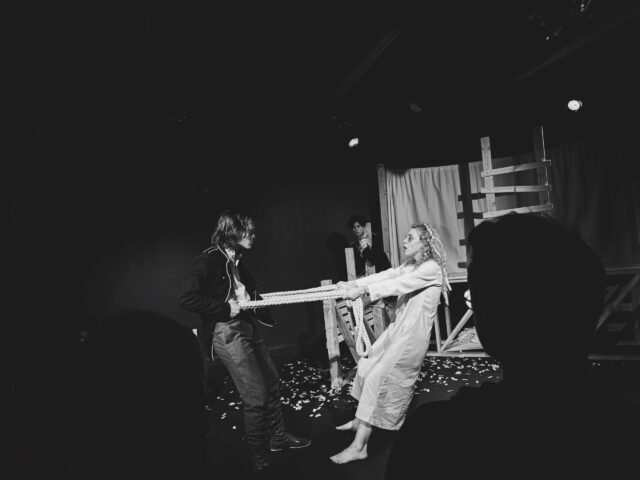
Kolya Krasotkin (Benjamin Nowak) and Zhutchka the dog (Alina Mihailevschi) fight for survival in The Mutt
THE MUTT
IATI Theater
64 East Fourth St. between Second & Third Aves.
Through September 21, $54.65
themuttplay.com
As the audience enters the tiny, downstairs black box space of the IATI Theater on East Fourth St. to see Anoushka Nesterova’s The Mutt, there is already a character there, a woman on all fours, panting lightly but desperately. Ticket holders fill in two perpendicular rows on two sides, looking through the program, talking to their friends, or taking photos of the human-dog, behind whom is an unpainted wooden construction that is part of a barn loft. The play begins with a video, projected on a horizontal white cloth in the loft, of snow and train tracks. In voiceover, a man says, “Once upon a time there was a woman, and she was wicked as wicked could be, and she died. And not one good deed was left behind her. The devils took her and threw her into the lake of fire. So her guardian angel stood and wondered what good deed of hers he could remember to tell to God.” The parable, which also refers to Paradise, ends, “And the woman fell into the lake and she is burning there to this day. So the angel wept and went away.”
The Mutt is an intimate retelling of “The Boys,” Book X of Fedor Dostoevsky’s 1880 Russian epic The Brothers Karamazov, a sprawling philosophical novel about faith, morality, and the human condition. It follows the exceedingly bright and cynical thirteen-year-old Kolya Krasotkin (Benjamin Nowak); his younger apostle, Smurov (Tommy Dougherty); the older, aristocratic Alyosha Karamazov (Fabio Bernardis), also known as Alexei, named after Dostoevsky’s son, who died at the age of three of epilepsy in 1878; and Zhutchka (Alina Mihailevschi or Nesterova), the dog, who is supposed to be dead, brutally killed by the ailing schoolboy Ilyusha Snegirev (Jaden Cavalleri) and renamed Perezvon. Ilyusha’s father, Captain Snegirev (Marcus Troy or Sasha Litovchenko), has been recently humiliated by one of Alyosha’s brothers and wants to leave town with his son, but they can’t afford to go.
An early exchange establishes some of the background, although many of the plot details are kept purposely vague and indeterminate:
Krasotkin: They won’t whip you for being with me?
Smurow: Lord, no, they never whip me! And you’ve got Perezvon with you?
Krasotkin: Yes, Perezvon.
Smurow: You’re taking her, too?
Krasotkin: Yes, him too.
Smurow: Ah! if it were only Zhutchka!
Krasotkin: Impossible. Zhutchka does not exist. Zhutchka has vanished in the darkness of the unknown.
Smurow: Ah! couldn’t we do this? You see, Ilusha says that Zhutchka was a shaggy, grayish, smoky-looking dog like Perezvon. Couldn’t you tell him this is Zhutchka, and he might believe you?
Krasotkin: Boy, shun a lie, that’s one thing; even for a good cause — that’s another. Above all, I hope you’ve not told them anything about my coming.
Smurow: Heaven forbid! I know what I am about. But you won’t comfort him with Perezvon. You know his father, the captain, told us that he was going to bring him a mastiff pup today. A real one, with a black nose. He thinks that would comfort Ilyusha, but I doubt it.
Krasotkin: And how is Ilyusha?
Smurow: Ah, he is bad, very bad! He is quite conscious, but his breathing! His breathing’s gone wrong. The other day he asked to be walked around the room, they put his boots on, he tried to walk, but he couldn’t stand. “Ah, I told you before, Papa,” he said, “that those boots were no good. I could never walk properly in them.” He fancied it was his boots that made him stagger. He won’t live another week. The doctor will come to them.
Krasotkin: Swindlers.
Smurow: Who are swindlers?
Krasotkin: Doctors, and all medical scum, generally speaking, and, naturally, in particular as well. I reject medicine. A useless institution. I mean to go into all that. But what’s that sentimentality you’ve got up there? The whole class seems to be there every day.
Smurow: Not the whole class. There’s nothing in that.
Krasotkin: What I don’t understand in all this is the part that Alexei Karamazov is taking in it. He has too much time to spend on sentimentality with boys.
Smurow: There’s no sentimentality about it. You are going yourself now to make it up with Ilyusha.
Krasotkin: Make it up with him? What an absurd expression! But I allow no one to analyze my actions.
Smurow: And how pleased Ilyusha will be to see you! He has no idea that you are coming. Why was it, why was it you wouldn’t come all this time?
Krasotkin: My dear boy, that’s my business, not yours. I am going of myself because I choose to, but you’ve all been hauled there by Karamazov — there’s a difference, you know. And how do you know? I may not be going to make it up at all. It’s a stupid expression.
Motives are questioned, the existence of a Supreme Being is debated, money is literally thrown around, socialism is defined, and a puppet show reaches to the heart of things as the characters get caught up in intellectual battles and physical altercations.
“What good is faith by force?” Zhutchka asks Krasotkin, who replies, “Never for one minute have I taken you for reality. You are a lie, you are my illness, you are a phantom.”
Presented by Streetcar Productions and Art Against Humanity, The Mutt is a kind of mutt itself, a mixed-breed of dance, theater, performance art, and music, poetically integrated by directors Nesterova and Elena Che and choreographer Gisela Quinteros, incorporating experimental movement with white ropes that bind and release the guilty and the innocent on Alyona Sotnikova’s minimalist set as the Jazz Pilgrim’s ominous score drones in the background. The video projections of a cold, lonely Russian winter are by Anastasia Slepchenkova, a blast of light in the dark.
The strong cast gives depth to the characters and add a modern feel to the proceedings, with Zhutchka nearly always front and center, stuck between fantasy and reality, life and death, being and nothingness.
“There was an old sinner in the eighteenth century who stated that, if there were no God, he would have to be invented. And man has, indeed, invented God. And the strange thing, the wonder would not be that God really exists, the wonder is that such an idea, the idea of the necessity of God, could enter the head of such a savage, vicious beast as man,” the narrator says over a second-act video. “As for me, I long ago decided not to think about whether man created God or God created man. And I won’t go through all the axioms laid down by Russian boys on that subject, and not only with the boys but with their professors too, since Russian professors today are quite often the same Russian boys. Yet, what must be noted above all else in relation to God is this: Does He exist, or does He not?”
That question has been asked through the ages, but don’t expect to find the answer in The Mutt, or in the eight-hundred-page novel, the four-hour 1969 Russian film, the seven-hour 2009 miniseries, or the forty-two-hour audiobook.
[Mark Rifkin is a Brooklyn-born, Manhattan-based writer and editor; you can follow him on Substack here.]