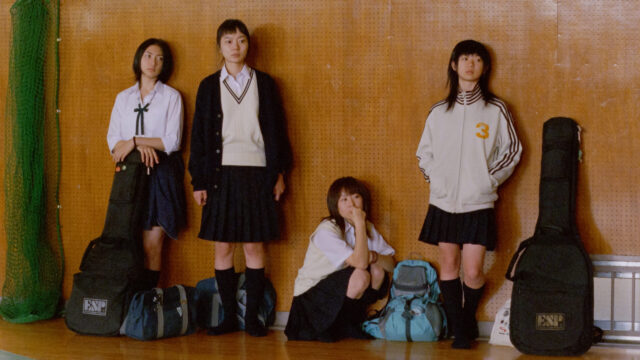
Four girls prepare to play in their high school rock festival in Linda Linda Linda
LINDA LINDA LINDA (Nobuhiro Yamashita, 2005)
IFC Center
323 Sixth Ave. at West Third St.
Opens Friday, September 5
www.ifccenter.com
gkids.com/films
The twentieth anniversary 4K restoration of Nobuhiro Yamashita’s 2005 teen cult classic, Linda Linda Linda, is reason to sing and dance and celebrate.
Opening at IFC Center on September 5, the film is a brilliant exploration of teen angst, a kind of Japanese John Hughes tale involving female friendship, jealousy, young love, and establishing one’s identity as an all-girl band prepares for the annual Shiba High Holly Festival. But unlike most Hughes flicks, there are few parents and teachers to be seen, and only in extremely minor roles; this is all about the children, on the cusp of adulthood.
The film begins with a teen crew making a video for the festival: “Don’t let anyone tell us that when we’re no longer kids, we grow up,” a student says. “When we grow up, we won’t quit being kids. Where are the real we? Should the real we be here? We’ve only got a little more time to be the real us. . . . ”
When guitarist and lead singer Moe Imamura (Shione Yukawa) has to drop out of the group after damaging the middle finger of her left hand, drummer Kyoko Yamada (Aki Maeda), bassist Nozomi Shirakawa (Shiori Sekine), and keyboardist Kei Tachibana (Yuu Kashii) have to make some fast changes if they are to perform at the show. Kei switches to guitar, but they need a vocalist. The Japanese trio briefly considers former band member Rinko Marumoto (Takayo Mimura), but she is in a fight with Moe.
Sitting outside, they decide to choose the next girl they see, and it turns out to be Son (Bae Doona), a Korean exchange student who is learning Japanese. Son initially says no but ultimately changes her mind and joins the band. They rehearse in Kei’s ex-boyfriend’s (Masaki Miura) studio, where at first they sound terrible as they practice songs by the Blue Hearts, a popular Japanese punk band that existed from 1985 to 1995.
With the pressure on to improve in time for their performance, they experience more adolescent growing pains, as Kyoko develops a crush on Kazuya Oe (Katsuya Kobayashi); the extremely nervous Makihara (Kenichi Matsuyama) confesses his love for Son; the bandmates go food shopping for dinner; master guitarist Takako Nakajima (Yuko Yamazaki) decides not to play at the event; and school music club leader Abe (Keisuke Koide) has her work cut out for her once the concert starts.
Written by Yamashita with Kōsuke Mukai and Wakako Miyashita and named for a Blue Hearts song, Linda Linda Linda feels as fresh and exhilarating today as it was twenty years ago. It’s thrilling watching the band members, always in their school uniforms of white shirt with a green bow, nearly knee-length dark socks and skirt, and light-yellow sleeveless vest, develop as individuals and a group; all the actors play their own instruments and do their own singing, which was not an issue with Shiori, who is the bassist for the Tokyo rock band Base Ball Bear, two of whose songs also appear in the film. The score was composed by guitarist James Iha of Smashing Pumpkins.
Bae (The Host, Air Doll), Aki (Battle Royale, I Never Shot Anyone), Yu (Lorelei: The Witch of the Pacific Ocean, Death Note), and Shiori are terrific as their characters discover new sides of themselves while coming together as a band, even knowing that it’s just for three songs and then they will all likely go their separate ways when they graduate. There’s a particular moving focus on Son, who spends time at the festival’s Japan-Korea Culture Exchange Exhibit, a fish out of water attempting to adapt to her new environs.
Adults exist only on the periphery; even Koyama (Masahiro Komoto), the teacher in charge of the music club, keeps an eye on them but doesn’t understand the dynamics involved. In one hilarious scene, he tries to send a message to the band through Rinko, but he stumbles over words and Rinko cuts him off, asking, “Can I go now?” as he stands with his hands on his hips, not quite knowing what to say but thinking about his own musical past and, perhaps, choices he made.
Hands and fingers serve as a leitmotif throughout the film, metaphors for the students taking more control of their lives as they prepare for the next step. Moe’s broken or sprained finger, suffered while playing basketball in gym class, sets everything in motion. Kei strums her guitar under a poster of Bob Marley smoking a joint, his giant hand practically blessing her. Son grabs a microphone like she’s holding on for dear life. A young girl throws darts at a poster of the different cuts of meat in a cow. The student making the festival video stands defiant, her fists clenched by her side as she declares, “We won’t let our high school days become a memory. . . . This is our kingdom.” And then there’s the strange gift Tomoki gives Kei with her mother (Lily) present.
Linda Linda Linda is a stirring, touching film about the pain and pleasure of youth, concluding with an unforgettable finale that is likely to have you jumping out of your seat, fists raised high in the air.
[Mark Rifkin is a Brooklyn-born, Manhattan-based writer and editor; you can follow him on Substack here.]