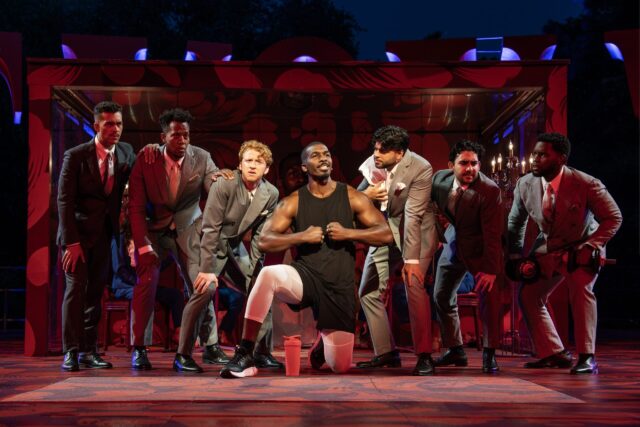
Duke Orsino (Khris Davis) and his minions get ready for action in Twelfth Night (photo by Joan Marcus)
TWELFTH NIGHT
Delacorte Theater, Central Park
Tuesday – Sunday through September 14, free with advance RSVP, 8:00
shakespeareinthepark.org
The confusion begins early in Saheem Ali’s inconsistent adaptation of William Shakespeare’s 1601–02 romantic comedy, Twelfth Night, which opens the newly revitalized Delacorte Theater in Central Park. As the audience enters the space — the majority of the $85 million upgrade went to technical operations, dressing rooms, bathrooms, accessibility, and signage, along with improvements to the facade and seats — a string quartet is playing on a red stage that features swirling patterns and, in giant, bold letters around the back, the subtitle of the play: What You Will. (The renovation did not rid the Delacorte of its famous raccoons, one of which ambled along atop the back wall moments before the play began, eliciting the adoring attention of the crowd.)
Then Ghanaian American singer-songwriter Moses Sumney, portraying the fool, Feste, walks onto the stage with a guitar and sings, “All the world’s a stage, / And all the men and women merely players. / They have their exits and their entrances, / And one man — or woman — in their time plays many parts.”
The line actually comes from the second act of As You Like It and seems like a cliché here taken out of context, even with its addition of “or woman.” Meanwhile, the musical shift from classical to Sumney’s alternative/indie R&B is jarring, and the character feels more like a demonic troubadour than one of Shakespeare’s fools.
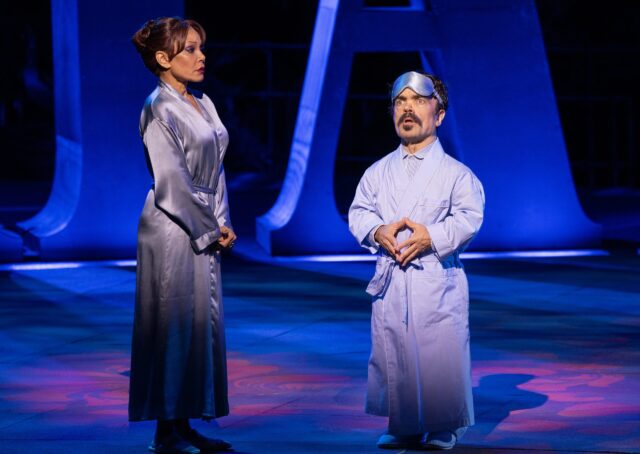
Maria (Daphne Rubin-Vega) offers some intriguing news to Malvolio (Peter Dinklage) in Shakespeare production at revitalized Delacorte (photo by Joan Marcus)
Next, a sea captain (Joe Tapper) and Viola (Lupita Nyong’o) rise in a small boat from one of the Delacorte’s new modular trap doors. Emphasizing that they are strangers to this land, the first words they say to each other are in Swahili, although most of their conversation in in English. (Nyong’o was born in Mexico and raised in Kenya and speaks fluent English, Spanish, Luo, and Swahili.) The explicatory scene lets us know that there has been a shipwreck that has led the captain and Viola to Illyria, which is ruled by the duke Orsino (Khris Davis), who is in love with Olivia (Sandra Oh), a count’s daughter who is mourning the recent deaths of her father and brother and currently uninterested in suitors. Viola’s brother, Sebastian (Junior Nyong’o), was also on the ship, and Viola holds out hope that he has survived as well. She decides to disguise herself as a man named Cesario and serve the duke. (Sebastian has indeed survived and is on the island, with Antonio [b], an enemy of the duke’s, as his servant.) Only then do we meet Orsino as he declares to court gentleman Curio (Ariyan Kassam) and Feste, “If music be the food of love, play on,” which usually starts the play.
Thus, this Twelfth Night has a completely different atmosphere, which is not in itself a bad thing. I am not a Bard purist who insists that Shakespeare plays should not be messed with. Among the endless beauties of his work are the myriad possibilities it offers for reinterpretation. Over the last dozen years, I have seen three memorable productions of Twelfth Night: one on Broadway starring Mark Rylance as an Olivia who is light on her feet and a wickedly funny and towering Stephen Fry as her steward, the much-maligned Malvolio, in a delightful version that harkened back to the seventeenth century in form and style; one off Broadway by Axis that was dark and foreboding and utterly involving; and one at the Delacorte in 2018, an engaging musical comedy by Shaina Taub, who also portrayed Feste. (Twelfth Night is a favorite of the Public Theater’s Shakespeare in the Park presentations, having been staged six times previously, going back to 1969.)
In 2021, I was disappointed in Jocelyn Bioh and Ali’s Merry Wives, which moved the location of the story from Windsor to South Harlem and felt too caught up in shtick, and the same is true here. Scenes move by too quickly as actors enter and leave down the aisles, via the traps, and through the “What You Will” wall like a one-ring circus, not allowing enough time for character development or actor chemistry. Attempts at amusement abound: Olivia’s uncle, the Falstaffian Sir Toby Belch (John Ellison Conlee), and his sidekick, the cheeky Sir Andrew Aguecheek (Jesse Tyler Ferguson), hang out in a hot tub doing lines of coke and whippets when they’re not plotting with Olivia’s chambermaid, Maria (Daphne Rubin-Vega), to publicly embarrass Malvolio (Peter Dinklage) in front of Olivia, whom he secretly pines for. Orsino asserts his strength and power by working out barechested at a gym and ordering his minions to drop and do pushups for punishment. Sir Toby, Sir Andrew, and Fabian (Kapil Talwalkar) hide from Malvolio behind four handheld letters, T, R, E, and E, instead of a tree, which is cute at first but goes on too long. A duel is transformed into a comic boxing match, with Sir Andrew in full boxing regalia.
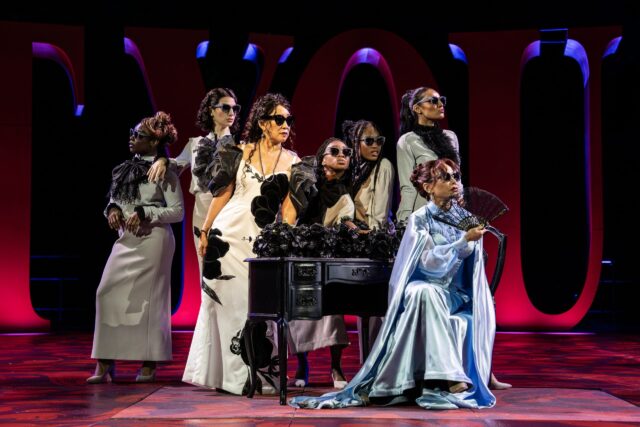
Olivia (Sandra Oh) and her minions get ready for action in Twelfth Night (photo by Joan Marcus)
Real-life siblings Lupita and Junior Nyong’o are dapper in their double-breasted suits. The inspired casting of Dinklage as Malvolio tails off when he is left doing too much voguing, particularly when trying to put a smile on his face. Davis has impressive abs. The actor known as b seems out of place whenever they’re onstage, although the part of Antonio can be a challenge to integrate in even the best of productions. Rubin-Vega looks fabulous, but it’s hard to remember she’s playing a maid. Conlee has fun as Sir Toby, but it’s Oh who steals the show as Olivia, wonderfully balancing comedy and pathos as her lust builds up, subduing her mourning with an elegant wit and grace, best capturing the spirit of Ali’s intentions.
The director has excelled in such non-Shakespeare plays as James Ijames’s Fat Ham, Bioh’s Nollywood Dreams, and Donja R. Love’s Fireflies, but I’ve found both Merry Wives and now Twelfth Night overwrought and scattershot, with too many scenes and characters appearing to come from different plays, lacking continuity despite individual moments that shine. It’s perhaps best exemplified by the Twelfth Night finale, a showcase for costume designer Oana Botez and set designer Maruti Evans; it looks fabulous, but it comes out of nowhere. It elicits wild applause from the audience, but it feels like a preening peacock that has arrived onstage, perhaps watching out for that raccoon.
[Mark Rifkin is a Brooklyn-born, Manhattan-based writer and editor; you can follow him on Substack here.]