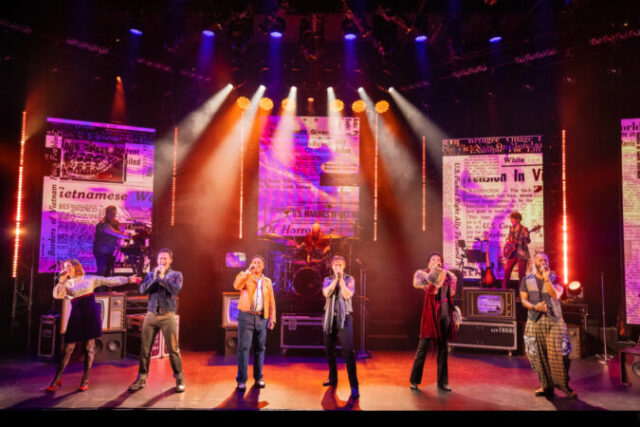
A game cast battles through a perplexing book in Rolling Thunder at New World Stages (photo by Evan Zimmerman for MurphyMade)
ROLLING THUNDER VNM: A ROCK JOURNEY
New World Stages
340 West Fiftieth St. between Ninth & Tenth Aves.
Wednesday – Monday through September 7, $48-$140
rollingthunderus.com
newworldstages.com
In 2008, the jukebox musical Rock of Ages opened at New World Stages on West Fiftieth St., a hugely entertaining fictional story based on classic hits of the 1980s by Journey, Night Ranger, Twisted Sister, Foreigner, Pat Benatar, and others. The production moved to Broadway, was adapted into a 2012 film, and continues to be produced around the world.
This summer, in the same theater, the Australian Rolling Thunder VNM: A Rock Journey is making its US premiere, a by-the-numbers, cliché-ridden story set during the Vietnam War, featuring classic hits of the 1960s and 1970s by Bob Dylan, the Rolling Stones, Curtis Mayfield, the Animals, and others. It’s highly unlikely that it will move to Broadway or be made into a movie.
The two-hour, two-act musical — which has nothing to do with the 1977 film about a soldier returning home from the Vietnam War, the annual motorcycle rally for POWs/MIAs, or Dylan’s 1975–76 Rolling Thunder Revue tour — follows four men who are sent overseas to fight the North Vietnamese. Johnny (Drew Becker) is a Nebraska farm boy who has made his father proud by enlisting, although his mother is unhappy about his decision. “I’ve been thinking about my one big chance for adventure, to see a bit of the world while I could,” he tells the audience. Johnny writes regularly to his high school sweetheart, Linda (Cassadee Pope), and his mother; Linda writes back, bursting with love and affection, but Johnny hears nothing from his mother. Describing his dreams as “Technicolor nightmares,” Johnny admits to Linda, “Your letters keep me sane, amidst the mortar and machine gun fire, when praying you won’t get killed.”
Johnny is in the same unit as his friend Thomas (Justin Matthew Sargent), who convinced him to sign up. After seeing a marine in uniform, Tommy was quick to enlist. “I thought, ‘That’s how I want to look. I’m going to be a marine!’” he says. “I pray I can be a leader among men.” Tommy, who was born into a military family, writes letters to his beloved, Lauren (Courtnee Carter), who, upon going to college, becomes interested in the antiwar movement and one of its school leaders, Jimi (Deon’te Goodman). “The campus in Lincoln is like stepping into a whole new world,” she writes to Tommy.
Andy Johnson (Daniel Yearwood) has been drafted but is clearly not cut out for battle. “I felt sick in the stomach. Go to war or go to prison. What choice did I have?” he opines. Andy gets advice from his buddy from home, Mike (Goodman), who has already been deployed. “Don’t worry, I’m keeping my eye on Andy,” Mike assures Mrs. Johnson.
Meanwhile, Nurse Kelly (Carter), whose two brothers are in Vietnam, keeps the audience informed about the increasing tragedy. “I’ve lost count of the young soldiers in body bags. In this job there’s no time for tears,” she explains.
The characters’ experiences play out in melodramatic, predictable fashion as the war goes bad, protests spread across America, and relationships get complicated.
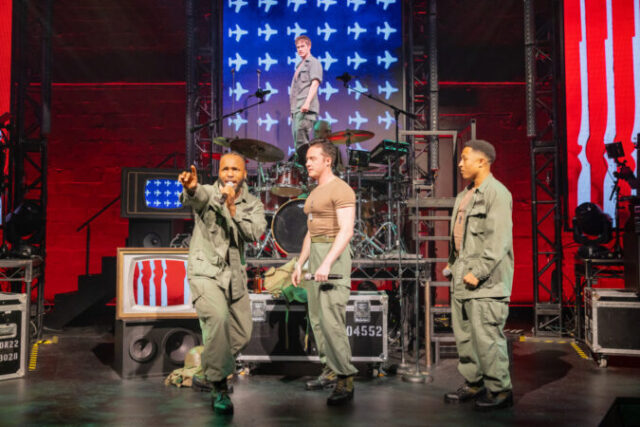
Four soldiers try to survive the Vietnam War in jukebox musical (photo by Evan Zimmerman)
Wilson Chin’s bold set consists of multiple television sets that initially display lighthearted sitcoms (I Love Lucy, My Three Sons), then shift to archival news footage. Conductor and keyboardist Sonny Paladino, guitarists Aurelian Budynek and Sherrod Barnes, bassist Yuko Tadano, and drummer Grant Braddock perform on platforms in front of screens on which Caite Hevner projects news clips, shots of Saigon streets and Vietnamese jungles, whirring helicopters, and groovy color fantasies. (The musicians sometimes appear to morph into the background scenes, which can be disarming.) The standard costumes are by Andrea Lauer — three actors play multiple roles, and it’s not always immediately clear who they are — with flashy lighting by Jake DeGroot and propulsive sound by Mike Tracey.
Director Kenneth Ferrone is limited by Bryce Hallett’s confusing book, which has little sense of time or place, and the musical numbers often feel like way too much of a stretch. For example, the June 1968 assassination of Bobby Kennedy is followed by Walter Cronkite’s February 1968 entreaty for the US to end the war, Dr. Martin Luther King Jr.’s April 1967 “silence is betrayal” speech, and Richard Nixon’s November 1969 “silent majority” declaration.
Several songs fit in well with the narrative — Edwin Starr’s “War,” the Rolling Stones’ “Gimme Shelter,” which was written at least in part about the Vietnam War, Steppenwolf’s “Born to Be Wild” and “Magic Carpet Ride,” which captured the zeitgeist of the era — but too many are forced and dull the proceedings, including Roberta Flack’s “Killing Me Softly with His Song,” Kris Kristofferson’s “Help Me Make it Through the Night,” and, most egregiously, Simon and Garfunkel’s “Bridge over Troubled Water.”
The songs are not in chronological order, adding to the befuddlement, and the script credits one particular version of each song without mentioning the composer or original performer. Thus, “The Letter” is linked to Joe Cocker, not the Box Tops or Wayne Carson, who penned the tune; Jimi Hendrix is listed with “All Along the Watchtower,” not the composer, Dylan; and Santana is credited with “Black Magic Woman,” not the originators, Peter Green and Fleetwood Mac. Even though the soldiers would be more familiar with those versions, credit should be given where due. Alternately, P. F. Sloan is credited with “Eve of Destruction,” which he wrote and recorded, but the song is more closely associated with Barry McGuire, who scored a hit with it.
The ensemble cast is excellent, despite being hamstrung by the material, and the band kicks out the jams, playing Chong Lim and Sonny Paladino’s mostly faithful arrangements and orchestrations. The highlight is Goodman’s spectacular rendition of “Eve of Destruction,” in which he hauntingly sings, “My blood’s so mad feels like coagulatin’ / I’m sittin’ here just contemplatin’ / You can’t twist the truth, it knows no regulation / And a handful of senators don’t pass legislation / Marches alone can’t bring integration / When human respect is disintegratin’ / This whole crazy world is just too frustratin’ / And you tell me / Over and over and over again, my friend / Ah, you don’t believe we’re on the eve of destruction.” [ed. note: I used the actual lyrics as written and sung by Sloan; the script has certain words incorrect that appear to be transcription mistakes, not specifically intended changes.]
Rolling Thunder concludes with a fun encore sing-along, but most of what came before it is not a rock show for the ages.
[Mark Rifkin is a Brooklyn-born, Manhattan-based writer and editor; you can follow him on Substack here.]