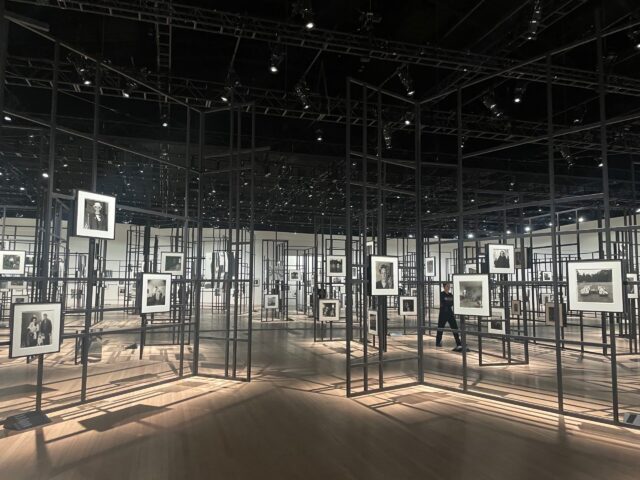
“Diane Arbus: Constellation” continues at Park Avenue Armory through August 17 (photo by twi-ny/mdr)
DIANE ARBUS: CONSTELLATION
Park Avenue Armory, Wade Thompson Drill Hall
643 Park Ave. at 67th St.
Daily through August 17, $25
www.armoryonpark.org
Don’t look too hard for a theme to “Constellation,” the exciting and dramatic Diane Arbus installation at Park Ave. Armory. “The connection is that there is no connection,” curator Matthieu Humery explained at a press preview.
The exhibition fills half of the armory’s 55,000-square-foot Wade Thompson Drill Hall, with a mylar mirror in the middle that makes it look like the entire space is populated by the seemingly endless parade of diverse people the New York City–born Arbus photographed during the course of her career, cut short by her suicide in 1971 at the age of forty-eight. There are 454 photos in all, arranged on gridlike beams that form a kind of maze, where visitors can take multiple paths, like walking through the streets of the metropolis that was her canvas; the setup also evokes an alternate subway map. The black frames match the black beams, giving it an organic feel.
The photos are placed at different heights, identified by small blocks on the floor and in a long list inside the official pamphlet; there are no detailed labels, making each photo, like each person she photographed, equal, whether a stripper, a drag performer, a political supporter, kids playing, a circus strongman, twins and triplets, a well-known artist, a corpse, a dominatrix, or swimmers at the beach. The only specific organization is the section that includes her breakthrough limited edition “box of ten,” which contains iconic, familiar images. Other favorites are scattered about in a colossal, inviting jumble. The lighting creates fascinating shadow patterns that have a ghostly presence on the floor.
“They are the proof that something was there and no longer is. Like a stain,” Arbus wrote in a 1971 letter to Davis Pratt of Harvard’s Fogg Museum. “And the stillness of them is boggling. You can turn away but when you come back they’ll still be there looking at you.” To take that philosophy to another level, numerous photos at the armory are backed by mirrors so visitors can imagine themselves being caught by Arbus’s lens and becoming part of the unique and welcoming community she built more than fifty years ago. “I would like to photograph everybody,” she wrote in the margin of a letter to photographer, graphic designer, and teacher Marvin Israel, seen in #120 in the show. Famous faces range from Tiny Tim, Jorge Luis Borges, Norman Mailer, and Roy Lichtenstein to James Brown, Charles Atlas, Peter Ustinov, and Jayne Mansfield, but Arbus treated all of her subjects as celebrities.
However, whereas we’re all taught to avoid making eye contact on New York City buses, subways, and sidewalks, you should take your time as you wander through the aisles, making friends with these hundreds of strangers, among them a young couple eating hot dogs in a park, an elderly gentleman apparently with three legs, a woman on a couch holding a baby monkey like an infant, a Jewish giant towering over his parents in their Bronx home, four members of the radical feminist group the Red Stockings, a transvestite on her bed with her birthday cake, a girl in a devil mask with a naked doll, a wax museum ax murderer, a boy clutching a toy grenade, a silhouetted couple watching a newsreel of a cross burning, kids playing baseball, two women at the Automat, and Ronald C. Harrison, the Human Pincushion. Most shots are posed, with many of the subjects looking directly into the camera.
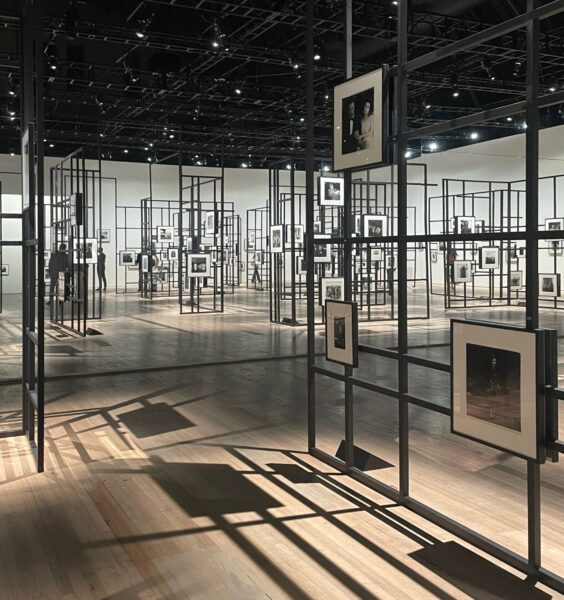
“Constellation” offers a multitude of paths to take (photo by twi-ny/mdr)
I highly recommend not reading the titles of the works, at least not during your first trip around, to get the full impact of Arbus’s egalitarian view of humanity; each one of us is unique, yet we are also alike, and we basically all want the same thing out of life: happiness. Arbus’s photos inherently make us happy.
The prints were made by Neil Selkirk, a photographer who studied with Arbus and is the only person authorized by her estate to produce prints from the original negatives, using what he calls an “abstruse technical process.” He has cited A family one evening in a nudist camp as one of the works that stands out for him, holding a special place; it’s a 1965 gelatin print of a husband, wife, and child hanging out naked in a grassy field, the corner of a car’s tailfin visible on one side, all three people peering at us as if they have something better to do.
The display, sponsored by the LUMA Foundation, is supplemented with a short video of close-up eyes from Arbus’s photos, projected onto a freestanding wall in the drill hall, as well as, in the Board of Officers Room, two documentaries, including the ninety-minute What Diane Arbus Wasn’t Doing, and How She Wasn’t Doing It, a filmed conversation between Selkirk and Darius Himes from Christie’s.
“I have learned to get past the door, from the outside to the inside. One milieu leads to another,” Arbus wrote in her 1966 application for her second Guggenheim fellowship (which she received), “a certain group of young nihilists, a variety of menages, a retirement town in the Southwest, a new kind of Messiah, a particular Utopian cult who plan to establish themselves on a nearby island, Beauties of different ethnic groups, certain criminal types, a minority elite.”
Just another day in New York City, this time courtesy of Diane Arbus and Park Ave. Armory.
[Mark Rifkin is a Brooklyn-born, Manhattan-based writer and editor; you can follow him on Substack here.]