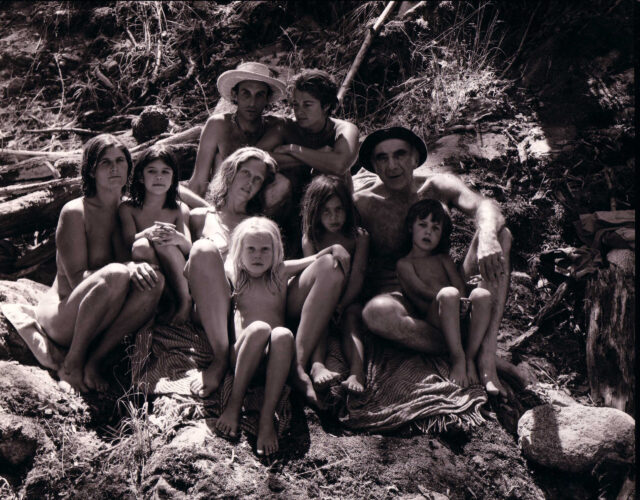
Restored documentary looks at life at Northern California commune from 1968 to 1979 and beyond (photo by Jock Sturges)
COMMUNE (Jonathan Berman, 2005 / restored 2025)
DCTV Firehouse Cinema
87 Lafayette St.
July 11-17
www.dctvny.org
Jonathan Berman’s twentieth anniversary restoration of his documentary Commune could hardly be more timely. The film details the fascinating story of Black Bear Ranch in Siskiyou County in Northern California near Mt. Shasta, where dozens of people left their traditional lives and started their own community to escape what was happening in the country in the wake of the violent Democratic National Convention in Chicago in 1968.
“After going to Washington, DC, for a while and thinking, boy, it’s going to be a long time before all these people retire and get out of here and something changes, I don’t think I can stand to wait around,” Mahaj Seeger says in the film.
Actor Peter Coyote explains, “We thought the government was going to be overthrown in two years and there would be a new culture rising from the ashes, and we wanted to have an alternative, a nonmercantile alternative that offered citizens the options of being something other than a consumer or an employee.”
And Cedar Seeger admits, “I moved there to get away from America; I did not want to be an American as defined by the mainstream, although I guess deep down I’ve always felt proud that I’m an American. But to me those values are represented in open-mindedness and free thinking and tolerance and the ability to do what you want.”
The group purchased eighty acres of woods for twenty-two thousand dollars, with contributions from the Doors, the Monkees, Frank Zappa, and others. The goal was to create a society that played by its own rules, not subject to political parties or any existing set of laws and mores. As Michael Tierra declares in the film, their motto was “Free Land for Free People.”
In addition to all the above, Berman speaks with such commune participants as Creek Hanauer, Martin Linhart, Peter Leaf, and Kenoli Oleari. Elsa and Richard Marley share critical behind-the-scenes information. Tierra relates how he tried to get James Coburn involved. Catherine Guerra preaches free love. Osha Neumann, a member of the anarchist Motherfuckers, says that it “felt like coming home.” Activist Harriet Beinfeld brings up the FBI, which in 1970 reported, “Commune might be a training ground for militants planning insurrection in Northern California.” Geba Greenberg and Allegra Brucker discuss becoming self-trained midwives to help women give birth on the ranch.
We learn what they are doing in 2005 and meet some of the children who grew up in the commune, including Aaron Marley, a scientist who works with experimental lab rats, and Tesilya Hanauer, a writer and massage therapist.
While neighbor Hoss Bennett remembers fondly about how he helped the commune, local resident Mel Kramer declares, “It was shocking,” and public defender Larry Bacon calls it an “invasion of flower children.”
Berman and editors Michael Taylor and Marisa Simpson interweave archival news footage and photos and home movies taken at the ranch, showing the group renovating a ramshackle barn, growing vegetables, preparing food, and prancing about naked, which they did a lot. Ultimately, it was not as idyllic as was hoped, as the concept of free love led to jealousies, and there was debate over how the children were being raised. The beginning of the end might have been the infiltration of the Shivalila cult in 1979, led by Gridley Wright, who had unique and controversial views of child-rearing. A 1987 reunion offers engaging perspective.
In his 2025 director note, Berman (The Shvitz, Calling All Earthlings) points out, “With the very real modern struggles of Trump’s America, people are seeking solutions of every kind to an increasing authoritarianism. As feminist activist Carol Hanisch wrote in 1969, ‘The personal is political,’ and nothing is more personal than how we live and the who, what, and where of the place we call home. . . . In our modern high-tech world, where an Amazon delivery is moments away and there’s less need to leave our dwellings, we face a plague of loneliness. Is coming together the cure? Or perhaps, as Sartre wrote, ‘Hell is other people’!”
Accompanied by a lovely country-bluegrass-groovy-pop soundtrack by Elliott Sharp, Commune makes a compelling case for living off the grid, at least for a little while.
The twentieth anniversary restoration is screening July 11–17 at DCTV Firehouse Cinema, with Q&As with Berman on July 11 at 7:00 with a live performance by Sharp, on July 12 at 7:00 with Taylor, and on July 13 at 4:00; on July 17 at 7:00.
[Mark Rifkin is a Brooklyn-born, Manhattan-based writer and editor; you can follow him on Substack here.]