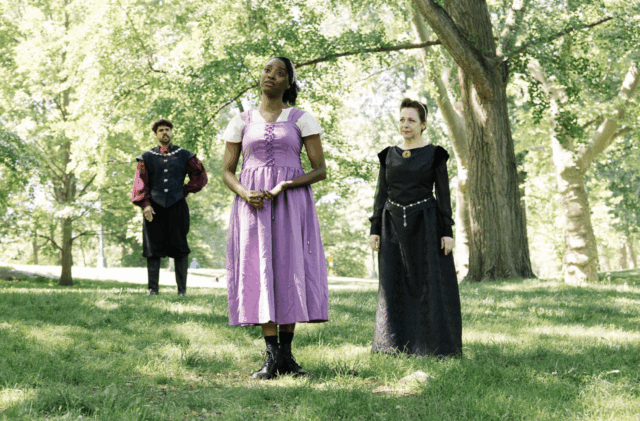
New York Classical Theatre’s All’s Well That Ends Well travels from Central Park to Carl Schurz Park to Battery Park (photo © Da Ping Luo)
ALL’S WELL THAT ENDS WELL
June 3-22: Central Park, Central Park West & 103rd St.
June 24-29: Carl Schurz Park, East 87th St. & East End Ave.
July 1-6: Castle Clinton, Battery Park
nyclassical.org
Every summer, numerous companies deliver free Shakespeare in parks (and even a parking lot) throughout the five boroughs. One of the best, most consistent troupes is New York Classical Theatre (NYCT), which has “staged” more than nine hundred free performances since 2000, including nearly two dozen Bard plays in addition to classics by Oscar Wilde, Anton Chekhov, Molière, Bernard Shaw, Friedrich Schiller, and others. Burdman refers to it as Panoramic Theatre, in which scenes take place in different parts of the parks, the audience moving along with the cast. NYCT has done it again with a splendid revival of All’s Well That Ends Well.
Most everyone knows the phrase “All’s well that ends well,” but few have actually seen what is one of the Bard’s problem plays, and it feels as problematic as ever in the twenty-first century. However, Burdman and NYCT are breathing new life into it this season as it travels from Central Park to Carl Schurz Park to Castle Clinton in Battery Park, continuing the mission they began in 2000: “NY Classical firmly believes that everyone — regardless of economic, social, or educational background — should have the opportunity to enjoy live professional theatre together as a community. Our free, engaging performances interpreted for approachable spaces inspire experienced theatergoers to reconnect with the classics and build new and future audiences.”
All’s Well That Ends Well is a kind of rom-com with an edge, a twist that feels forced, and not just in the current environment. Helena (Anique Clements) has been recently orphaned by the death of her father, Gérard de Narbonne, physician to the ailing king of France (Nick Salamone). She is now a ward of the countess of Roussillon (Carine Montbertrand) and is deeply in love with the countess’s son, Bertram (Paul Deo Jr.), who wants nothing to do with her. Helena travels to the king to offer him one of her father’s remedies; the king is suspect, since so many other doctors have failed him, so Helena offers him a deal: The king will take the prescription and, if it cures him, Helena can choose any man in the kingdom to be her husband, but if he is still sick, he can have Helena executed. The king agrees.
The king’s fistula goes away, and Helena tells him she wishes to marry Bertram, who is strongly against the union but must ultimately fulfill the king’s command. But instead of consummating the marriage, Bertram takes off to fight in Florence, leaving behind a letter in which he sets for his new bride what appear to be impossible tasks: “When thou canst get the ring upon my finger, which never shall come off, and show me a child begotten of thy body that I am father to, then call me husband. But in such a ‘then,’ I write a ‘never.’”
Bertram is accompanied by his untrustworthy friend, Parolles (Karel Heřmánek), a fool and a coward who thinks he’s a fashionista and doesn’t realize when he’s being ridiculed, including by the French courtier Lafeu (Clay Sorseth), who wouldn’t mind if his daughter were to wed Bertram.
A determined Helena disguises herself as a pilgrim and goes to Italy, where she meets old widow Capilet (Montbertrand) and her virgin daughter, Diana (Angelique Archer). The three devise a plan to coerce Bertram into marrying Helena, and it’s a devious one that is at the heart of why the play is so rarely performed.

Anique Clements and Carine Montbertrand stand out in NYCT Shakespeare production in the parks (photo © Da Ping Luo)
Partly inspired by a story from Boccaccio’s Decameron that was adapted by Geoffrey Chaucer in “The Clerk’s Tale,” All’s Well That Ends Well has been performed at the Delacorte in the Public Theater’s Shakespeare in the Park series four times, in 1966, 1978, 1993, and 2011, and has appeared on Broadway only once: Trevor Nunn’s Royal Shakespeare production, which ran for a month at the Martin Beck in 1983. Otherwise, there are small iterations here and there, including TV movies in 1968, 1978, and 1981. So it is exciting that Burdman has brought it back; the company last presented it in 2006.
I saw the show when it was in Central Park by the 103rd St. entrance, winding its way under trees, down paths, and by a pond. (The shows in Carl Schurz Park will be seated in one location, while the scenes will move in Castle Clinton.) Burdman has streamlined it to fit into the company promise of keeping it under two hours, so several characters and some major quotes have been excised (“No legacy is so rich as honesty”; “A young man married is a man that’s marred”), but others are still there (“Love all, trust a few, do wrong to none”; “many a man’s tongue shakes out his master’s undoing”).
The costumes are lovely, the props minimal (blindfolds, a pair of swords, a crown), and the lighting necessary only as the sun sets. (Members of the crew sit in the front with flashlights focused on the speaking actor.) Burdman directs the proceedings with a swift hand, the actors occasionally meandering through the audience. The strong cast is led by superb performances by Clements, who is so appealing as Helena that it’s hard to believe Bertram’s reluctance to wed her, and Montbertrand, who ably shifts between the countess and the widow. Reeves gets well-deserved breakout applause for her singing.
The finale is still troubling, requiring a key suspension of disbelief, but even so, NYCT’s production lives up to the title of the play.
[Mark Rifkin is a Brooklyn-born, Manhattan-based writer and editor; you can follow him on Substack here.]