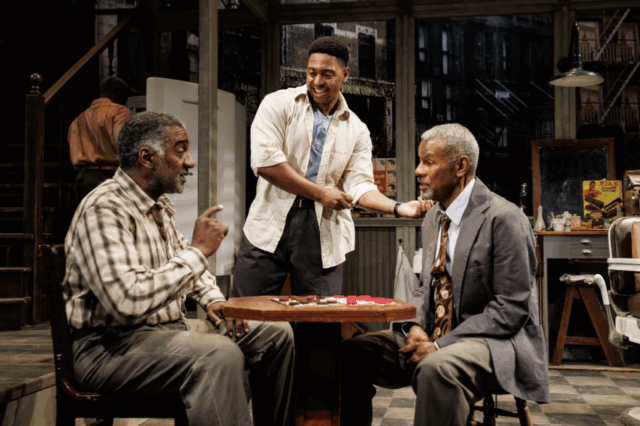
Russell Parker (Norm Lewis) and William Jenkins (James Foster Jr.) play checkers while Theo (Bryce Michael Wood) tries to get their attention in Ceremonies in Dark Old Men (photo by Maria Baranova)
CEREMONIES IN DARK OLD MEN
Theatre at St. Clement’s
423 West Forty-Sixth St. between Ninth & Tenth Aves.
Through June 29, $39-$119
thepeccadillo.com
necinc.org
The Peccadillo Theater Company and Negro Ensemble Company’s potent revival of Georgia-born Lonne Elder III’s 1969 Ceremonies in Dark Old Men firmly establishes it as a missing link between Chicago-born Lorraine Hansberry’s 1959 A Raisin in the Sun and Pittsburgh-born August Wilson’s ten-part 1982–2005 Century Cycle.
Hansberry took the title of her first play from Missouri-born writer and activist Langston Hughes’s 1951 poem “Harlem”: “What happens to a dream deferred? Does it dry up / like a raisin in the sun? / Or fester like a sore — / And then run? / Does it stink like rotten meat? / Or crust and sugar over — / like a syrupy sweet? / Maybe it just sags / like a heavy load. / Or does it explode?” In the original Broadway production of A Raisin in the Sun, the impressive cast featured Sidney Poitier, Ruby Dee, Ivan Dixon, John Fiedler, Louis Gossett Jr., Claudia McNeil, Diana Sands, Glynn Turman, Ed Hall, Douglas Turner Ward, and, as Bobo, Lonne Elder III, an experience that helped lead to his becoming a playwright dealing with social issues.
Originally produced at St. Mark’s Playhouse, Ceremonies in Dark Old Men has also had stellar actors over the years, including Billy Dee Williams, Denise Nicholas, Ward, Ruben Santiago-Hudson, Keith David, Teddy Wilson, Lawrence Hilton Jacobs, Joan Pringle, Taurean Blacque, Turman, Eugene Lee, Brandon J. Dirden, Jason Dirden, and Cara Patterson, many of whom have appeared in Wilson plays as well.
Directed by Clinton Turner Davis, who has previously helmed Wilson’s Joe Turner’s Come and Gone and Hughes’s Black Nativity, this new adaptation of Ceremonies in Dark Old Men, the first New York City revival since 1985 (which was directed by and starred Ward) is a poignant and affecting exploration of a Black family struggling to get by in Harlem. The story takes place in a barbershop on 126th St. between Seventh and Lenox Aves. in Harlem, where the widowed Russell Parker (Norm Lewis) reads the paper, plays checkers with his friend William Jenkins (James Foster Jr.), and refuses to look for a job, even though he has no customers day after day. His two sons, Theopolis (Bryce Michael Wood) and Bobby (Jeremiah Packer), also avoid work; Theo keeps hatching get-rich-quick schemes, while Bobby reads comic books and steals items from local shops.
Russell’s daughter, Adele (Morgan Siobhan Green), is the only practical one, holding down a job so she can pay the rent and feed her father and brothers. But after taking care of her ailing mother with little help from the others, not dating, and working hard while Russell, Theo, and Bobby bring in no money, she gives them an ultimatum: They have six days to find employment or they’re out on the street.
“I am not going to let the three of you drive me into the grave the way you did Mama — And if you really want to know how I feel about that, I’ll tell you,” she says. “Mama killed herself because there was no kind of order in this house — there was nothing but her old-fashion love for a bum like you, Theo — and this one — [points to Bobby]. Who’s got nothing better to do with his time than to shoplift every time he walks into a department store. And you, Daddy, you and those fanciful stories you’re always ready to tell, and all the talk of the good old days when you were the big vaudeville star, of hitting the numbers, big. How? How, Daddy? In a way, you let Mama make a bum out of you — you let her kill herself!”
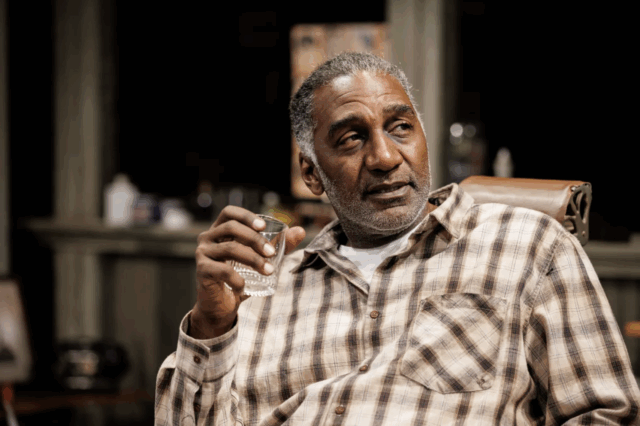
Norm Lewis is sensational as Russell Parker in rare revival (photo by Maria Baranova)
Theo starts making bootleg corn liquor, which quickly becomes popular, and he teams up with the cool, crooked Blue Haven (Calvin M. Thompson) to sell it. He needs to work out of the barbershop without letting Adele know, and for that he has to get his father’s approval. Russell is initially against the idea, but he eventually acquiesces, as Jenkins and Bobby get involved as well. The lure of easy money is just too great.
“We’re going into business, Adele. I have come to that and I have come to it on my own,” he declares to his daughter. “I am going to stop worrying once and for all whether I live naked in the cold or whether I die like an animal, unless I can live the best way I know how to. I am getting old and I oughta have some fun. I’m going to get me some money, and I’m going to spend it! I’m going to get drunk! I’m going to dance some more! I’m getting old! I’m going to fall in love one more time before I die!”
It doesn’t quite turn out that way.
Tony and Grammy nominee Lewis (The Gershwin’s Porgy & Bess, Chicken & Biscuits) imbues Russell with a Shakespearean dignity as he moves across the stage, walking with a hitch in his step from his years as a vaudeville dancer. He’s not a feeble old man, but he’s also in no shape to suddenly make up for lost time. It’s a complex, layered performance that fits right in with the worlds created by Hansberry and Wilson. All three playwrights died too young, Hansberry at thirty-four, Wilson at sixty, and Elder III at sixty-eight.
Elder III (Charades on East Fourth Street, Splendid Mummer) wrote only six plays in his career, but he earned an Oscar nomination for cowriting the screenplay for the 1972 adaptation of Sounder; he also penned the popular 1978 miniseries A Woman Called Moses. Ceremonies might be fifty-five years old, but it resonates in a way that makes it feel like it could have been written yesterday. The rest of the cast, which includes Morgan Siobhan Green as a young floozy, skillfully inhabits Harry Feiner’s elaborately detailed set; Green (Be More Chill, White Girl in Danger) is particularly effective as Adele, who clearly means what she says and has had it with the men in her family.
In his 1951 book-length poem Montage of a Dream Deferred, which contains “Harlem,” Hughes wrote, “Hold fast to dreams / For if dreams die / Life is a broken-winged bird / That cannot fly.” In Ceremonies, all the characters have broken wings, and no one ends up soaring.
[Mark Rifkin is a Brooklyn-born, Manhattan-based writer and editor; you can follow him on Substack here.]