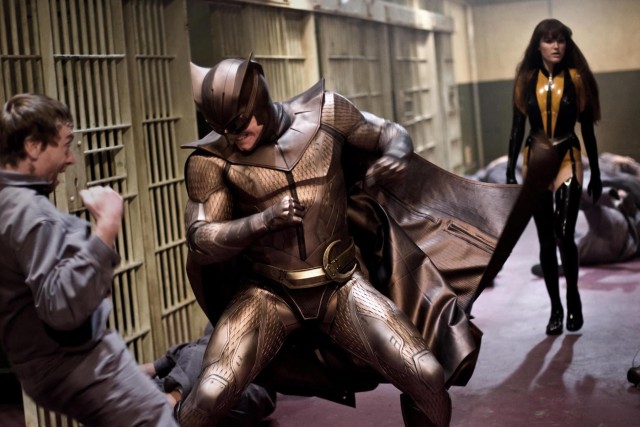
Nite Owl (Patrick Wilson) and Silk Spectre (Malin Akerman) fight crime in WATCHMEN
WATCHMEN (Zack Snyder, 2009)
MoMA Film, Museum of Modern Art
11 West 53rd St. between Fifth & Sixth Aves.
Saturday, July 27, 5:00
Tickets: $12, in person only, may be applied to museum admission within thirty days, same-day screenings free with museum admission, available at Film and Media Desk beginning at 9:30 am
212-708-9400
www.moma.org
www.watchmenmovie.warnerbros.com
 After more than twenty years, it finally arrived. Zack (300) Snyder’s brilliant, near panel-by-panel re-creation of Alan Moore and Dave Gibbons’s genre-defining Watchmen doesn’t update the setting one bit. It’s still an alternate history, a dystopian 1980s with Richard Nixon in office, celebrating victory in Vietnam while trying to with the Cold War against the Russians. That era’s very real preoccupations might not quite match our own, but in this age of international terrorism, fear of violent death is still used as an effective political tool. Snyder’s bold move, to keep the ’80s setting intact, complete with hair, color, and style, is visually stunning, if oddly disconcerting; he also does an outstanding job going back to the ’50s and ’70s, following Gibbons’s beautiful design and Moore’s musical sensibility. (The soundtrack includes obvious songs by Dylan, Hendrix, Simon & Garfunkel, Leonard Cohen, and Wagner as well as a killer “Desolation Row” by My Chemical Romance over the closing credits.) Yet the genius lies in the universal nature of Moore’s story. Snyder maintains his atmosphere of dread, of people being tiny cogs caught in a machine manufacturing fear to control humanity, and it works. Because for many, that same system operates today, albeit with different faces, different bad guys, and different silhouettes and color schemes. Snyder’s refusal to update the superficial points out all the more strongly the essential power of Moore’s observations. The look is superb, with Gibbons’s characters walking right off the page and into three dimensions, breathing humans that fully embody their two-dimensional origins, often more fascinating out of costume than dressed for duty.
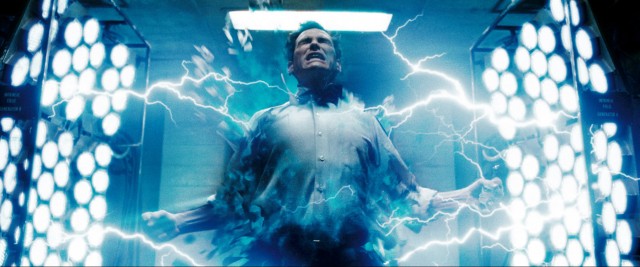
Jon Osterman (Billy Crudup) turns into Dr. Manhattan in WATCHMEN
The story, of course, is more difficult to transfer intact. There are added scenes that weren’t panels as well as inevitable elisions and telescoping of the original twelve-issue limited series. The sheer genius of Moore’s metafiction, his exploration of the Nietzschean “superman” and his comic book counterparts, and the supratextural additions, such as his deftly woven counterpoint comic-within-a-comic Tales of the Black Freighter, don’t all make it to the big screen. How could they? The movie’s more than two and a half hours already. If you didn’t read the book, you might miss the metafiction, the counterpoint, and possibly much of the plot, but the awesome Rorschach and the amazing Dr. Manhattan are psychologically and visually pitch-perfect. See it for the characters, at the very least (played by Billy Crudup, Jackie Earle Haley, Patrick Wilson, Matthew Goode, Malin Akerman, and Carla Gugino bringing to life Nite Owl, the Silk Spectre, Ozymandias, and others, with Jeffrey Dean Morgan nearly stealing the show as the Comedian). Mirroring the destruction/rebuilding of the narrative arc, Moore’s book itself effectively deconstructed the comic book superhero genre, blowing it to bits and pulling it to pieces, setting the stage for the genre’s rebirth, the graphic novel creative explosion of the 1980s and ’90s. Perhaps it is not coincidental that the film came out a time when that genre was experiencing a rebirth of its own, with The Dark Knight and Iron Man garnering both critical praise and public acclaim. But Moore’s commentary on the twentieth century, true compassion, and humankind’s messy urge to annihilate and save itself at the same time still makes a hell of a lot of sense today. Watchmen is screening July 27 at 5:00 as part of the MoMA series “A View from the Vaults: Warner Bros. Today,” which consists of thirty-one films from the last twenty years of movies coming out of the famed studio, including the Harry Potter, Dark Knight, and Lord of the Ring series as well as such wide-ranging fare as Spike Jonze’s Where the Wild Things Are, Ted Braun’s Darfur Now, Jay Roach’s The Campaign, Christopher Nolan’s Inception, and George Clooney’s Good Night, and Good Luck.