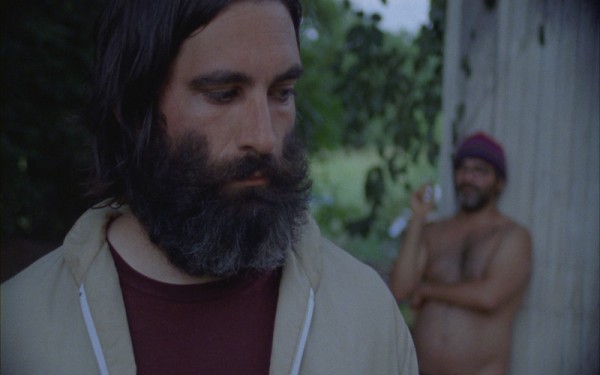
Michael Tully wrote, directed, and stars in the creepy southern Gothic dysfunctional family drama SEPTIEN
SEPTIEN (Michael Tully, 2011)
IFC Center
323 Sixth Ave. at West Third St.
July 6-14
212-924-7771
www.ifccenter.com
www.septienfilm.com
We first met Michael Tully eleven years ago, when he was an aspiring filmmaker working with us at an informational movie database company. A good-natured guy who loves talking about sports and films, Tully has gone on to direct the gritty Cocaine Angel (2006), the documentary Silver Jew (2007), about David Berman and his band, the Silver Jews, and the Web series Superego (2010). In his latest feature, the southern Gothic Septien, Tully is a triple threat, serving as writer and director as well as star. Tully plays Cornelius Rawlings, a prodigal son who walked away from his family eighteen years earlier and suddenly returns home, to the delight and concern of his two brothers, Ezra (executive producer Robert Longstreet), who has become the small clan’s rather odd and obsessive matriarch, and Amos (Onur Tukel), a hairy, shirtless artist whose weird drawings just might be predicting the future. Cornelius, in a hoodie and sporting out-of-control facial hair, is hiding a dark secret as he wanders around behaving oddly, challenging strangers to one-on-one sporting contests and pretending he’s floating dead in a lake. Darkly atmospheric and extremely funny, Septien is not afraid to take chances, much like Tully himself, who discussed the film, basketball, and more with us as he prepared for its theatrical release July 6 at the IFC Center; he will participate in a Q&A following the 8:00 screening on Wednesday night.
twi-ny: You’ve been writing about film for many years, including when we worked together back in 2000. What’s it like on the other side of things, being the interviewee instead of the interviewer, the filmmaker instead of the critic?
Michael Tully: Those were the good ol’ days, weren’t they? Actually, no they weren’t. Seriously, Mark, you were a genuinely cool boss and so many fun people worked at that company that life wasn’t as bad as it could have been. But looking back on those years now, I am down-on-my-knees happy to have escaped my confused, frustrated twenties with nothing more than too many hangovers and too much thumb-twiddling. Back then, I didn’t think I’d ever actually have the courage to make a film. But by doing this interview, I guess that means that the wheels have finally been set in motion!
As for the question of existing on two sides of the camera, it really all comes down to the fact that I love movies. I don’t have an extreme, clinically diagnosable attention deficit disorder, yet I find that I tend to get restless in a general sense, so this floating from filmmaker to film writer is simply a way for me to stay connected to things and, frankly, not be bored. Getting interviewed is fun, and I would be a liar and an idiot if I didn’t say that it’s more personally rewarding to attend a festival wearing a filmmaker badge as opposed to a press badge. That said, this year at Sundance I walked around Park City wearing a double-sided lanyard (filmmaker and press), and I made it a point to spend as much time seeing and talking about other movies as I could. I find that knowing what it’s like to be both an interviewee and an interviewer helps to keep me humble and grounded. The world needs more somewhat well-adjusted, less wholly self-absorbed filmmakers in it.
twi-ny: Silver Jew premiered at SXSW, Cocaine Angel at Rotterdam, and now Septien at Sundance. What were those film festival experiences like?
MT: I learned early on that if you’re seeing the glass as half empty at any stage of the filmmaking process, you’re looking at the wrong half of the glass. This certainly applies to the film festival experience as well. Merely getting accepted into a film festival—not just the more prestigious ones that you mentioned but any festival—is a real honor, so I look at everything as icing on the cake. If only three tickets are sold for a 150-seat theater, my view is, “Cool, three people showed up to watch our movie!” At that point, the film is finished, which is really all one can control, so to have the legitimacy of presenting it on a big screen to friends and strangers . . . that’s more of a victory than one could ever hope for. Of course, people don’t ever tell you the depths to which they did not like your movie, but you can tell when someone has an especially positive reaction. If I can leave each festival with one of those, I consider it a smash success. At the above fests, that happened to some extent at every screening I attended.

MIchael Tully, Onur Tukel, and Robert Longstreet play the severely dysfunctional Rawlings brothers in SEPTIEN
twi-ny: You’ve worked on a number of films with your good friend David Gordon Green. What have you learned from him on and off those sets?
MT: David is such a helpful and positive energy source. An outlandish brainstorm over Irish coffees at the 2010 Sundance Film Festival turned the seed of Septien into a pretty sturdy skeleton, so he actually had a direct creative impact on this particular project. But in a personal sense, David’s consistent need for laughter, as well as his boundless, childlike enthusiasm for movies, is always infectious and inspiring. In a professional sense, he likes to keep his sets as casual and fun as possible, and I am 100% in support of that as well. Working on those early films—George Washington, All The Real Girls—helped me to realize that there doesn’t have to be fighting and tension and high stress in order to make a good movie. David treats everyone the same way, and that tends to create an enthusiastic atmosphere that becomes especially helpful on a particularly rough day, or especially at the tail end of a shoot. I’ve never understood directors or producers who look down upon the PAs. (Mind you, I felt this way before I had the humiliating experience of being a looked-down-upon PA.) We’re all there for a reason. Of course, there’s a hierarchy, but if everybody didn’t do their job, these movies would never get made. Any set of David’s I’ve either worked on or visited, I’ve never felt that ugly tension.
twi-ny: In Septien, you are shown to be an exceptional athlete even though you look like the Unabomber. Were you a high school star, and if so, in what sports? Do you still play any sports today?
MT: I was never even somewhat close to being a “star” in sports. I always played backyard football but I was too much of a wimp to play for real. I was on the basketball traveling team as an adolescent and showed more potential to be something special when I was younger, but everyone grew beyond and ran past me by tenth grade or so. Sports were always recreational for me. I still play co-ed bball on Sunday mornings in the winter in Carroll Gardens, and I try my best to play as much tennis as possible in the spring, summer, and fall, though I’ve refused to buy a tennis permit this year since they raised the fee 100% from $100 to $200.
With regard to Septien, let me make two things clear: 1) The actors I hustled in the sports scenes in the movie would have absolutely destroyed me if we had played for real. That said: 2) I did actually make those trick shots!
Should the Knicks have let Donnie Walsh go?
MT: I have lost my affinity for the NBA and I don’t have an opinion either way, except to say that my usual natural aversion to the Knicks—I know, shame on me, but don’t worry, it’s nowhere near comparable to my disdain for the Lakers—has been softened by their reigning inadequacy on the court. They’ve fallen so low recently that I’ve actually begun to feel sorry for them. The real sports question that has been consuming me this summer is what will it feel like to not see Gary Williams on the bench next season as head coach of my beloved Maryland Terrapins, and will Mark Turgeon be able to forge a better bond with the coaches and kids in the Baltimore/DC area to land some more top-notch recruits. It’s gonna be so weird to watch the Terps next season. But the record had begun to skip, and I applaud Gary for getting out before his heart and brain exploded on the court during one of his especially raucous tirades.
(On July 5 at 8:00, the night before Septien opens at the IFC Center, Tully will be at 92YTribeca presenting a rare public screening of Buzz Kulik’s 1974 cult classic Bad Ronald, which stars Scott Jacoby as the deeply troubled title character. “Though they are very different,” Tully explains on the Y’s website, “one of our primary goals in making Septien was to capture that same ‘five-year-old-discovering-a-movie-that-he-probably-shouldn’t-be-watching’ spirit that I felt when I stumbled upon this strangely alluring gem.” And the artwork that Onur Tukel created for his Septien character will be on display at the Pennington Gallery at 355 West Broadway from 10:00 am to 8:00 pm through July 14.)
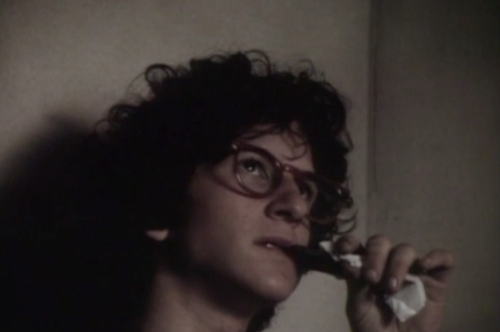
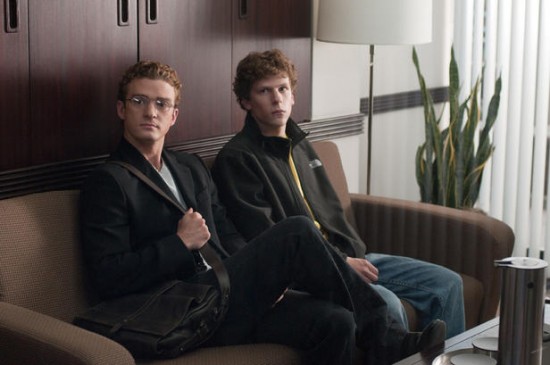
 Nominated for eight Oscars and winner of three, The Social Network stars Jesse Eisenberg (The Squid and the Whale, Adventureland) as computer whiz kid Mark Zuckerberg, the boy genius who developed what became Facebook while attending Harvard. The film is told primarily in flashback as Zuckerberg is being sued for having allegedly stolen the idea from the Winklevoss twins (both played by Arnie Hammer). Zuckerberg is depicted as a spiteful, mean-spirited, self-indulgent person trying to prove to his ex-girlfriend (Erica Albright) that he will amount to something. Justin Timberlake is outstanding as the fast-moving, smooth-talking Sean Parker, the founder of Napster who loves living the high life. For a young man who created a social media platform where people collect friends, Zuckerberg made a lot of enemies on his way to the top. The film was written by Aaron Sorkin (A Few Good Men, The West Wing), who makes an appearance as an ad executive meeting with Zuckerberg, and directed by David Fincher, who has made such other terrific films as Fight Club, Zodiac, and The Curious Case of Benjamin Button. The Social Network is screening July 6 in Hudson River Park, kicking off the free Wednesday night RiverFlicks for Grown-ups series, with free popcorn; the upcoming schedule, which features 2010’s blockbuster hits, includes Easy A (July 13), The Kids Are All Right (July 20), The Other Guys (July 27), The Fighter (August 3), Scott Pilgrim vs. the World (August 10), and The Town (August 17). For a complete list of free outdoor summer films throughout the city, click

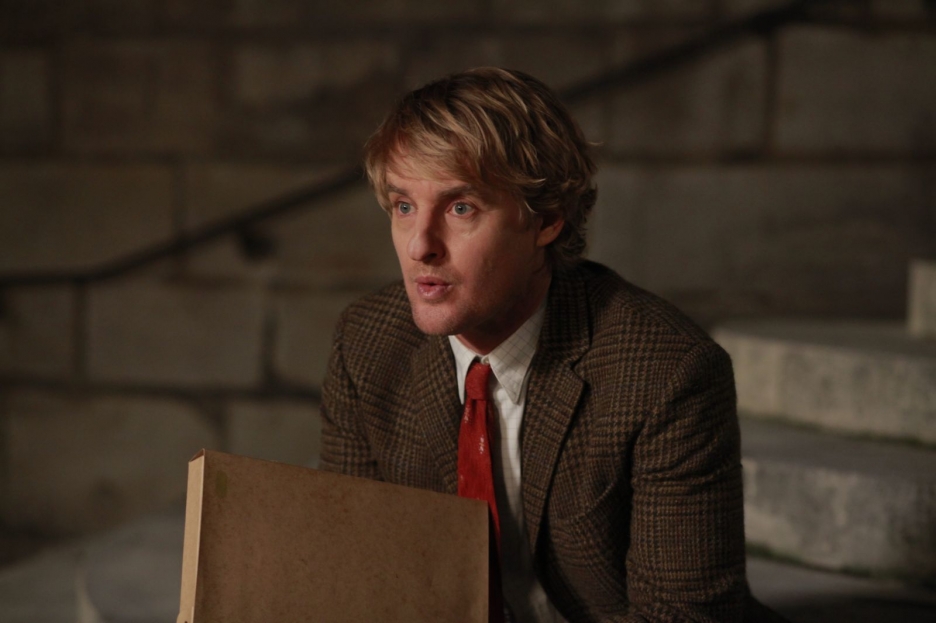
 In 1979, Woody Allen and master cinematographer Gordon Willis made love to New York City architecture in gorgeous black and white in the stunning opening section of Manhattan set to George Gershwin’s “Rhapsody in Blue.” Allen’s latest, Midnight in Paris, begins with Allen and cinematographer Darius Khondji getting intimate with the City of Light in lush color, scanning familiar Parisian landmarks to Cole Porter’s “Let’s Do It, Let’s Fall in Love.” In this beautifully shot love letter to Paris, Owen Wilson stars as Gil Pender, a Hollywood hack screenwriter working on his first novel, about a nostalgia dealer. He and his fiancée, Inez (Rachel McAdams), are vacationing in Paris with her parents, the wealthy, ultraconservative John (Kurt Fuller) and Helen (Mimi Kennedy), who think their daughter can do much better. Gil and Inez bump into their friends Carol (Nina Arianda) and Paul (Michael Sheen), the latter a pedantic know-it-all who begins many an observation with “If I’m not mistaken” and whom Gil can’t stand. Gil is hoping Paris will get his creative juices flowing, and that’s exactly what happens late one evening when he is walking the streets alone at midnight and is invited into an old-fashioned car and taken to what appears to be a throwback party — until he meets F. Scott and Zelda Fitzgerald (Tom Hiddleston and Alison Pill), Cole Porter (Yves Heck), Ernest Hemingway (Corey Stoll), and fashion designer and Picasso muse Adriana (Marion Cotillard). Suddenly he feels more at ease in the swinging ’20s than the 2010s, heading out each night to the same spot, hoping to hang out more with the Fitzgeralds, Hemingway, Gertrude Stein (Kathy Bates), Picasso (Marcial Di Fonzo), and, most importantly, Adriana. Nostalgia for the past and the promise of the future collide as Gil searches deep inside himself, trying to discover just what it is that he wants and needs out of life. Combining elements of such previous films as The Purple Rose of Cairo, Alice, Everything You Ever Wanted to Know About Sex*, and Everyone Says I Love You with a rather standard Twilight Zone-esque setup and a nod to his mid-’60s Lost Generation joke — in which he hangs out with Hemingway, the Fitzgeralds, Picasso, and Stein talking about art and literature, with a series of punch lines involving Allen getting punched in the mouth — Midnight in Paris is a charming, if at times overwrought and just plain silly, romantic fantasy that evokes Allen’s own fondness for nostalgia and the past. As more and more famous artists keep showing up, it gets more than a tad ridiculous, although it is also kinda fun. Midnight in Paris, which opened the 2011 Cannes Film Festival, follows four Allen films set in London (Match Point, Scoop, Cassandra’s Dream, and You Will Meet a Tall Dark Stranger), one in Barcelona (Vicky Christina Barcelona), and only one in New York (Whatever Works) as Allen continues to travel the world after experiencing a dwindling audience and scandal back home. Wilson is excellent as the nostalgic writer, playing him with an edgy uncomfortablilty that makes him endearing, and Cotillard is sexy and alluring as the quintessential artistic muse. And in an inspired bit of casting, French first lady Carla Bruni plays a tour guide who butts heads with the smarmy Paul when discussing Rodin’s “The Thinker.”